

Magistrans, the commitment to developing hormones for trans people in Mexico
Magistrans is an initiative that aims to build trans health sovereignty. Remote medical care, hormone production, and a philosophy of well-being.

Share

MEXICO CITY, Mexico. In a global context where the rights of trans people face restrictive policies and hate speech, an initiative has emerged in Mexico that seeks not only to facilitate access to healthcare, but also to transform how trans and non-binary people experience their gender affirmation processes. This initiative is Magistrans , a service coordinator that combines remote medical care, customized hormone production, and a philosophy centered on well-being and dignity .
“What we do here is coordinate different stages of hormone therapy. We have agreements for clinical analysis services and the possibility of acquiring packages where we are working to raise awareness of the care, which is the first thing, and with that, have online consultations with doctors to carry out the treatment,” explains Irene Valdivia, community director at Magistrans.
The project, founded by Spanish lawyer and consultant Nerea Aragonés, arises from a personal and collective need after observing the systemic obstacles faced by trans and non-binary people in the traditional health system and those specializing in gender-affirming health care in Mexico.
In short, Nerea explains that: “our mission is to cultivate gender euphoria globally through simple and comforting hormonal therapies.”.

Photo: Courtesy of Pablo Mateo.
A response to shortages and violence in health settings
Magistrans's origins can be traced back to Nerea's own experience, who began her transition in Mexico six years ago. Despite having economic advantages, she encountered a lack of professional sensitivity, malpractice, and, above all, a shortage of hormones.
Their experience was also supported by a survey they conducted with 550 trans and non-binary people in Mexico, which revealed that 52% of trans people have had to interrupt their hormone treatment due to economic barriers, lack of specialists or shortages, mainly.
Nerea points out that Magistrans' structure is designed to be a counterweight to the negligence of the traditional pharmaceutical industry.
“The hormones we’ve been using until now are designed and marketed for cis people, and they’re being prescribed to us off-label. That’s a risk because they can exclude us whenever they want. That’s why we’ve looked for laboratories in Mexico to manufacture hormones from scratch, designed with each person’s bodily autonomy in mind,” Nerea explains.
One of the pillars of this project is to avoid clinical practices that trans people have experienced as invasive or unnecessary.
“We’ve had many discussions with the medical team; for example, about pelvic ultrasounds. It’s one of the most traumatic things they can do to us. The WPATH ( World Professional Association for Transgender Health ) guidelines state that it’s not mandatory, only at the doctor’s discretion . If we weren’t trans people who had suffered through these situations, we couldn’t say, ‘You can’t demand that.’ I can’t be comforting you if the first thing I tell you is to go have someone poke around in your genitals,” says Nerea.
Hormone spray
Magistrans' proposal introduces significant innovations to the Mexican market: hormones in spray form, which avoids fluctuations and the pain of injections.
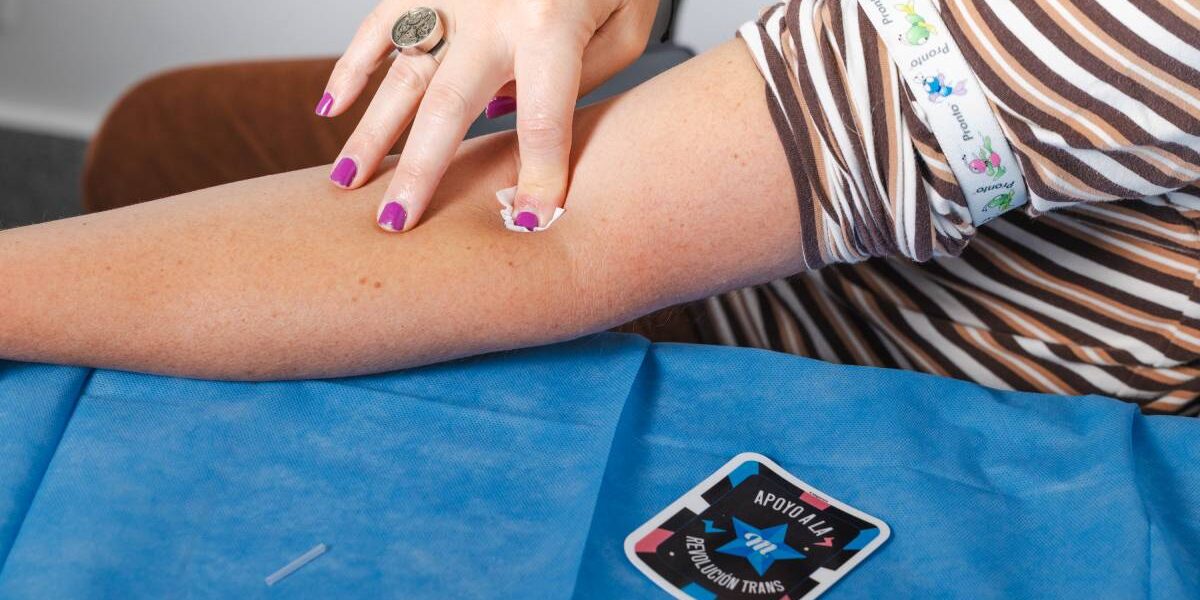
Hormone sprays (both estradiol and testosterone) work as a transdermal delivery method. They are applied by spraying directly onto the skin, allowing the medication to bypass the liver and be more easily absorbed by the body.
This system, they explain, “replaces traditional injections and gels, offering a gentler and more stable process by avoiding the hormonal peaks and troughs that often drastically affect mood and skin.”.
One of its greatest innovations is that it is manufactured in specialized Mexican laboratories with nine different concentrations. This allows for precise microdoses tailored to each individual, especially for non-binary individuals, eliminating the hormone waste that often occurs when using only a portion of conventional ampoules or gel packets.
So that it reaches everyone
Paline, a content creator and member of the Magistrans communications team, is also a user and highlights the importance of this advancement for transmasculine and non-binary people. “I think it’s important to mention this for transmasculine people. Specifically for non-binary people, microdosing sprays are only available at Magistrans. I’m using microdosing, and before, I would buy the whole ampoule and throw away the other half. Magistrans is trying to specialize in the needs of trans people and not adapt to what mainstream medicine has for us. The process has been very supportive; I didn’t have to justify why I was microdosing. With the spray, the change in my mood has been more compassionate because we’re not adapting to the dosages used by bodybuilders,” Paline explains.

Photo: Courtesy of Pablo Mateo.
In addition to its innovative approach to hormone management, the initiative aims to decentralize healthcare. By operating remotely and offering home delivery, it breaks down the barrier of centralization in Mexico City and reaches communities outside of major cities where access to expert endocrinologists is virtually nonexistent.
A perspective on sex work
A central aspect of Magistrans' design is the inclusion of perspectives that public health often ignores, such as those of sex workers. For the team, it's not just about providing hormones, but about understanding their lifestyles .
Irene Valdivia highlights the importance of this approach after conducting direct surveys in areas of sex work such as Tlalpan.
“We went directly to Tlalpan to conduct surveys with colleagues and we saw this lack of perspective on sex work in public health. They work, or we work, completely at night and sleep during the day; this makes it impossible to get to a clinic at 7 in the morning to have blood drawn,” she explains.
According to Irene, vulnerable populations are often used as an "excuse" to obtain funding for HIV-related issues , but their real needs for adequate scheduling and dignified treatment are ignored. The goal is for the service to adapt to the user, not the other way around , ensuring that medical care doesn't interfere with their work schedules.
A team that is growing
Despite its recent operational launch in October 2025, Magistrans already has 70 users distributed in various parts of the country.
The project has nationwide coverage, reaching even remote communities outside of state capitals. It also has agreements for clinical analysis in almost all of Mexico.
The team consists of seven full-time and one part-time staff, all members of diverse backgrounds; including a medical team of six endocrinologists, five of whom specialize in internal medicine and one of whom is a trans woman.
Magistrans numbers
To understand the needs of trans and non-binary populations, Magistrans conducted its own survey of 550 trans people in Mexico, which yielded key figures to understand the precariousness of access to gender-affirming health care.
Fifty-two percent of the population has had to interrupt their treatment due to financial reasons or a lack of specialists. Among the main barriers, 44% reported hormone shortages , 11% cited high costs, and 10% admitted to not seeking medical services for fear of discrimination.
Faced with this scenario, Magistrans offers subscription plans ranging from 1,100 to 1,300 pesos per month, seeking to be the most affordable option on the market.
Furthermore, they use free software to protect the privacy of user data, as well as sending packages in neutral boxes to avoid "exposing" their users.
A global ambition for “trans health sovereignty”
In light of the tightening of anti-trans laws in countries like the United States and the United Kingdom, Nerea Aragonés emphasizes the urgent need to build “trans health sovereignty.” Magistrans is just the first step in a broader ecosystem called “T System,” which will include a foundation in Europe and its own pharmaceutical company.
The project's ambition is global. They aim to become the world's largest provider of hormone services in order to create the most robust trans health database, so that the science of gender affirmation processes can be achieved using hormones specifically approved for this purpose.
We are present
We are committed to journalism that delves into the territories and conducts thorough investigations, combined with new technologies and narrative formats. We want the protagonists, their stories, and their struggles to be present.
SUPPORT US

FOLLOW US
Related notes



We are present
This and other stories are not usually on the media agenda. Together we can bring them to light.