

Increase and record number of hate crimes in Argentina: one every 38 hours
2025 marked a record in violence against LGBT people in Argentina, according to the report from the National Observatory of Hate Crimes.


Share

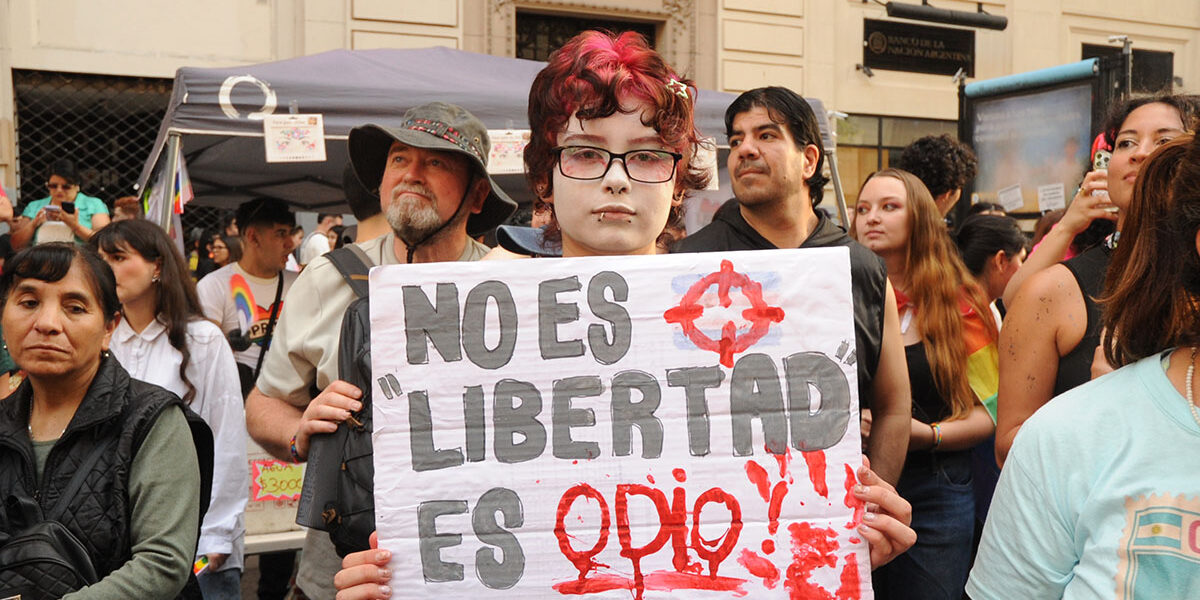
2025 marked a turning point in violence against LGBTQ+ people in Argentina. Throughout the year, at least 227 hate crimes based on sexual orientation or gender identity occurred, representing a 62 percent increase compared to the previous year. This is the highest figure recorded by the National Observatory of Hate Crimes since it began operating ten years ago : one crime every 38 hours.
Culture war, hate speech and violence
The report released a few days ago indicates that the perpetrators were mostly members of the security forces and unknown individuals acting in public. The most common method used in the attacks was physical assault. The context: a state that has abdicated its role of protecting and guaranteeing rights, and has chosen the LGBTIQ+ community and feminist movements as targets in its “culture war.”.
“In just a few years, hate crimes in our country have practically doubled. It is clear that this is related to how hate speech and violence have been intensified and entrenched by the national government in our society,” shared lesbian activist and president of the Argentine LGBT Federation (a member of the Observatory), María Rachid.
Violence in 2026
In the first months of 2026, a series of attacks against sexual diversity already took place.
Journalist and columnist Lucas Román, writing for Futurock , reported being beaten by a man in broad daylight in the Almagro neighborhood of Buenos Aires. “This whole thing about being gay isn't over,” Román said of the incident.
Leonardo Javier Veterale, the comedian known as La Barby, also reported being attacked as he left the radio station where he works as a columnist on La Negra Pop .
On the night of January 25 , Sharlotte Plaza, president of the LGBTIQ+ Collective Mariposa Multicolor of Calilegua, was attacked at her home and suffered life-threatening injuries.
In recent days, the media reported the murder of teacher Walter Daniel Aguirre (55 years old) in the Caballito neighborhood of Buenos Aires, describing it as an attack by a suspected "black widow." They made no mention of the possibility that it was a hate crime, despite its characteristics. Aguirre entered his apartment at night with a young man. He was found the next day by one of his employees, alone, murdered, and bound. So far, the National Criminal and Correctional Prosecutor's Office No. 58, headed by Jorge Emilio Fernández, has declined to provide information to the press. The Argentine Federation of LGBT+ People (FALGBT) has offered its assistance to the prosecutor's office and submitted its recent Report on LGBT+ Hate Crimes.
More institutional violence
Violence perpetrated by security forces increased alarmingly: from 17 cases recorded in 2024 to 64 cases in 2025.
Last year, between November 18 and 26 (eight days), police in the provinces of Salta, Córdoba, and Buenos Aires were involved in the deaths of three LGBT+ people . In addition, social organizations reported that on April 14, in the early morning hours, personnel from the Buenos Aires Provincial Penitentiary Service violently stormed Pavilion 9 (the LGBTQ+ pavilion) of Penal Unit No. 2 in Sierra Chica , assaulting more than 45 LGBT+ people. And in Córdoba, eight prison guards from Bouwer Prison were arrested following a report of a beating of a transgender inmate.
The largest percentage of crimes in 2025 (32%) occurred precisely in police stations and penal establishments.
“In many cases, security forces and prison services operate as direct agents of harm, turning the State—which should guarantee rights—into a perpetrator of extreme violence against LGBT+ people, particularly against the trans population,” the report analyzes.
Another striking statistic is that a high percentage (43%) of perpetrators of violence against the LGBT+ community did not know the victims. “Today there is a minority that feels justified and has impunity to express its hatred through concrete violence,” activist Rachid shared.
Who are the victims?
-The largest proportion of victims of hate crimes recorded in the 2025 report corresponds to trans women and transvestites , who account for 62.5% of the cases (142).
-Second place are gay men, who represent 22% (50).
-In a smaller proportion, but significantly higher than the previous year, trans men (18 cases, compared to 5 in 2024).
-They are followed by lesbians (13) and non-binary people (4).
Last year began with President Javier Milei's speech to the international community at the Davos Economic Forum , where he attacked and spread misinformation about the LGBTQ+ community. In the following weeks, a series of attacks targeted openly lesbian individuals . Among them were Agui and Vane. A man who had been harassing them, Orlando Alcides Lutz Fogar, carried out his threat and set fire to the house where they lived with their daughter.
“I don’t know how we’re going to repair the damage they’ve done to our society, but we’re going to keep fighting so that what happened to us never happens again. Those who commit violence shouldn’t think they’re above the law and that there’s no justice,” Agui, who lost her home and faces significant expenses to get by, which has left her in debt, told Presentes .
In March of this year, the prosecution requested that the case investigating the incident be brought to trial. It will take place in Criminal Court No. 4 of La Plata. A date has not yet been set.
Of all hate crimes recorded in 2025, 64.8% (147 cases) involved violations of the right to physical integrity, meaning physical violence that did not result in death. This represents a 101% increase compared to 2024.
The remaining 35% (80 cases) were violations of the right to life, where the victims died. There were 16 murders (10 trans women, 5 gay men, and one lesbian), 53 deaths due to structural violence, and 11 suicides.
What is a hate crime?
The National Observatory of LGBT+ Hate Crimes defines hate crimes as intentional attacks that seek to harm or kill the victim, motivated by rejection, contempt, hatred, and/or discrimination toward the LGBT+ community. They also consider violations of rights resulting from omissions due to historical and structural state absence and/or neglect.
“Hate crimes are characterized by being committed with immense rage, with
"practices of extreme violence and, in cases of murder, with a level of cruelty that demonstrates that taking the lives of the victims is not enough, but that their bodies are also left destroyed," the latest report details.
In this sense, the most frequent method used for crimes was beatings, which account for almost 40% of the cases (90 incidents).
In the last two years, there has also been an increase in reported self-inflicted injuries. In 2025, there were at least 26 cases. “These situations are part of life trajectories marked by discrimination, precarious living conditions, and lack of state protection,” the report warns.
One of the most alarming aspects is the situation faced by transvestite and trans youth following Decree of Necessity and Urgency No. 62/2025. With it, the Executive Branch modified the Gender Identity Law by restricting access to gender affirmation treatments for people under eighteen years of age.
“The lack of access to work, health and institutional support networks is a central factor in understanding the increase in violence recorded in 2025,” the report states.
Of all the violations of the right to life recorded during 2025, 66% (53 cases) correspond to deaths due to structural violence. That is, those in which the systematic and historical violation of rights generated the precarious material conditions that led to these preventable deaths, the majority of whom were trans women or transvestites.
“Hate violence against LGBT+ people has intensified directly in a context of regression of rights, institutional weakening and state legitimization of discriminatory discourse,” the report concludes.
We are present
We are committed to journalism that delves into the territories and conducts thorough investigations, combined with new technologies and narrative formats. We want the protagonists, their stories, and their struggles to be present.
SUPPORT US

FOLLOW US
Related notes



We are present
This and other stories are not usually on the media agenda. Together we can bring them to light.