

Without feminism there is no future: Women and diverse groups united their ongoing struggles on March 8th
The power of trans feminism once again took to the streets and demonstrated its ability to mobilize and transform, especially among younger generations. This is what we saw and heard at the massive march in Buenos Aires.


Share

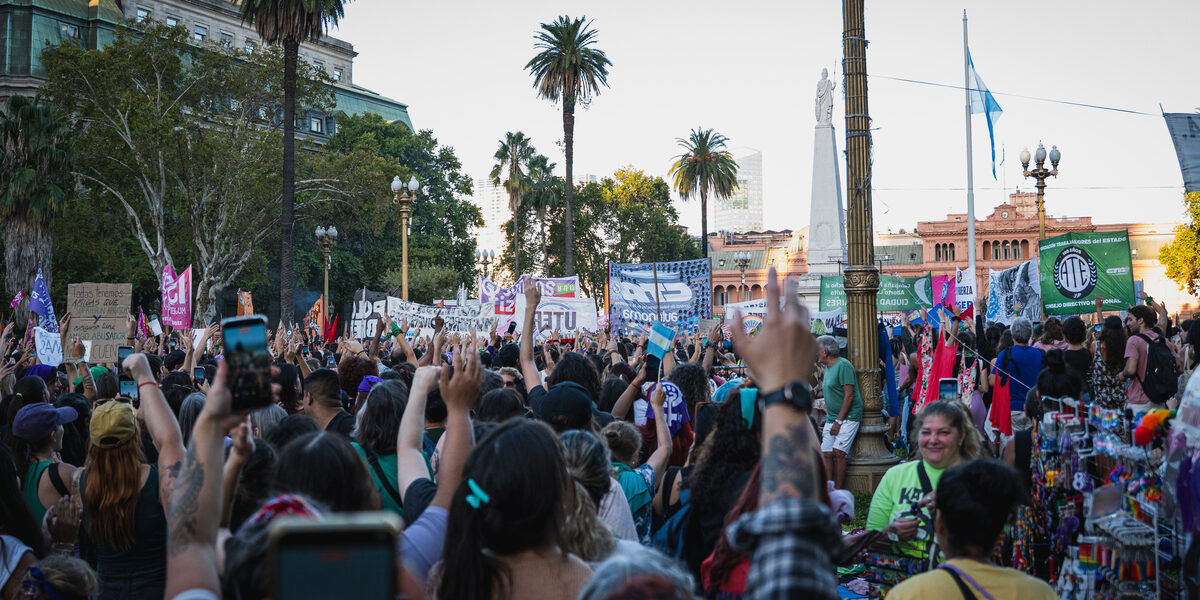
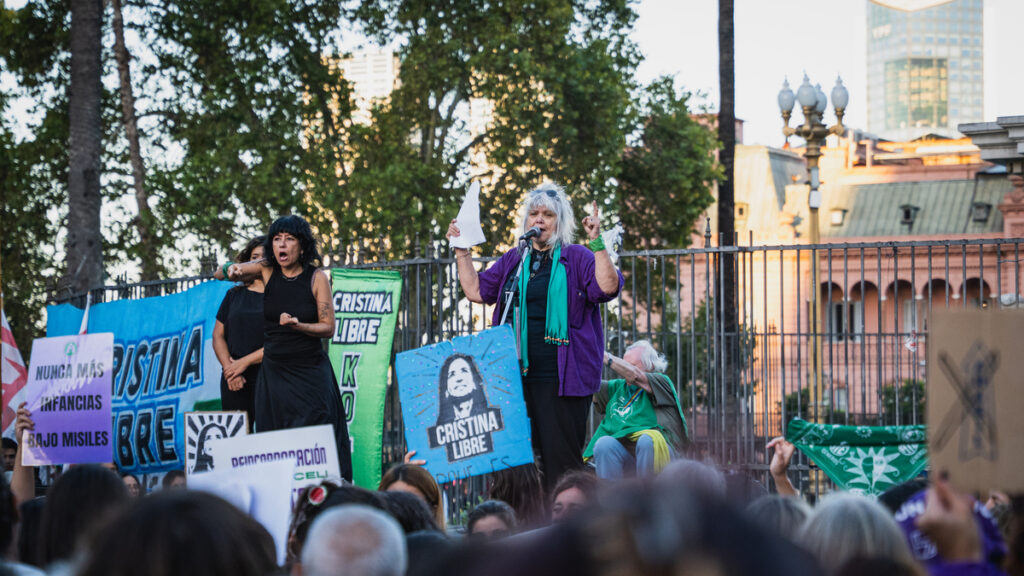
BUENOS AIRES, Argentina. The power of the transfeminist movement once again took to the streets to protest against the government's fascism and racism. Thousands of women and gender-diverse people amplified their voices from Congress to Plaza de Mayo, where a document drafted after a month of feminist assemblies and heated discussions was read. “Under all governments, it was the struggle and mobilization in the streets that allowed us to defend and achieve rights,” Liliana Daunes read at the closing demonstration in front of the Casa Rosada (Government House).
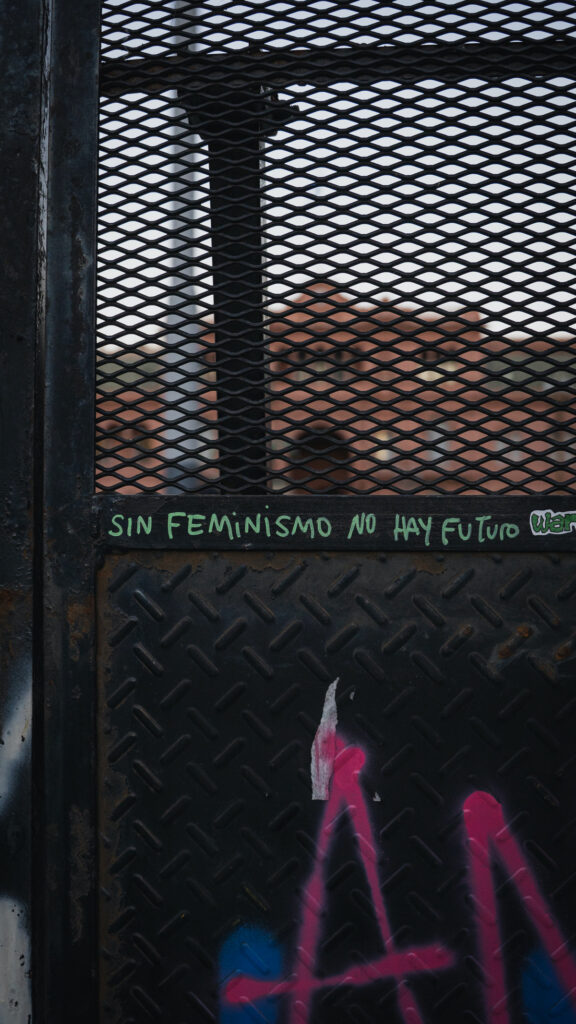
“Without feminism there is no future,” someone wrote on a fence separating the government headquarters from Plaza de Mayo. That idea encapsulates the immense mobilization for March 8, International Women's Day, which took place yesterday in various parts of the country. The crowd that filled Avenida de Mayo in Buenos Aires reflected the diversity of sectors that converge in the Argentine transfeminist movement.
It was a diverse march, with a mix of demands and generations. After midday, the streets around Congress began to fill with mostly women and people of diverse backgrounds. The main slogan: “Unite the struggles.”.
Feminisms, what for?
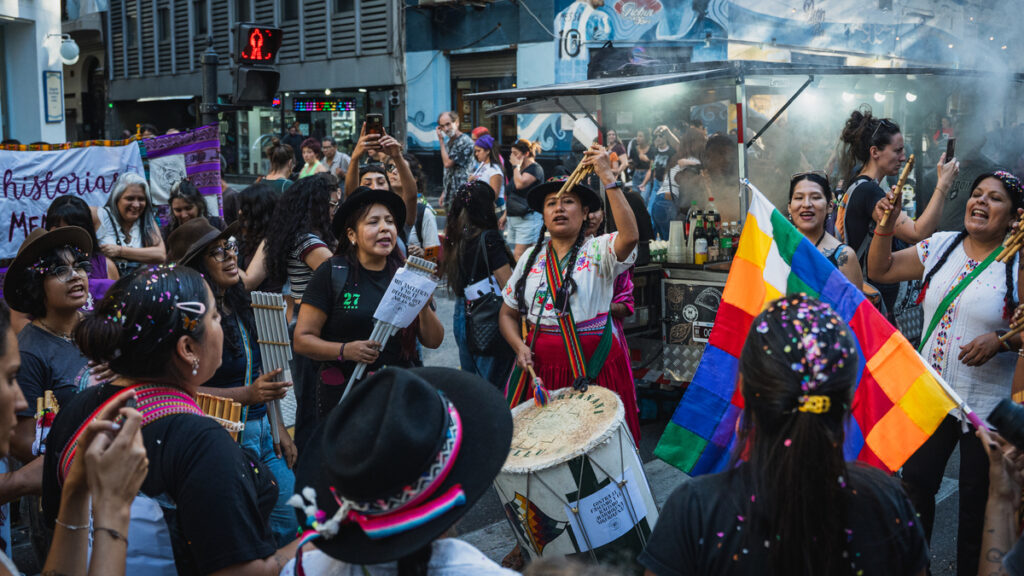
Tatiana Quispe, from the Quechua-Aymara community, a communicator for Telesisa, and a woman from the slums, marched with other Indigenous women to the music of the sikus (panpipes). “Feminism is what is happening in this time and place: social and cultural transformations, struggle and resistance. Being a feminist today isn't so much about a definition or concept, but about what one does with one's thoughts and feelings to transform this patriarchal, colonial, and racist world.”.
Estela Díaz, the Minister of Women and Diversity for the province of Buenos Aires, also spoke of feminism as a transcendent movement for all lives. “Today more than ever, feminism is a voice of resistance against the far right, an ethical and political imperative. Because it advocates for equality, justice, and the inclusion of those most excluded from this society. In a time of helplessness, cruelty, abandonment, and the discarding of all humanity, feminism proposes a different ethic and a model that also includes men. It offers them another perspective for building their own life projects.”.
In the Mostri Column, Ese Montenegro stated: “We must continue to call ourselves feminists. Because fascism is advancing, and there are only two types of gender: fascist or anti-fascist. Feminism is anti-fascist by definition.”
Feminisms in the voices of the youngest
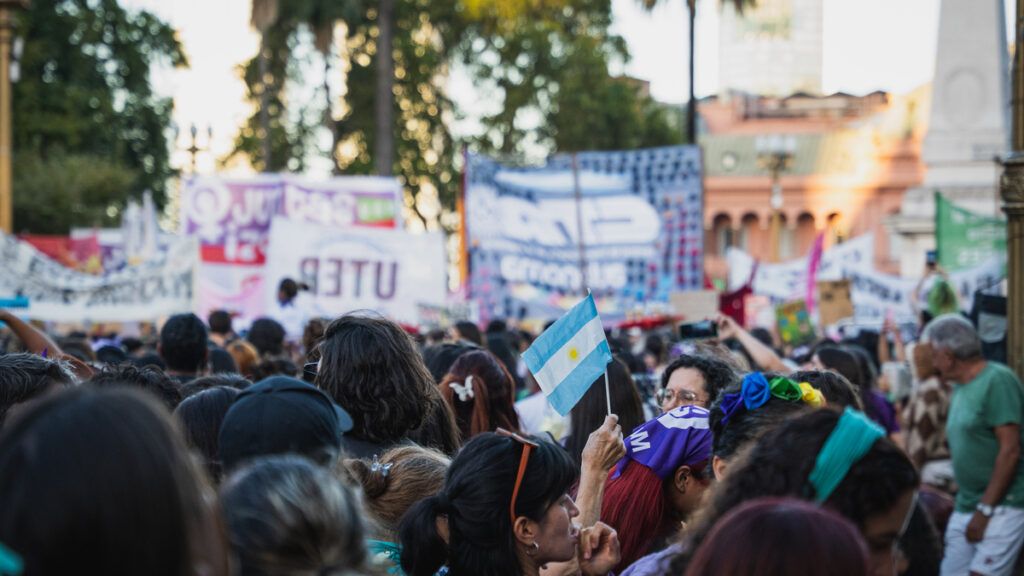
Dozens of girls ran laughing down one of the side streets off Avenida de Mayo. “I’ve been coming here since I was 10 with my mom. Now I come with my friends,” said Sofía in a group of high school students trying to get to the plaza while avoiding the crowded streets.
Ten years after the first International Feminist Strike and the Ni Una Menos movement; eight years after the "green wave" during Macri's presidency, feminism remains a vibrant force with a powerful ability to mobilize and transform new generations. The March 8th march saw a large turnout of teenagers.
“I came with my family. It’s partly our celebration, but it’s also a time to demand that they don’t take away our rights,” said 16-year-old Florencia. Beside her, her cousin added, “My mom and I have been coming here since I was eight, and now my aunt and cousin have joined us. This is our place.”.
Thirteen-year-old Uma came from Pilar and marched with her friends, wrapped in a rainbow flag. “I’m bisexual and a feminist. I’m marching because there’s a femicide every 32 hours. And because I’m fed up with walking down the street and hearing a bunch of guys say things to me. If you’re a guy, you don’t live with that fear of being raped.”.
Resistance and transvestite fury
Macarena Cornejo, coordinator of the training area at Mocha Celis, and Dixie Valentine , also a Mocha employee and artist, marched in the Popular High School column on the same day the school began classes. “We walked together, linked with everyone, because we understand that it is the only way to resist by forging bonds. Because we want a world with equality, a world with equity, and none of that would be possible without trans women present.”
Daniela Ruiz, actress, theater teacher, trans activist, and member of Identidad Marrón, told us: “I march because I am a transfeminist, antiracist, antifascist, and because I believe in the political vindication of trans identities. I march for all our sisters to say, ‘Stop transvesticide, stop transfemicide and trans homicide.’ I march because I am a sister and I believe in continuing to fight against this patriarchal system; that is why I am here, that is why I am visible, and I believe in trans fury.”
Florencia Guimaraes, a trans activist, came from La Matanza. “We march against the policies of hunger, austerity, plunder, repression, and extermination of the Milei government. We continue to demand justice for our disappeared comrades and for those who fell into trafficking networks. Also, as residents of La Matanza, we want to know what happened in the narco-feminicide of Brenda Lara and Morena, for whom we continue to demand justice . We trans women are here, as always, united. Even though in many places “International Women’s Day” is discussed in a reductive way, here we are—cis women, trans women, transvestites, all kinds of women and diverse identities—putting our bodies on the line in the streets, as our comrades Lohana Berkins and Diana Sacayan taught us.”
Patricia Rivas, a trans activist from Las Históricas—who marched demanding, among other things, historical reparations for older trans women and transvestites—said: “Women have rights, cis women and trans women. We cannot take a single step backward; on the contrary, we must take a hundred steps forward. We cannot allow a fascist government to make us regress. Because so many girls and women had to die in a burning factory so that we wouldn't have to continue under the yoke of men. And because they have to understand that trans women are women.”
“Recovering empathy”
Ailín, a social worker, marched with her daughter and niece. She emphasized the importance of seeing so many young people. “Young people are losing their identity and their sense of empathy, of putting themselves in someone else's shoes, and of fighting for the rights of minorities. These are dictates, imposed on us as trends. On social media, the only thing that's fostered is hatred of minorities and hatred of women's rights. It would be good if cruelty stopped being fashionable and if empathy were recovered.”.
Mariana, from the Doula Group, stated, “We are marching because of the profound crisis we are experiencing in every sense: in our communities, in our bodies, in our geographical territories, and with the policies dismantling workers' rights.” The group she belongs to supports women and gender-diverse individuals who are pregnant, have children, and are seeking abortions. “Supporting each other strengthens our cooperative relationships and revitalizes our bonds. We also denounce medical, gynecological, and obstetric violence and the lack of effective reporting mechanisms. We are at the mercy of the hegemonic medical establishment. Our denunciation is also a denunciation of sexual, structural, systematic, and institutional violence.”.
Mabel Collman is a member of the Civil Association of Families of Detainees . “I’m joining the march because 90% of the women are the true pillars that hold up the prison system. If the prisons aren’t exploding today, it’s because there are women holding them up in many different ways. Prison isn’t what we see in fictional shows like ‘ En el barro ’ or ‘El marginal. ’ There is also resistance and hope in prison,” she said, adding, “I love that there are women here for different reasons, that we’re coming together as sisters. That, I think, is what will bring down this government.”
The day's events in Plaza del Congreso began in the morning with the installation of "Traged by Femicides." More than one hundred embroidered pieces bearing the names of the victims were displayed to highlight the gender violence that the government currently denies.
Vegetable giveaway for farm workers
The events of March 8th included an action by female agricultural workers who held a "Vegetable and Corn Giveaway" in the Plaza de la Constitución. On Monday morning, they distributed 2,000 kilos of vegetables to residents who came to pick up their bags.
“Women farmworkers have lost many rights, and yet we continue to fight to bring food to the city. We are holding this vegetable giveaway to give visibility to our fellow women in the sector who work between 12 and 13 hours a day,” said Carolina Rodríguez, a representative of Mujeres de la Tierra (Women of the Land).
“We come representing the other women farmworkers; sometimes we feel very abandoned. It seems that our voice has no value,” said another of the peasant women who participated in the vegetable giveaway.
They denounced the fact that many lands are being sold off, making it increasingly difficult to live in the countryside and produce enough food to feed the country. This was the sentiment expressed by the women workers who joined the march yesterday.
Another transfeminist milestone
The massive March 8th march (held on March 9th) was another milestone in the history of organized women and LGBTQ+ groups. The fact that trans feminist unions took the lead in organizing the day commemorating International Working Women's Day was significant. The mobilization was not without its tensions, acknowledged Leonor Cruz of the CTA Autónoma at Friday's press conference. She also stated that it is a movement that has been years in the making.
The outcome of the assemblies wasn't only seen in the streets. It was also reflected in a lengthy document that, in three points, encompassed the demands and claims of the popular movement: “Uniting the struggles against the plunder and cruelty of Milei and all his accomplices,” “Against the reforms that make life precarious,” and “Feminist internationalism in the face of war and plunder.” The document also included the memory of the Mothers and Grandmothers of Plaza de Mayo, the 50th anniversary of the civic-military coup, and the demand for “Memory, Truth, and Justice.”.
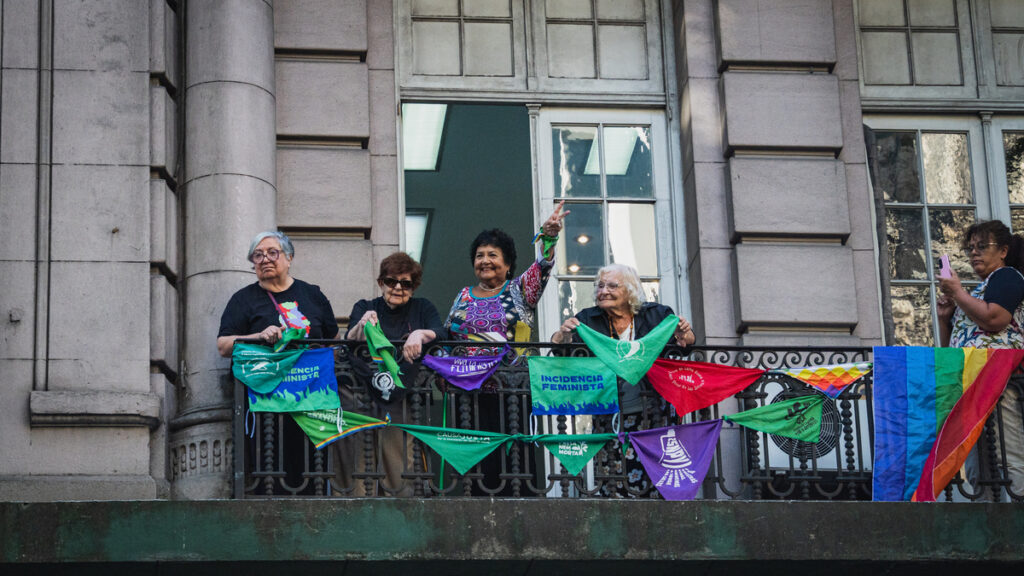
From one of the balconies overlooking Avenida de Mayo, Nelly Minyervsky, Dora Barrancos, Marta Alanís—among other members of the "historical" group of the Campaign for the Right to Abortion—celebrated the march as the columns passed by on their way to the plaza. It was one of the most significant scenes of the march and a symbol that alliances are built within feminist movements.
This article is part of our collaborative partnership with Tiempo Argentina and is published in both media outlets simultaneously.
The coverage of March 8th was carried out by: Aldana Somoza, Clara Pardi, Eugenia Siman, Emiliana Delgado, María Eugenia Ludueña, Lucas Gutiérrez, Agustina Ramos, and Luis Castañeda. It was a joint effort with Tiempo Argentino and Agencia Presentes.
We are present
We are committed to journalism that delves into the territories and conducts thorough investigations, combined with new technologies and narrative formats. We want the protagonists, their stories, and their struggles to be present.
SUPPORT US

FOLLOW US
Related notes


We are present
This and other stories are not usually on the media agenda. Together we can bring them to light.