

HIV: Why treatment adherence is a collective journey
Talking about adherence to HIV treatment is much more than just taking a pill. Activists explain the importance of comprehensive support and the need for a healthcare system that guarantees rights.


Share

Receiving an HIV+ diagnosis involves so many aspects that it's impossible to simplify it and say, "Just take a pill every day and you'll be fine." Adherence to antiretroviral treatment is part of a universe of socioeconomic factors that cannot be ignored.
“It’s difficult for me,” explains Landriel Oviedo. “I live in a rural area, in a province where there have never been comprehensive public policies, only epidemiological responses. Stigma, discrimination, the lack of decent work, and access to drinking water and basic services—rights guaranteed by the constitution—mark a life of inequality,” says this artivist, researcher, and executive director of the YacuYas Foundation in the province of La Rioja, Argentina.
Today, there is no cure for HIV, but it can be controlled with medication to prevent its progression. “Antiretrovirals are different groups of drugs that interrupt viral replication ,” explains infectious disease specialist Iael Altclas. To maintain this control, the medication must be taken daily. What is needed to do so?
Flor Bárcenas Feria, an Afro-Caribbean poet from Montería, Colombia, and a human rights advocate for trans people, addresses this from her own lived experience: “As a Black trans woman, I know the harsh reality. For us, there are many more barriers to accessing the fundamental right to health.”
Sometimes, accessing a healthcare system involves facing traumatic situations. “Invisibility, misgendering, mockery, and discrimination. We live in a reality that has led us to think and believe that our health doesn't deserve care , and that has consequences for our emotional and material well-being,” Flor states.

What does the State have to do with viral load?
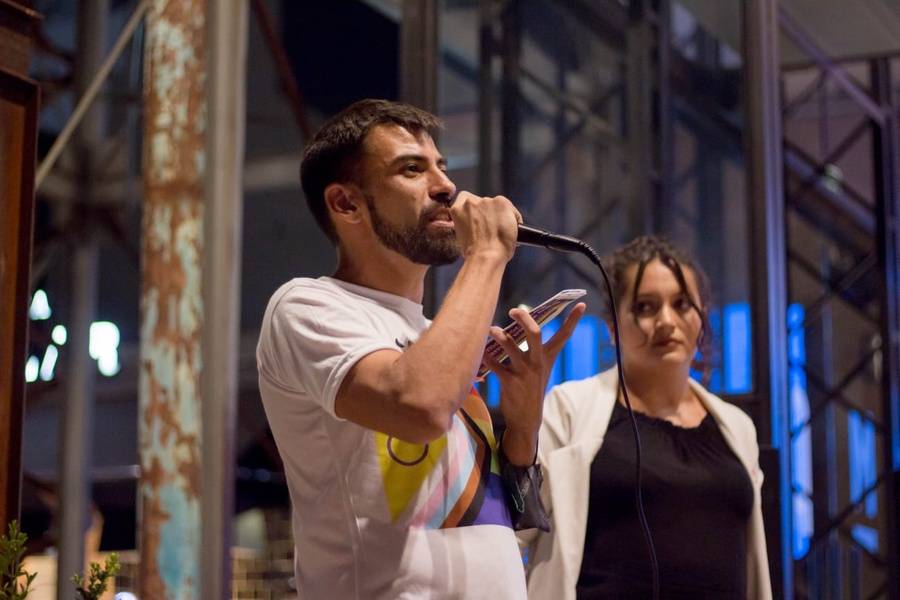
Abril A. is 37 years old and was diagnosed at age 12. During her activism, she was part of the Argentine Network of Young People and Adolescents Living with HIV (RAJAP), a support group for young people living with the virus. “There were some tough times during my adolescence, when I had to hide at social events to take my medication.” Although she received family support, she emphasizes that “it’s really difficult to stick to a treatment plan when you have to do it in secret to avoid discrimination .
“Bureaucracy also hinders proper adherence,” Abril explains. The public health system provides monthly treatment, but not everyone has the money to go to the hospital. There are also the hassles of finding prescriptions and adapting to pharmacy hours, among other steps that complicate matters for people living with HIV.
Sometimes, pharmacies at health centers are only open during hours that coincide with work schedules. “If taking time to go get medication means losing the little money you have to survive, it’s almost impossible to adhere to your treatment.” For others, in informal work situations, the urgent need is food. “The economic crisis has a tremendous impact on health. What the government does or doesn’t do is directly linked to what happens to our viral load .
Every pill is political
“It’s crucial to understand that adherence isn’t just personal . It’s the result of a collective history that we must continue to defend today,” says Landriel. Since the virus emerged, activist groups have mobilized in the face of government silence and inaction to obtain answers.
“Many people living with HIV are not fully aware of what their medication entails. They are not only unaware of the treatment itself, but also of the decades of political and community struggle that guaranteed it ,” explains Landriel, highlighting the importance of the Comprehensive Response Law to HIV, viral hepatitis, STIs and tuberculosis enacted in 2022.
For Abril, when the diagnosis is experienced in silence “as happens to many people,” misinformation abounds. “Taking medication every day seems easy, but for that to happen, many other things have to occur first.”.
Flor summarizes it from a structural perspective: “To assess the political costs of the medication is to look at the reality of Black trans women and transvestites and ask ourselves who is prioritized and who is marginalized within the healthcare system.” “Health doesn’t depend solely on individual will ; it depends on the dignified conditions available to us for self-care.”
What happens without adhesion?
“When there are budget cuts, changing the treatment plans becomes a problem. Not so much because of the effectiveness of the drugs, because today we have a very interesting and effective range of options. But there is a fundamental factor that has to do with the discomfort or anxiety that these medications generate in people who take them,” explains infectious disease specialist Iael Altclas.
Stopping medication means the virus will replicate again. We're not talking about missing a dose for one night or a few days, but for extended periods. This can also mean that when we want or need to resume treatment, we won't be able to do so with the same regimen because we've developed resistance.
Altclas explains that “today, thanks to years of work at the HIV Directorate, the programs in the public system are among the best available. We don't want to lower that standard of quality, which is why we fear budget cuts.” In 2025, Javier Milei's government almost completely dismantled this directorate .
Adherence: a path that is not traveled alone
“What has the greatest impact is the lack of spaces to process the grief of living with HIV. Without genuine emotional support and without resources for those around us, it becomes an uphill battle,” Landriel comments.
Flor agrees: “When I think about why I failed to adhere to the plan, I recognize that the 'lack' was primarily emotional: instability and loss of meaning, conditions that are also related to being trans in a society that constantly tests us.”.
When we demand new answers from science, we must think of it not only as laboratories and pills, but also as encompassing the social sciences and medicine as a holistic field. “Without information, support, and guaranteed rights , adherence becomes a reflection of a system that still leaves us vulnerable. When the state or social security system delays treatment, adherence is compromised. Sometimes, the very toxicity of the treatment affects us without our knowledge,” says Landriel.
“Activist groups have a fundamental role in being the voice of the community, being able to speak in the first person about the issues that affect them,” explains infectious disease specialist Altclas. “Sometimes the specific demands are unclear, but that is also the responsibility of the medical system for not involving activists in decision-making, not only in daily healthcare but also in management.”.
Activists also acknowledge the critical state of the healthcare system. “It is the State that must guarantee the health of all its citizens, and that is not possible in a context of political violence, discrimination, and constant attacks on a healthcare system that tries to sustain its patients through the sacrifice of doctors in struggle,” Abril argues.
“Many times, positive people can’t maintain this adherence,” says Flor. “Speaking from a place of understanding the feeling transforms everything . I, too, was the one who kept quiet and never said that I had failed in my adherence for fear of being judged, and I know where that fear comes from.”
For Landriel, “if this happens to you, you’re not alone. It happens to many of us. And if you feel you need a hug, a space without judgment, we’re here. It’s not a matter of individual will; it’s a path you don’t travel alone, and here, with empathy, we’re here to support you.”.
This project is supported by the IAS ( International AIDS Society ) through Community Project Grants , as part of the preparations for the AIDS Conference 2026.
We are present
We are committed to journalism that delves into the territories and conducts thorough investigations, combined with new technologies and narrative formats. We want the protagonists, their stories, and their struggles to be present.
SUPPORT US

FOLLOW US
Related notes

We are present
This and other stories are not usually on the media agenda. Together we can bring them to light.