

What are the contributions of HIV+ activism to science in Latin America?
The link between activism and science is vital in this global context of setbacks. Activists from Mexico, Argentina, Chile, and Colombia share their experiences.


Share

HIV/AIDS activism has been a vital bridge between science, institutions, and affected populations for many years. Often, it drives scientific research aimed at developing better treatments. At other times, it acts as a catalyst for democratizing useful and reliable information for those who need it. The relationship between science and activism is crucial, activists in the region assert, for achieving long-standing demands: universal access to medication and comprehensive healthcare, improved quality of life, and a cure.
In a context where cuts to the HIV and AIDS response are increasing worldwide, while 9.2 million people still do not have access to treatment , what links and strategies can be established between activism and science to improve this situation?
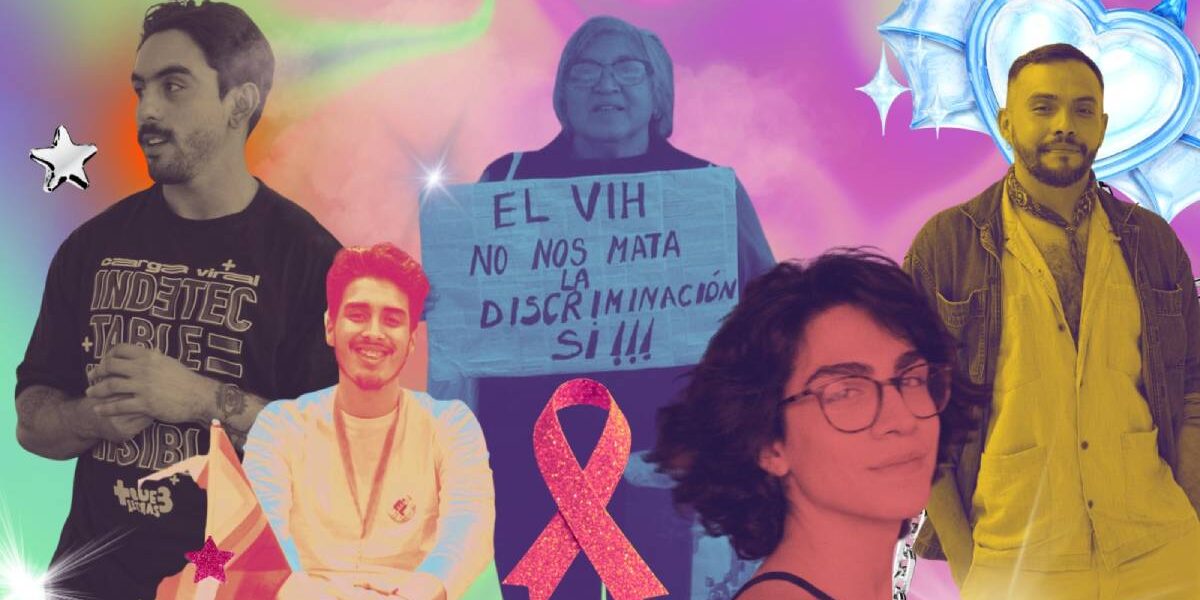
Presentes spoke with activists from five countries in the region to learn about their demands , what they expect from science, and how the link between HIV+ activism and scientific research has developed throughout history.
The brutal cuts to the US Presidential Plan for AIDS Relief (PEPFAR) , coupled with various local threats in other countries, led to sharp reductions in international HIV assistance in 2025. This, in turn, brought about a funding crisis, particularly in low- and middle-income countries.
According to forecasts by the Organization for Economic Cooperation and Development , external financing for health could decrease by between 30 and 40% in 2025, compared to 2023.
Mexico
For Misael Muñoz Calderón, a community worker on HIV and a member of the Advisory Assembly of the Council to Prevent and Eliminate Discrimination in Mexico City, being an activist in this global and local context is complicated.
“ The policies implemented in our country in 2019 , added to the policies of (Donald) Trump, have created a shortage of resources for social projects and with it the precarization of our work, which, although necessary, is poorly paid and in many cases a cause of persecution and questioning,” she shares.
In response to this situation, Misael hopes that “science will be put at the service of people's needs, not at the service of academic, political, or commercial interests.” He also acknowledges the value that activism has had for academia, as it provides “contact with the people” and “links between institutions and academia and the realities of the populations they study.”.
“At best, this coordinated work (between activists and science professionals) translates into data that serves to support impactful strategies on the lives of populations, humane and friendly processes that do not extract experiences but change realities,” he concludes.
Argentina
In Argentina, where Javier Milei's far-right government is entering its third year, the 2026 budget includes a 38% reduction in the purchase of supplies for HIV/AIDS care, most of which are acquired internationally. The plan calls for providing care to approximately 71,500 people living with HIV, compared to 79,170 in 2024. Additionally, the distribution of 23 million condoms and the production of preventative educational materials have been cut.
Gachy Awad, a 60-year-old woman from Argentine Patagonia, an activist for the rights of people with HIV and a member of ICW Argentina , agrees that "it is not easy to be an activist," adding that "being a woman and visible in a very adverse context" is even more challenging.
“ Having to be the voice of all those people who cannot speak, who are silenced, is a double commitment . Not to let down those people who dare to tell you what is happening to them. At the same time, making sure that those voices are truly heard by the decision-makers,” she says.
An urgent issue raised by many people living with HIV today is “the delay in receiving pensions, as many people are unemployed and only do odd jobs.” The Comprehensive Response Law to HIV, Viral Hepatitis, STIs, and Tuberculosis (No. 27,675), passed in Argentina in 2022 , created non-contributory lifetime pensions for those in situations of social vulnerability. “When this was first implemented, people could access it within three months. Today, we are talking about people who have been waiting for more than a year.”
Gachy hopes that, in the future, the quality of life for people living with HIV can be improved. “Antiretroviral treatment allows people to live longer. But how we live, what our quality of life is like, what happens to people over 50: these are all questions that reflect our experiences and feelings. Our voices are essential to contributing to scientific research aimed at improving our quality of life.”
“I hope a cure can be found, which is the ultimate goal, so we don’t have to depend on a pill every day to feel well. I also hope current treatments can be improved and made accessible to everyone,” she adds.
Paraguay
Matías Mendieta Duarte is a young Paraguayan human rights activist, migrant, and graduate in Anthropology. He works on issues related to youth, gender, HIV, and sexual minorities in Latin America. He has been living with HIV for nine years.
“Finding out that I was living with the virus in a context like Paraguay was challenging and even violent because of the precarious health system focused on the care of people living with HIV. That's when I understood that I had to migrate in search of my right to access free, quality public health care,” she shares with Presentes .
“Our region once had countries like Argentina and Chile that were at the forefront of education, but today, due to their far-right governments, they have suffered historic and very serious setbacks. Brazil has always been very advanced in this area, and in the case of Paraguay, the rights of vulnerable populations have historically been systematically denied,” he adds, regarding the regional outlook.
For Matías, the most urgent issue regarding HIV today “is education and, consequently, awareness.” Over the years, he has observed a disconnect between the social spaces built and woven by activists and the scientific community, each with its own distinct language. In this sense, he hopes for a “democratization of the information generated by science regarding HIV, as this would help to create a larger-scale response and ultimately lead to a cure.”.
“Activism redirects scientific advances to subsequent public policies that are appropriate to the contexts ,” Mendieta Duarte points out.
Chili
Chilean designer, visual artist and researcher, Lu J. Núñez Saavedra, adds that activism provides a “much more human, warm and grounded perspective on the things that should be considered” by science.
Lu is also a member of Young People and Students Living with HIV (JEVIH) , and works as the Marketing Coordinator for the Latin America and Caribbean Bureau of AHF ( AIDS Healthcare Foundation ). For her, activism is often a tiring exercise.
“It seems there’s too much trust placed in a small group of people to solve all the problems. But in reality, we have more of a complementary role to the one the State claims to have regarding its responsibilities to care for the nation and its people. We end up being given a lot of responsibility, but that work isn’t recognized as such ,” he argues.
Through her own experience and that of the people she knows, Lu emphasizes the urgent need for a cure for HIV and universal community healthcare. “Health, in general, continues to be an issue that is unfortunately never considered a right that all people deserve. It shouldn't only consider our HIV status. We also have to think about mental and physical health, which is associated with different things that allow us to feel well, such as exercise and nutrition.”.
Finally, she hopes that science “will never forget about people.” “It has a profoundly political role and a place to be able to change things, which I think is very important. But I think it’s still in a very neutral role. I would like to ask them to take a much more active role.”.
Colombia
Miguel Ángel López, co-founder of the More Than Three Letters Corporation of Colombia, uses the concept of inequality to think about HIV.
“ Activism is a beautiful project that gives my days a lot of meaning . But it’s also very frustrating because there are things you can’t fix. Plus, it depends a lot on where in Colombia you live and what privileges you have. It’s very different to be heard and gain ground as a white man living in the capital, compared to people in other situations,” he says.
Regarding her country, she explains: “The last few years in Colombia have been difficult. The progressive government we have tried to implement a healthcare reform that wasn't well-received and created more problems than we had before. Right now, there are people who aren't receiving their treatments, there are those who are receiving death threats for having HIV and are being exiled from their communities. HIV among the indigenous population has also not received a differentiated response.”.
In this context, activists contribute from a social and community perspective. “It’s not enough to create a long-acting injectable HIV drug if it doesn’t become a reality in societies. And that’s what activists do,” she says.
For him, HIV is a "great example of the inequalities in the world.".
According to UNAIDS data, in 2024, 630,000 people died from AIDS-related causes. Of these, 61% were in sub-Saharan Africa.
AIDS is NOT over!
— United Nations (@UN_es) December 1, 2025
➡️ More than 40 million people are living with HIV worldwide
➡️ 10 million people are waiting for HIV treatment
➡️ 1.3 million people acquired HIV in 2024.
This can and must change!
On this #WorldAIDSDay , the… pic.twitter.com/URRTFtB1ti
“I’m not desperately waiting for a cure. I believe we already have very good tools, and if we had access to them without so much inequality, the situation would be different. I think science needs to start helping us have a social and political impact, instead of being so reliant on the capitalist system. It’s important that we stop having scientific advances that are out of reach for the people who need them,” she concludes.
This project is supported by the IAS ( International AIDS Society ) through the Community Project Grants , as part of the preparations for the AIDS Conference 2026.
We are present
We are committed to journalism that delves into the territories and conducts thorough investigations, combined with new technologies and narrative formats. We want the protagonists, their stories, and their struggles to be present.
SUPPORT US

FOLLOW US
Related notes



We are present
This and other stories are not usually on the media agenda. Together we can bring them to light.