

Disability emergency: how to provide care without transportation or treatment
Defunding key sectors for the development of people with disabilities impacts their caregivers. These are their stories.


Share

BUENOS AIRES, Argentina. Lorena Díaz travels Monday through Friday with her 11-year-old son, Thiago, to his special education school in a vehicle that was covered by her health insurance plan. But for months now, her health insurance has not paid for services for people with disabilities, including transportation. Thiago, who has autism spectrum disorder, has already stopped receiving two of his treatments: occupational therapy and speech therapy. The psychologist told his mother that if she isn't paid by August 20, she will also have to stop his treatment. The driver who takes them to school told her the same thing.
They live in a house in Las Talitas (Tucumán, Argentina) with Thiago's father. Although they separated six years ago, they have to continue living together because neither can afford rent. He is a construction worker, and she cleans houses three times a week. "It's what I can do because I don't have time to care for Thiago," she told Presentes. Her son found his place at the Private Institute of Education and Adaptation (INPEA) in San Miguel de Tucumán. He had previously attended other schools, where he suffered greatly and didn't want to go, until his mother took him to this institution, which accommodates his diagnosis. "The first day back, he remembered his classmates' names. Before, he had never remembered a single name. He loves going to school."
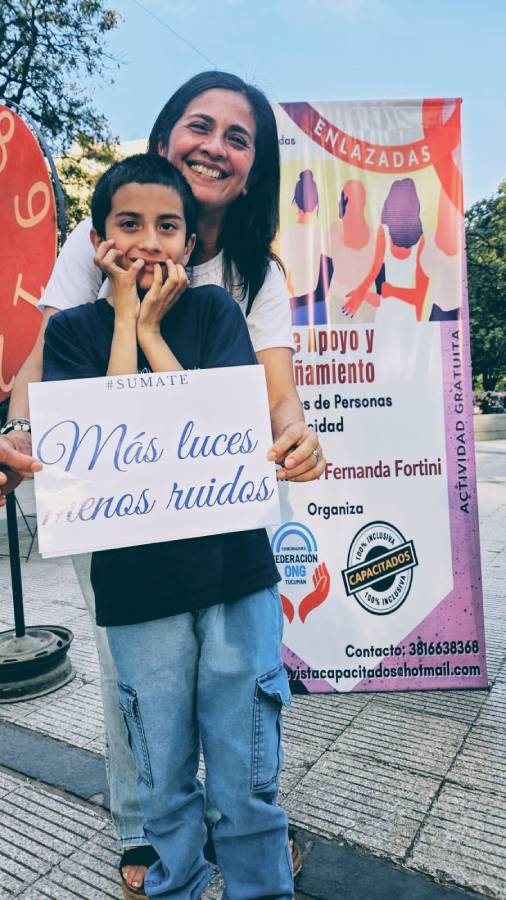
Due to the absence of two of his therapies, Lorena finds Thiago "quite dysregulated" and aggressive towards himself. If they were to lose the school bus service, they would have to take two buses each way, which brings other problems: "He can't travel standing up because he's afraid, he doesn't tolerate waiting for the bus very well, and the times to and from school are rush hour.".
Lorena's concern about how to provide a decent life for her son is shared by other families. For years they have been demanding that disability services be declared an emergency in the country. But the situation today is critical: professionals haven't been paid for months, their salaries are the same as in December, people with disabilities are giving up the possibility of receiving treatment, and many children lack transportation to get to school.
To try to improve the situation, and thanks to the efforts of various organizations, the Senate approved a bill on June 10th declaring a state of emergency for people with disabilities until December 2027. Two months later, on August 4th, President Milei vetoed in its entirety. This Wednesday, the National Congress will debate the presidential veto. Organizations have called for a vigil starting Tuesday night and a demonstration throughout the day.
In this emergency context, how are families caring for people with disabilities? Presentes spoke with some of them.
“Many kids stopped going to school because they no longer have transportation.”
Lautaro is an 8-year-old boy with a visual impairment. He attends primary school in the mornings and a special education school in the afternoons. His parents share the care of him and his two siblings: his mother works during the day and his father at night. But this year, Lautaro lost the transportation that previously ensured he could attend school. This has forced his father to sleep only two hours at night to be able to take him, and then another two hours in the afternoon: in total, he gets four hours of sleep a day.
“That reduces our quality of life. The cost of living for a family with a disability is significantly higher than for one without. And my son is still going to school, but many kids have stopped going because they no longer have the transportation they used to have guaranteed. And they have one less meal a day because they don't go to school,” Laura Alcaide, Lautaro's mother, a 35-year-old woman who is also visually impaired, told this agency.
“Many children are losing access to school transportation,” stated Ana María Bogarín, director of Colegio Nuevo Día, a psychopedagogue and graduate in Educational Sciences with 30 years of experience in special education. “I have students who travel for more than an hour on school transportation to get to class. If they lose their transportation or if their parents are asked to pay additional fees, it creates another gap. This is compounded by their own life stories: it's a community at social risk because they live below the poverty line.”
Among the problems he sees most in the families of his educational community are the loss of employment of the parents, that social services do not accept people with social monotax, difficulties in being able to attend parent meetings, the loss of external treatments because they cannot pay for them.
Being retired and taking care
María Elena Isaac is 68 years old and retired. She was widowed in 2001, when her daughter Celeste was seven. For fifteen years, until her retirement, she dedicated herself exclusively to working and caring for her daughter, who has autism. “The good thing is that she speaks. Although she doesn't have conventional language, she expresses herself a lot,” she shared with Presentes . “What she was never able to learn is to read and write. The psychiatrist told me the other day that it's as if she were three years old. That's why, when she was little, they didn't want to accept her in any institution. It took a lot of effort for them to accept her.”
For María Elena, finding a place where Celeste could attend full-time was vital. This allowed her to work, run errands, or go to the supermarket while Celeste was out of the house. For years, she hasn't taken the bus, gone to cafes or the supermarket, or even gone on vacation with her daughter due to the challenges of caring for her in those situations. Celeste is now 31 and attends the CISAM Foundation's Day Center in Villa Martelli, with guaranteed transportation. There, she has access to four therapists, psychomotor therapists, physical education, and music therapy.
“If I didn’t have a bank and transportation, things would be very difficult today, practically impossible. I’m retired, and although I don’t receive the minimum pension, I spend roughly twice what I earn each month. I’m lucky to have savings. Celeste doesn’t receive a disability pension, and I don’t receive a pension because my husband died young. I have my sister and my nephews, but day-to-day life is just the two of us,” she said.
Lucio, a 25-year-old with autism spectrum disorder and schizophrenia, attends the same institution as Celeste, but for half a day. “Thank God we can cover part of Lucio’s treatments. But the situation has worsened considerably. It’s difficult to get services, or they restrict the days they offer them. Before, a young man would come to our house three times a week, but now we’ve had to limit the visits because it’s become too difficult for us to manage. At least in my experience, this is the worst time in my son’s life,” Andrea Fabiana Acosta, a 57-year-old woman and mother of Lucio and his twin sister, Valentina, told this agency. “Both Lucio and his classmates need to continue going to the day center.”.
The power of networks
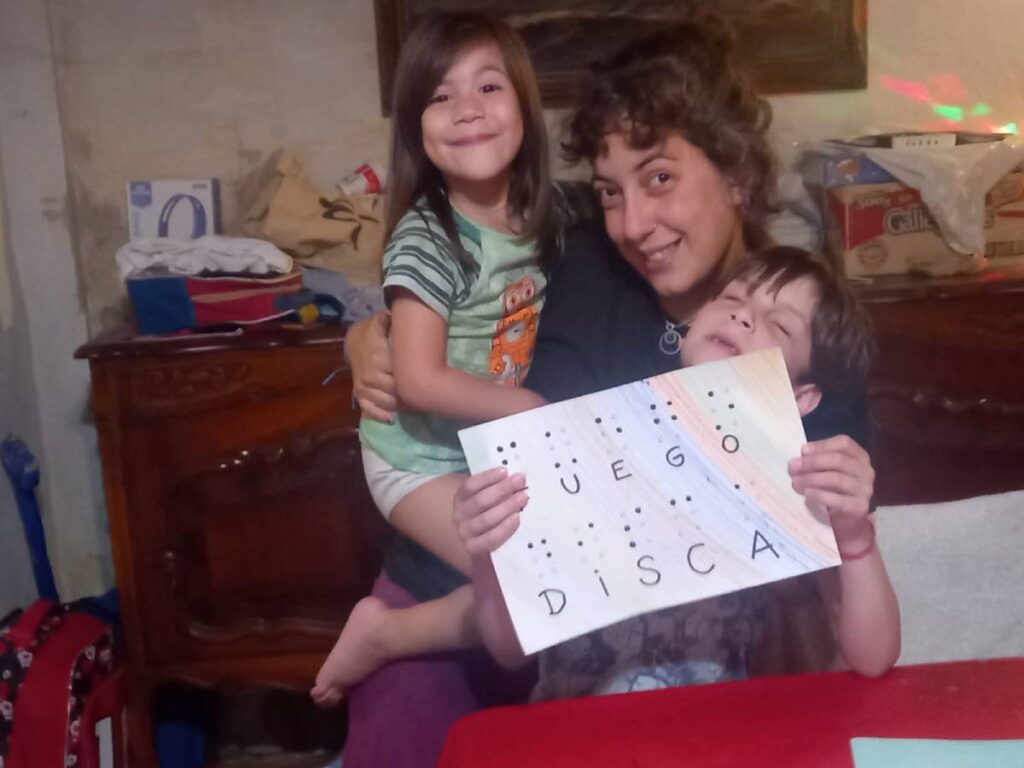
Laura, Lautaro's mother, is a sports journalist and proofreader at the National Braille and Talking Book . When she walks with her children on the street or meets someone new, she often says to them, "It's great that you can see because that way you'll be your mom's guide."
“They treat us as if we, as disabled people, are incapable of providing care. That’s not the case. The person who has to provide care, in this instance, is the adult. And children grow up with the idea that they are the ones who have to care for the adult,” she said. In this regard, she spoke of the infantilization that exists in relation to people with disabilities and the “perpetual childhood” mentality: “Historically, even adults are still considered children.”
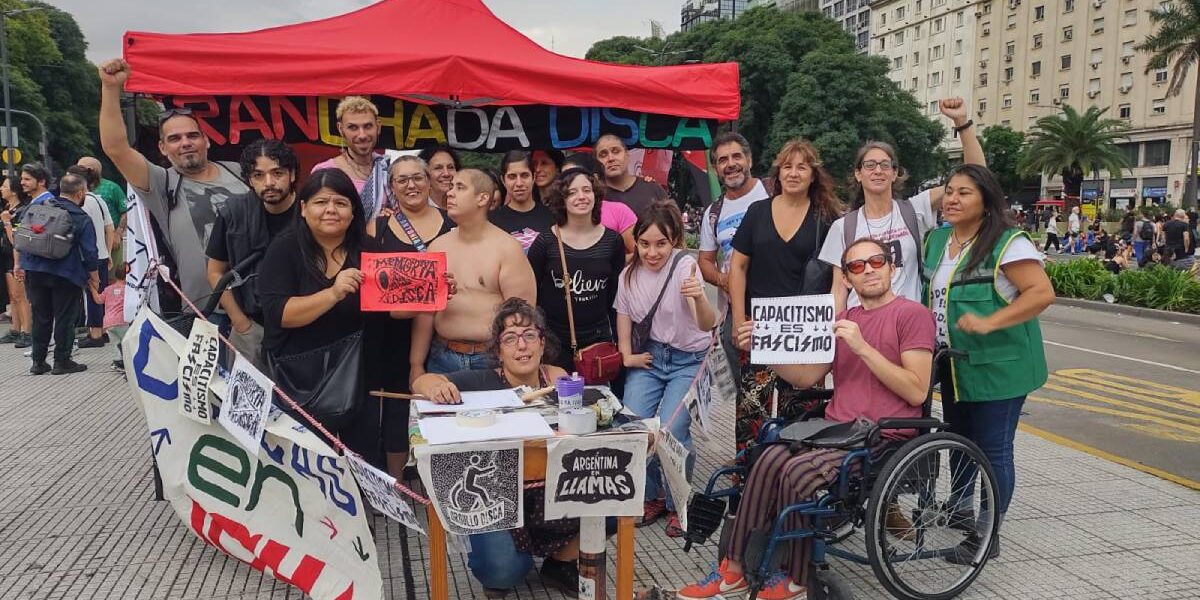
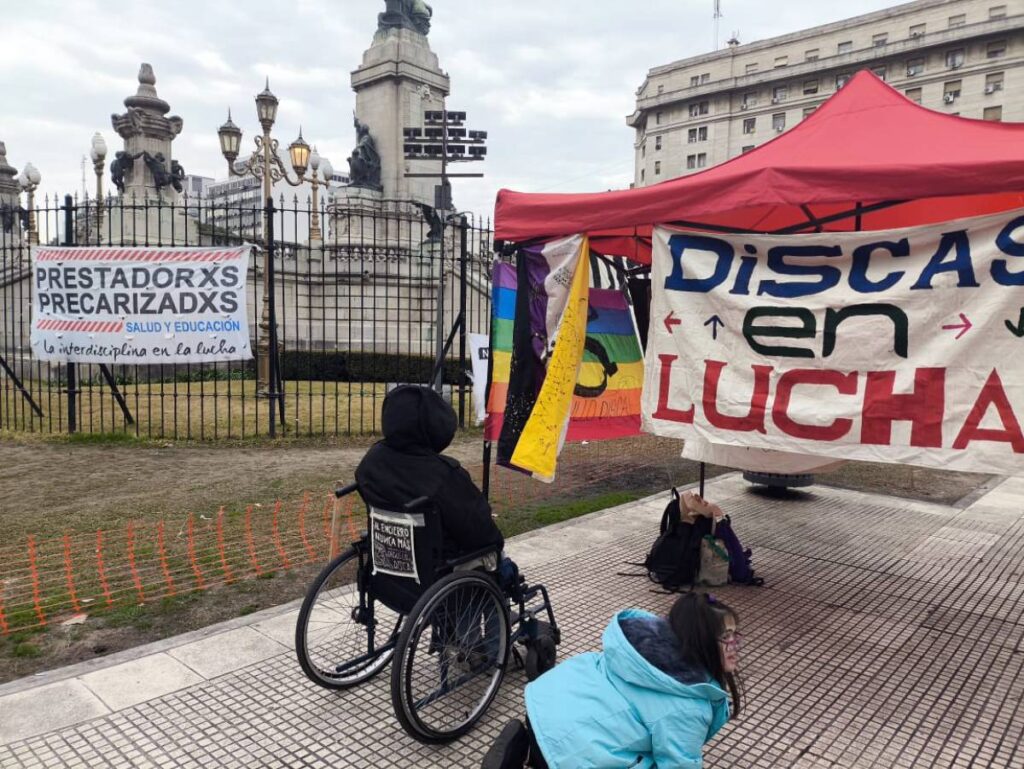
Besides caring for her children and working, Laura is an activist with Orgullo Disca (Disabled Pride) and the Asamblea de Discas en Lucha (Assembly of ). She has been present at the National Congress on several occasions to advocate for the Emergency Disability Law and for other events, demanding her rights. On several of those occasions, there was repression. “My son, who is blind, doesn't want me to go to the demonstrations. He's scared. I try not to tell him because it causes him a lot of anxiety not knowing what the situation is. Even though I try to shield him from it, he knows very well the situation we're living through,” she said.
Networked care
Networks and spaces for mutual listening are valued by families for sharing experiences and collectively providing care. Lorena Díaz, in Tucumán, participates in the group “Enlazadas” (Linked), created in November 2021. Around 50 women meet twice a month with a volunteer psychologist to talk about their experiences caring for people with disabilities, in a space provided to them free of charge.
“It’s a fantastic group. Personally, it helped me a lot. We all say we speak the same language because no one looks at us strangely; we’ve all been through the same thing. We also have a WhatsApp group where we talk every day, always supporting each other. We’re friends, and our children are too. We often go out together to parks to spend time together,” Lorena said.
In a critical context, collective action, activism, and organization become essential to claim the rights of people with disabilities.
“Despite this crisis we find ourselves in, people with disabilities, along with their families and service providers, are united in a tireless fight for the enactment of the Emergency Disability Law,” stated Rocío Librandi, a therapeutic companion and social psychologist, member of the Organization of Precarious Service Providers in Health and Education and the Tribuna Disca Struggle Front . “This law won't solve all our problems, but it will give us a much-needed respite to continue fighting for all our demands. This is a shared struggle. They won't break us: we are a powerful collective.”
We are present
We are committed to journalism that delves into the territories and conducts thorough investigations, combined with new technologies and narrative formats. We want the protagonists, their stories, and their struggles to be present.
SUPPORT US

FOLLOW US
Related notes



We are present
This and other stories are not usually on the media agenda. Together we can bring them to light.