

Paraguay: Lawsuit against a key cultural center for diversity and art
The La Chispa Cultural Center, a leading independent art venue in Asunción, faces a legal process that puts its existence and that of other self-managed cultural spaces at risk.


Share

In Asunción, a lawsuit for “air pollution and harmful noise emissions” threatens to erase one of the most vibrant cultural experiences of the last decade. La Chispa Cultural Center, which since 2014 has operated on a block in the historic district as a haven for independent art and community, faces a new chapter of harassment: the indictment of the center's cultural manager, Juan Sebastián Coronel.
The Prosecutor's Office, headed by Agent Elvia Chávez, accuses La Chispa of operating without the required permits and of generating noise levels exceeding those permitted by law. It maintains that the establishment negatively impacted the health, well-being, and tranquility of the neighbors, in addition to violating municipal and environmental regulations.
On August 7, the first day of Coronel's trial, defense attorneys Emilia Yugovich and Florencia Tornadu filed two motions to dismiss. They requested the application of the most favorable law and the definitive dismissal of the charges against Juan Sebastián Coronel. The Sentencing Court, composed of Héctor Capurro, Yolanda Portillo, and Juan Carlos Zárate, rejected the latter motion. Judge Ademzeas postponed the decision on the dismissal of the charges, which the defense argues are based on a law and ordinance that have already been repealed. Emilia Yugovich had argued that current municipal regulations allow for higher noise emission levels than those recorded in this case.
But the case goes beyond a technical dispute.
A trial of diversity
On Monday the 11th, the third day of the trial took place. The prosecution witnesses concluded their testimonies, and most of the defense witnesses appeared. For Milena Ruiz Díaz, cultural manager of La Chispa, this is a trial of culture that doesn't fit into traditional molds and the dominant ideology . She affirms that the debate isn't about noise, but rather "what is art and what isn't, what is culture and what isn't." According to her, it became clear during the trial that the neighbors who testified for the prosecution reject the type of audience and the expressions of diversity that attend La Chispa's activities : LGBTQ+ people, people of color, those with non-hegemonic aesthetics, or those from working-class backgrounds. "It's a punishment for setting an example, for demonstrating that another model of culture is possible," she states.
Sebastián Coronel, currently charged as the manager of the cultural center, agrees: “If we had only performed Paraguayan folk music and polka, we wouldn't have had any problems. It's the kind of people who bother us, not what they do.” He points out that this persecution is not new: it has previously taken the form of police checks, inspections by the Tax Administration (SET), and unfounded accusations. Under the pretext of “revitalization,” officials from the Municipality of Asunción painted over the murals in the cultural block a year after La Chispa vacated the space due to the charges. Coronel maintains that this is proof of the persecution and seeks to “erase any trace of diversity in the city.”
Sanctuary of the underground
On Estrella Street, between Colón and Montevideo, La Chispa became a place where art and community could come together, free of charge. What began with free cultural activities grew thanks to activists, neighbors, and artists who contributed their time and talent. Fundraising events, food fairs, plays, concerts, and poetry festivals were held.
Over time, La Chispa was recognized by the “Points of Culture” program of the National Secretariat of Culture in 2022. It was the “Sanctuary of the underground” where Café Tacuba, Aterciopelados, El Kuelgue, Las Ligas Menores, Manu Chao, Purahéi Soul and Milkshake shared the stage with artists who were stepping onto a stage for the first time; a place where the community always came before the commercial.
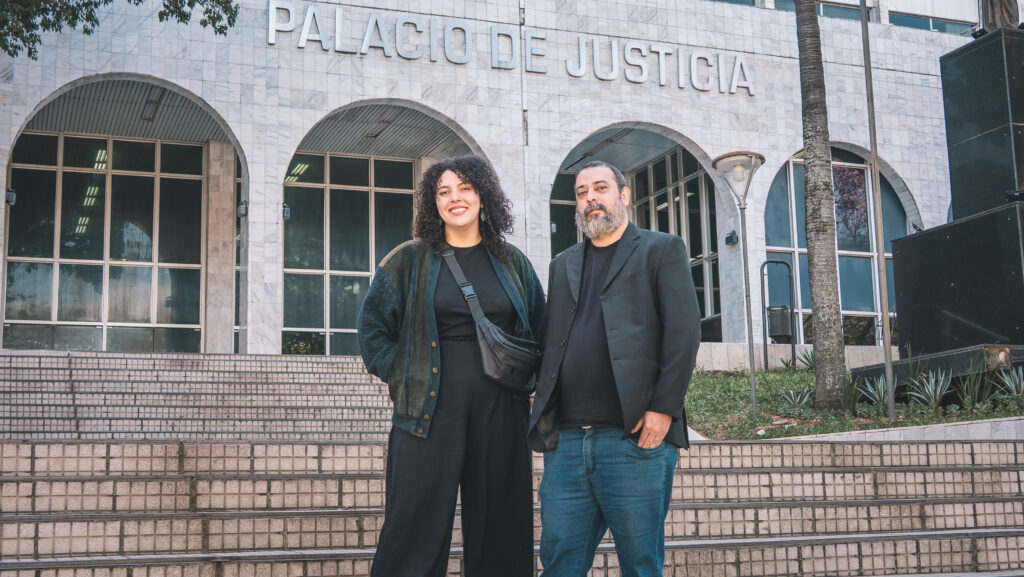
The Minister of Culture elaborated on the definition of “culture.” She highlighted the work of La Chispa within the framework of activities in the Historic Center. “It is a cultural center officially recognized in 2022 by the previous administration. It energizes cultural activity, supports emerging artists, contributes to the revitalization of the historic center, and provides employment for many people through its fairs. Thanks to La Chispa's activities in public spaces, which have always been authorized by the Municipality of Asunción and supported by the Secretariat of Culture, many artists have gained visibility, and several have become leading figures in Paraguayan culture.”.
Sergio Alvarenga, a musician and writer, testified on the third day of the public trial. “When the municipality organizes a rock concert and the people they consider desirable attend, everything is fine. But if La Chispa organizes it and the audience is 'shady' in their eyes, then it's wrong.” In his opinion, what bothers them is not the volume, but the refusal to accept cultural expressions that are not considered art.
For Milena, the charges also reveal the disarray and arbitrariness in urban management. “The municipality applied a 2004 ordinance, repealed by Law 6390, instead of the current regulations that allow for much higher noise levels. Under that logic, no cultural activity could take place,” she warns. The defense is confident that this technical argument can reverse the process, but acknowledges that the cultural battle is more difficult to win.
"Creating culture is creating a city"
Meanwhile, the community that formed around La Chispa (vendors, emerging artists, neighbors, activists) mourns the loss of a space that was both an economic lifeline and a creative haven. “I haven’t found anything like it,” says Alvarenga. “It was a showcase for those of us who don’t fit into the commercial circuit.”
As the city grows uncontrollably, it displaces its inhabitants in a context of gentrification. Gas stations and supermarkets proliferate, the number of cars grows rampant, and public spaces and urban forests disappear.
La Chispa, which is now part of the Red Escucha network and works with the National Secretariat of Culture to ensure these spaces receive municipal recognition and protection, faces a threat that extends far beyond its walls. If it closes, it will be a loss not only for art but also for cultural democracy in Paraguay. Because every time a place like La Chispa shuts down, the possibility of imagining a freer, more creative, and more community-oriented city also fades. Milena Ruiz Díaz sums it up this way: “Creating culture is also building a city. And today, what’s at stake is the very possibility of that city being diverse.”
We are present
We are committed to journalism that delves into the territories and conducts thorough investigations, combined with new technologies and narrative formats. We want the protagonists, their stories, and their struggles to be present.
SUPPORT US

FOLLOW US
Related notes
We are present
This and other stories are not usually on the media agenda. Together we can bring them to light.