

La Chola Poblete, queer artist: “Argentina is neither white nor heterosexual”
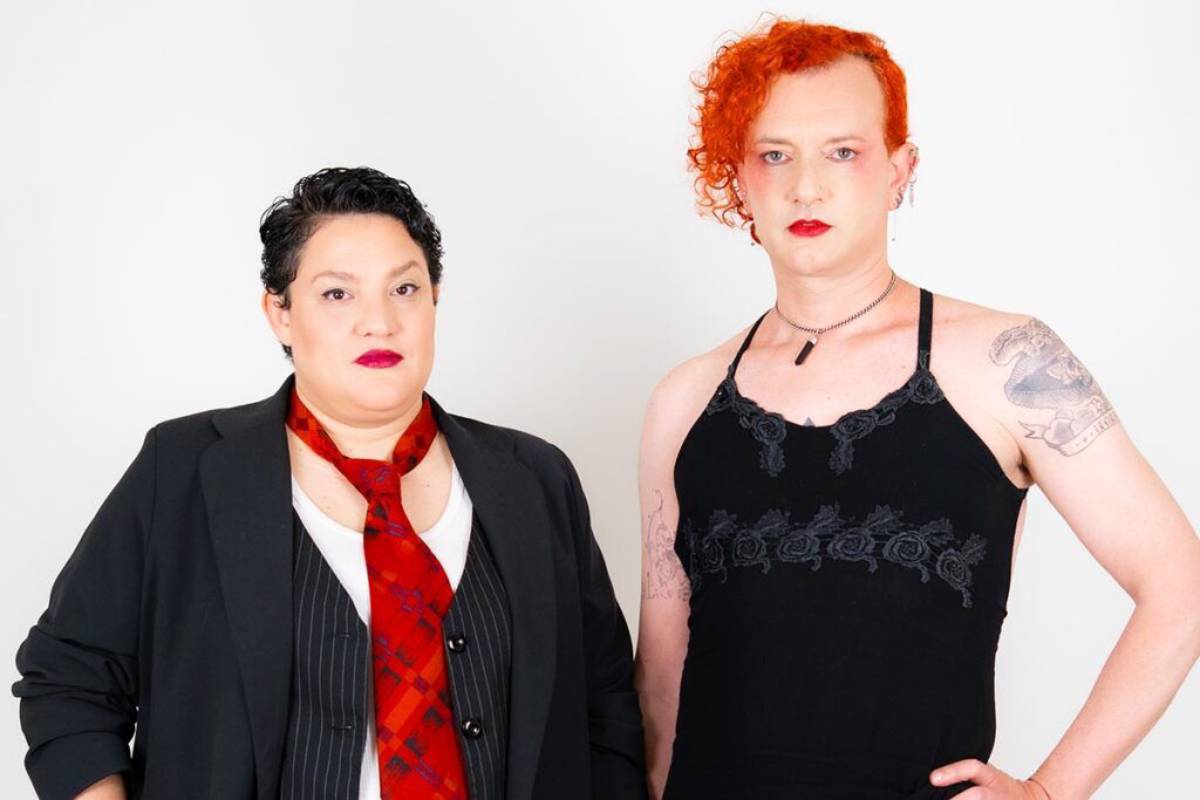
La Chola Poblete is becoming an iconic visual artist worldwide. Her work fuses Indigenous culture, queer brown identity, pop culture, and transvestite fury. We interviewed her in her San Telmo studio.


Share

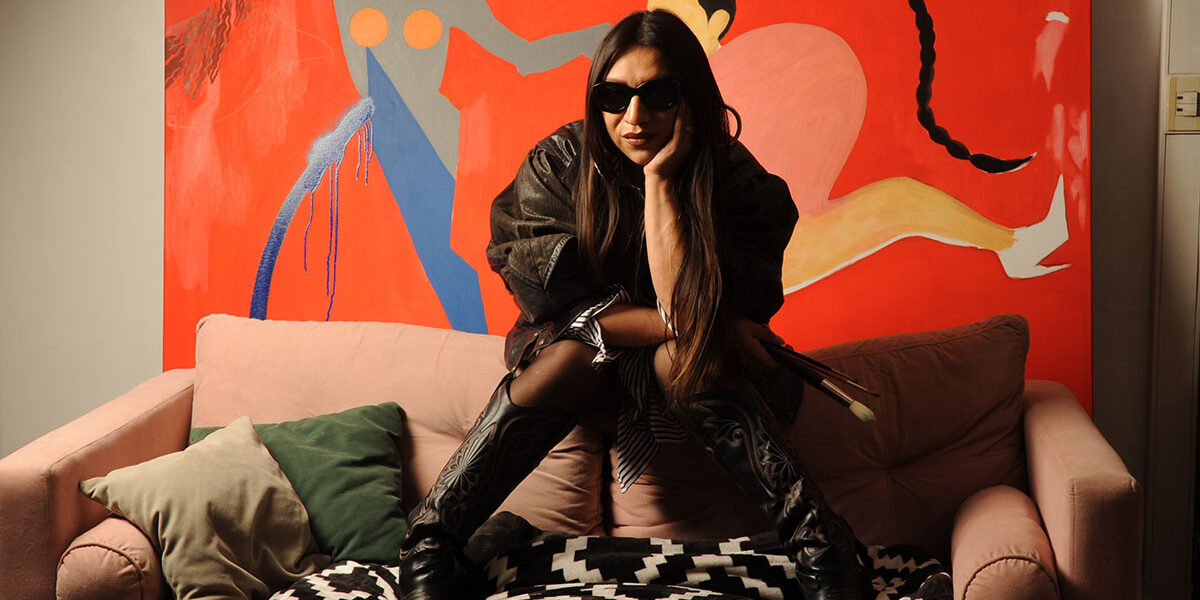
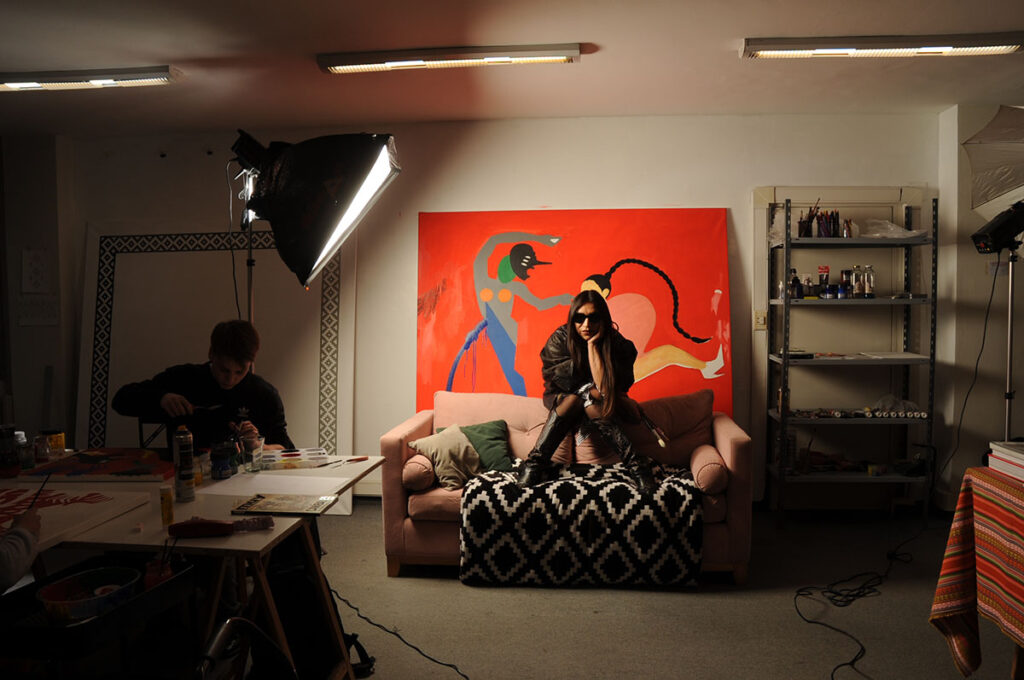
Chola Poblete 's first encounter with art was thanks to a dwarf. She was five years old and leafing through an illustrated encyclopedia at her grandmother's house in a humble neighborhood of Guaymallén, Mendoza, where she lived with her mother. She pointed to the image, and her mother replied, "It's a painting." That's how she learned about the possibility of painting. "It stuck with me because instead of saying, 'It 's a dwarf ,' she said, 'It's a painting ,' at a time when I didn't know paintings existed, or art, or museums or galleries. My mother was a domestic worker; she worked all day. We weren't taken to museums at school either. But that day something opened up for me," she tells Presentes, as she walks through her studio in downtown Buenos Aires, a spacious area covered with works in progress and an office.
Thirty-one years have passed since that first revelation, and today Chola Poblete is one of Argentina's most internationally renowned visual artists . Long gone is the romantic image of the artist secluded in a small studio, intimately connected to her work. The glass entrance door now displays "Chola" in phosphorescent letters, as if it were a dressing room. She's preparing a major exhibition for November in Buenos Aires, and three other people work in her studio. Nico and Manola help her paint, and Gonza handles the administrative tasks.
American Beauty: The Intersectional Bombshell
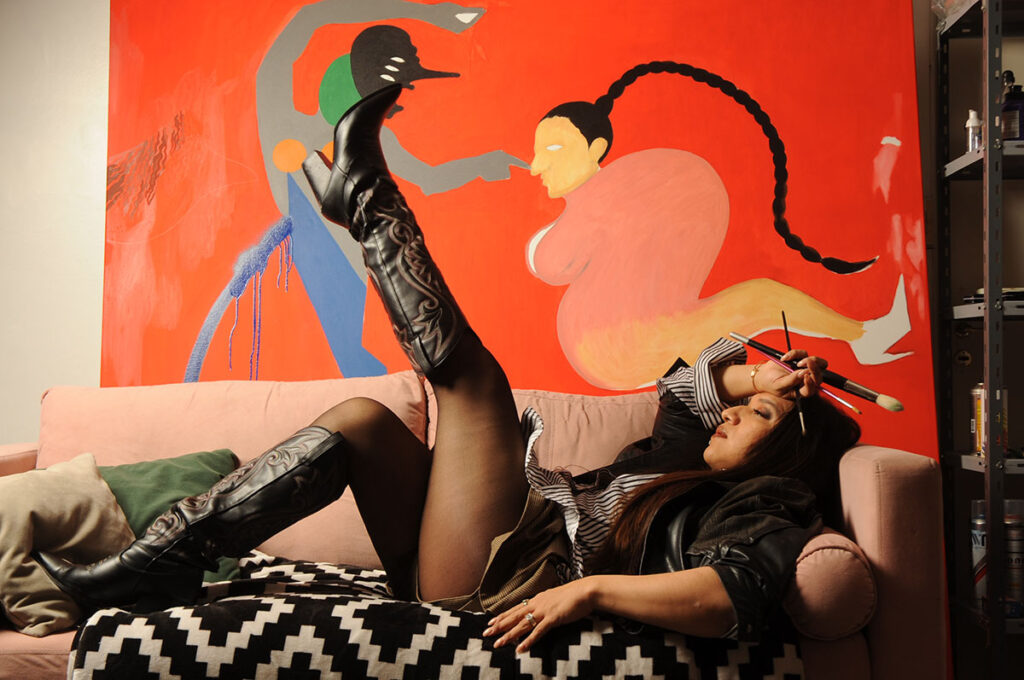
Since 2017, starting with her first exhibition at ARTEBA, everything accelerated. In that performance, “American Beauty ,” she wore a traditional Andean dress and danced while her feet destroyed a mattress of Lays potato chips, the ancestral food turned junk food. This is how the intersectional force that is Chola became known: Indigenous culture, queer , class consciousness, and pop culture. It's what critics have labeled Latin American post-neobaroque or bastard post-neobaroque, and today it occupies a privileged place in the contemporary art market. With local representatives ranging from Egar Murillo (Jujuy, 1951- Mendoza, 2025) , a reference for Chola and several generations of artists, to the performer Tiziano Cruz (Jujuy, 1988) passing through the Mapuche visual artist Seba Calfuequeo (Santiago de Chile 1991) and universes where cultural hybridization and syncretism appear from the interdisciplinary.
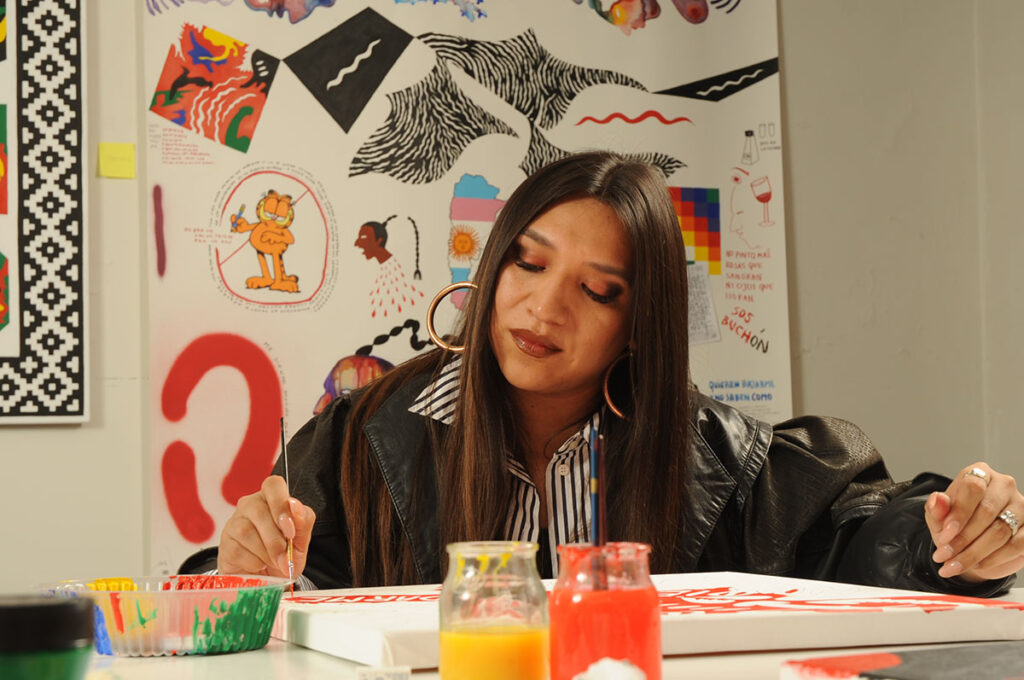
Chola Poblete's work was built from a convergence of practices and supports: performance, sculptures made of bread, acrylics, collage, fabrics, photography and watercolors - like the virgins that made her famous - sacred images surrounded by profane iconography, whipalas, rock song lyrics, the Argentine shield and other symbols that deconstruct any idea of identity as something static.
From one queen to another, five centuries later
After that performance at Arteba, she received a scholarship from the Di Tella University's Artists Program. With that came the end of the underground scene and a new life in Buenos Aires. “At first, I didn't want anything to do with Buenos Aires. I had a terrible time. I didn't have a penny, no gallery would take me on, I did an exhibition at the San Martín Cultural Center simply because they were giving me money. It was the worst exhibition I've ever done. Nobody came, I didn't invite anyone. It was in a horrible hallway,” she says.
During those years, she survived by doing a little bit of everything—designing flyers, working at the Museum of Contemporary Art in La Boca—and, paradoxically, it was during the pandemic that her career took off. She received a call from the Pasto Gallery , and in 2022 they took her work to the ARCO art fair in Madrid. “That’s where it all began,” says La Chola. The turning point was Queen Letizia’s visit to her booth: the photographs and the account of that encounter went viral. La Chola decided not to follow the royal greeting protocol and told the queen, through their face masks: “After 530 years, we meet again.”
“The Royal Household gives you a protocol for how to communicate with the King and Queen, and I wanted to do something different, a performance, but they wouldn't let me, and I didn't want to fall into the cliché. Then it occurred to me that it was the 530th anniversary of the Conquest. I felt like the queen of my stand. I said that line to her, and she just stared at me. She asked me what pronoun I wanted to be called by, and we walked around the stand. Pretty cool, really. The next day my phone was blowing up, and I realized the impact it had had. At one point, I was on the subway with some friends, and a guy who must have been from Bolivia or Peru said to me, ' Chola, I love you .' Imagine that, in Madrid. I couldn't believe it.”
It wasn't her first time visiting the Spanish capital, nor was it the first time a trip to Madrid had changed her life. When she was 20, she came out while studying to be a teacher and earning a degree in Visual Arts at the University in Mendoza, which resulted in a fight with her mother. She began experiencing anxiety attacks and depression, and left home. Some aunts who lived in Madrid invited her to stay with them for a while.
“I visited every museum I could. I wanted to see for myself what I had studied, and there I encountered the dwarf from my childhood. It was Velázquez's dwarf. That plunged me into an even deeper crisis, because I felt that all that European art didn't represent me, or my culture. That European tradition in our painting didn't represent the real Argentina either. And I wanted to be in art books .” In the midst of that crisis, her character La Chola Poblete was born, an alter ego that, through a process of transition, gradually became her identity.
Infiltrator between worlds
When asked about the role of identity in her life and work, La Chola doesn't give categorical answers because these dimensions have become intertwined. The life experiences of Mauricio Poblete—a biographical figure she continues to revisit in her work—led to the creation of La Chola, and in turn, La Chola gradually took over until she became her very self. But, she says, she increasingly inhabits a state of dissociation and questions how much of this identity transformation is performance.
Chola's universe is populated by influences that transcend the art world. Before learning technique and history at university, she grew up drawing models she copied from gossip magazines, reading Rolling Stone, listening to Radio Aspen, and watching MTV. "I'm a product of the '90s," she says with a laugh, pointing to some Barbie dolls that now reside in her studio. It was a cruel decade for those who didn't conform to a dominant ideology, and that lingering feeling, somewhere between nostalgia and social critique, is very present in her work, which at times adopts melancholic tones, as in "Exercises of Crying," an introspective exhibition she held in 2024 for the Museum of Modern Art in Buenos Aires.
“Love for girls like me”
“I basically write about what happens to me. And sometimes when I feel like I’m writing too much in a personal diary style and I don’t want to reveal so much—because maybe I’ve already revealed too much—I start writing down song lyrics or quotes from other artists in interviews that I identify with.” These quotes express her concerns about love (or heartbreak), and coexist alongside more political or social reflections. “I’ve never been in a relationship, and I long for one, but love isn’t easy for girls like me. Right now, things are going incredibly well professionally; I feel like everything has fallen into place. I’ve traveled all over the world. But when I get home after being surrounded by so many people—from events, exhibitions, or even just here in the studio—I’d love to have a glass of wine with someone, share some time with someone, and that doesn’t exist. That’s when I get this existential angst. The people I’ve met only want or desire you behind closed doors; they don’t commit. Or you end up on apps with random people who don’t understand my work or who I am. There’s a real divide here; I feel like in one place I’m valued a lot, and in the other, I’m nothing,” she says. It’s in the realm of intimate relationships where she feels the most discrimination for being trans. Because in the rest of daily life, she says, racism is what prevails, and she’s felt that since she was a child.
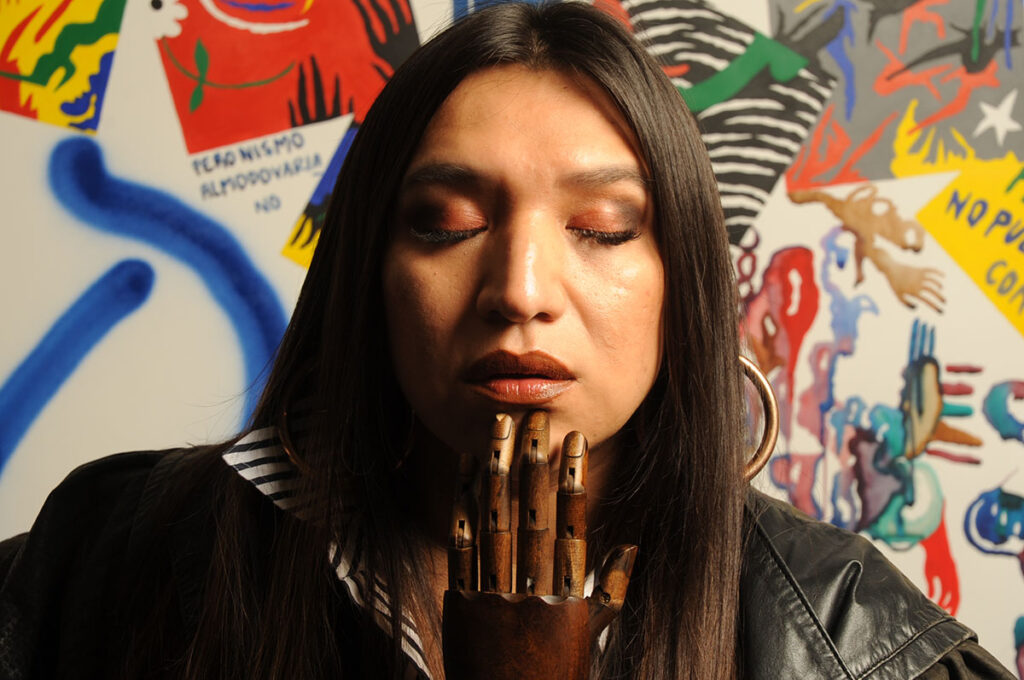
“I was discriminated against more for my skin color than for being gay.”
“Especially in Mendoza, where there’s a huge community of migrant workers and people who come from the north or from Peru and Bolivia to work in the wineries. And Mendoza is very prudish. There are a lot of derogatory words or insults related to that sector. Boliperuano, chola, el ajo, la cebolla, etc. In the clubs, I felt more discriminated against because of my skin color than because I was gay. But I managed to get in; I made friends with the bouncers, talked to them until they were tired of it, and then they’d say, ‘Come on in.’”
Chola was used to navigating different worlds, between different social classes and levels of access to culture. Just like now. Her mother sent her to schools downtown, near their jobs, so they could coincide with her recess. At those schools, her classmates were the children of professionals, a reality very different from that of her neighborhood. “I had a neighbor who didn't have a penny and walked around barefoot. Then I would go to the house of one of my classmates downtown, with his cement house, and we didn't even have a dividing wall. When it rained and everything flooded, my mother would put supermarket bags over our shoes so we could leave the neighborhood and take the bus. I felt like the most ridiculous person in the world walking all those blocks, but when we got downtown, we would take off the bags, and we looked spotless, our little shoes all shiny. That's why I think life prepared me to tolerate a lot of uncomfortable situations and adapt ,” she replies when asked how she navigates the art world, which is also the world of money.
Fire and fury transvestite
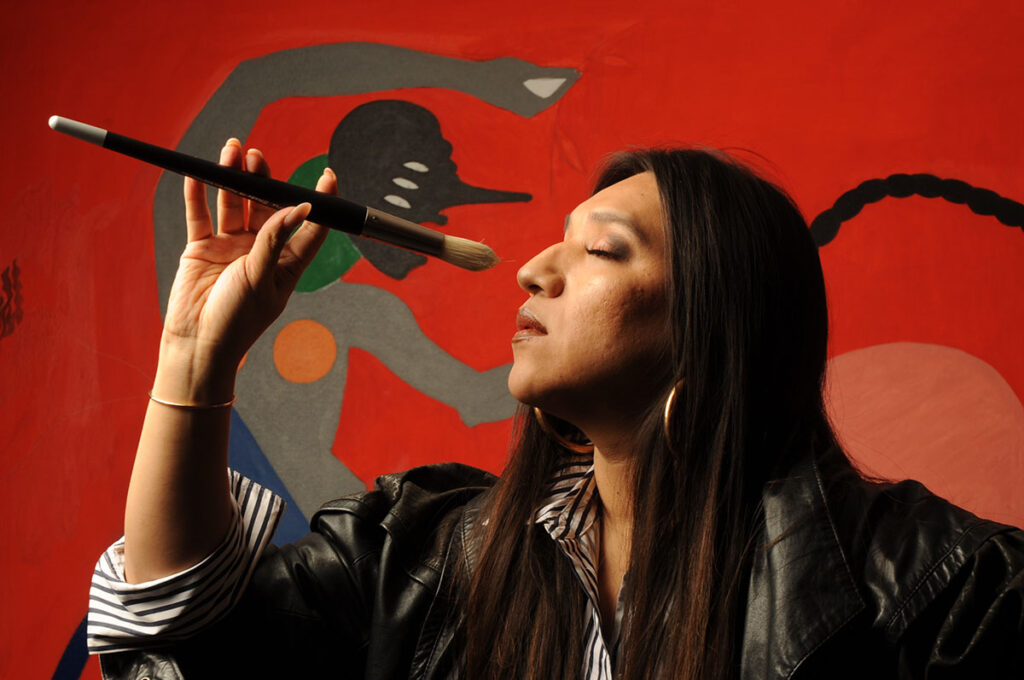
“The Venice Biennale recognizes a queer artist for the first time,” “Argentine trans artist receives honorable mention at the Venice Biennale,” headlined newspapers and websites around the world last year. The European breakthrough that began with Madrid and Queen Letizia in 2022 continued with the Deutsche Bank Foundation Artist of the Year award in 2023 and a special invitation to participate in the Venice Biennale in 2024, curated by Adriano Pedrosa, artistic director of the São Paulo Museum of Art.
“When Adriano told me the news, he said: I want three works . And I said: I want another meeting. He laughed, because nobody asks for more meetings when you're invited to the Biennale. You say yes and that's it. But I wanted to show off and display more work. From Berlin, I took a plane to Venice and had the meeting. He said, ' Okay, I'll give you 24 meters,' which is a lot . Because I wanted to create an installation piece, do everything, give it my all, and he gave me that incredible space, and now he's going to curate my exhibition in São Paulo next year,” she says proudly.
“I don’t back down at the first hurdle, not a chance. That drive has always led me to many things. And the truth is, it has nothing to do with love, but with anger. Or an anguish that transforms into anger and makes me feel empowered. And say, I want this. It’s something that grips me from within, like a fire,” she says. That fire, she acknowledges, is also collective; it has to do with the networks she’s built with her trans friends, who are now experiencing firsthand the setbacks in gender policies and the hate speech of Javier Milei’s government.
“I have friends who lost their jobs, who went back to the streets after finally having a formal job. Others are in the Palermo Woods, and the police are more brutal than ever. That's what's happening. But I think we've crossed a line anyway. Beyond the current context, there are things we're not going to undo, and that has to do with all the deconstruction of recent years, feminism, everything that's happened, ” she says with conviction.
It's as if two realities coexist: one political, seeking to dismantle identity politics and laws, and another that inhabits the parallel worlds of social media and art circuits, where dissident identities, for the first time, have a massive audience that admires and listens to them. “I watch a lot of TikTok, and there you'll find La Cuerpo and other trans women, or women from other parts of the world. They have millions of followers and are role models for many of the younger generations. The idea is to show that other realities exist, like I do with my work when I go to Europe, for example, and show that Argentina isn't white or heterosexual .
We are present
We are committed to journalism that delves into the territories and conducts thorough investigations, combined with new technologies and narrative formats. We want the protagonists, their stories, and their struggles to be present.
SUPPORT US

FOLLOW US
Related notes
We are present
This and other stories are not usually on the media agenda. Together we can bring them to light.