

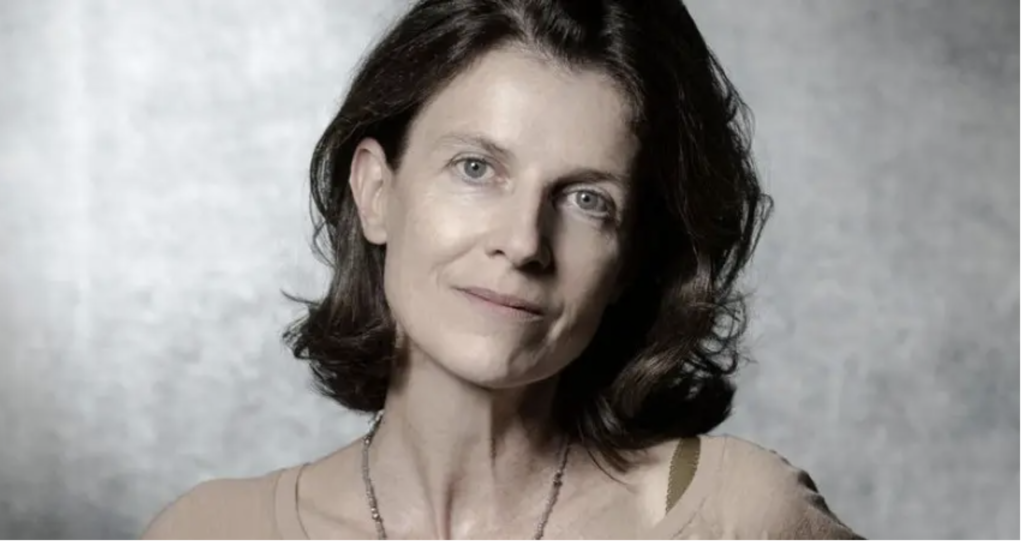
Emmanuelle Bayamack-Tam: “My characters are like free electrons, they question biology”
Emmanuelle Bayamack-Tam uses fiction and humor to build a bulwark against intolerance. We interviewed the French writer, celebrated by Paul Preciado, about why her characters shatter the gender binary and propose a possible desire for everyone.


Share

BUENOS AIRES, Argentina. An intersex protagonist, Farrah, whose setting, family, and story shift throughout the novel; another protagonist, Sharon, a woman of undefined beauty and color, also transforms as the books progress. The characters of French writer Emmanuelle Bayamack-Tam form a mutant sisterhood, a kind of X-Men without superpowers but with desire and queer as compasses pointing toward freedom, a concept now hijacked by the far right.
Bayamack-Tam is an author who crafted a literary project poised between self-awareness and delirium, brimming with literary references (quotes and passages from authors like Flaubert, Proust, and Nerval permeate her novels) amidst settings where political imagination reigns supreme. Just as her characters shatter gender binary thinking, her works traverse various genres—millenarian novels, theater, poetry, and chronicles—and are also published under the pseudonym Rebecca Lighieri, which she adopted for novels intended for a wider audience.
During his visit to Buenos Aires, where he presented his translated novels “The Thirteenth Hour” (Médicis Prize 2022) and “Arcadia” (Inter Book Prize, 2019), published by Cuenco De Plata and celebrated by colleagues such as Paul Preciado, he spoke with Agencia Presentes about the choice of his creative universe, the use of humor and imagination as a political gesture.
– ¿Why does the theme of gender identity appear at the center of her work?
– This has always been there. The first novel I wrote, in 1996, was about a boy who felt like a girl. In France, gender studies were very behind the times, and I didn't know what gender dysphoria was, for example, nor did I have much of an idea about trans identities. I came to that topic for personal reasons that I prefer not to make public. Since childhood, I've felt the extent to which people are fluid. When I started writing , my characters appeared, who are like free electrons: neither man nor woman, neither Black nor white, with fluid desires as well. This allows me to question everything that revolves around biology . After that first novel in the '90s, I wrote another, "La princesse de." (The Princess of). It takes place in a cabaret among trans people and drag performers. Those books weren't read very much. I think my writing gradually became more politicized; at first, the characters weren't situated. But I don't write pamphlets or essays; I stand in the realm of fiction and poetry. I think they would be banal books if they didn't engage with social issues.
– What does the use of humor contribute?
– I realized that the authors I like best are very funny: Kafka, Beckett, Proust, even Virginia Woolf has moments of great humor and irony. For me, it's absolutely essential. A serious tone is foreign to me; what I write is usually satire. I like the mix of registers: sometimes horror, sometimes humor, sometimes a more political tone.
– Your novels propose utopias, or at least worlds where what is rejected today appears as normal. Do you think literature can generate any kind of change in societies?
– I'd like to believe that. Having access to literature, to poetry, helps. Seeing other representations of the world helps, but unfortunately, very few of us have access. Literature can offer solace, it's an escape, but only for a tiny fraction of the population. Every now and then I give workshops in prisons and I've seen the impact of literature on some people, but it doesn't exactly change their lives or their worldview.
– Have you been questioned by diversity activists for addressing these issues without being LGBT?
“ I don’t write pamphlets or write in place of anyone . I write fiction where my characters can’t be easily categorized; some are trans, others intersex, others have fluid gender identities. In France, I’ve never been questioned about this; on the contrary, I think they see me as an ally. And in this day and age, allies are needed more than ever; these are very difficult times. Even our president, Macron, has opportunistically made ironic comments about trans people, not to mention the anti-immigrant rhetoric and the racism that we experience every day, and it’s getting worse all the time. On the other hand , the nature of fiction writing is to immerse oneself in other people’s worlds, to flow, to avoid falling into binaries.”
– It's happening in journalism too: it's as if you can only write about the identity we inhabit or the issues that affect us personally.
– I think that vision is a real problem; it shrinks the world considerably and, above all, curiosity and sensitivity.
"It would be good if they taught us that desire is possible for everyone."«
– Religion has a special place in your work. In “The Thirteenth Hour” you directly created a church made up of all rejected or dissident identities, where poems by Nerval are recited instead of the Bible. Why does this appear with such force?
– I'm very interested in Christianity, and Catholicism in particular; I think there's extraordinary poetic material there. I also wonder how we went from an almost communist, queer to these exclusionary, patriarchal religions of today. Jesus had a sexual and emotional relationship with John, they took psychotropic drugs in the desert, they were most likely very dark-skinned, and that diverse community, so friendly to marginalized people, devolved into something very sectarian. Christ is depicted as blond with blue eyes—another fiction. In "The Thirteenth Hour," I was also interested in exploring what can be built from spirituality. We don't want to live in a prosaic, commercial society where all that matters is money. What elevates us, what transforms us?
– In addition to fluid identities, their characters desire from non-hegemonic bodies and from old age.
– I like the creation of myths, archetypes, and metamorphoses that people can identify with. Characters who might be considered monsters on the outside and bodies that don't fit hegemonic parameters. What happens to those who fall outside those parameters? They are, in fact, the majority. My idea is that all bodies are desirable, and a character like Arcadia comes to say precisely that: she likes people of all ages, of all genders; there are no limits . Instead of constantly harping on about wrinkles and body hair, it would be good if we were taught from childhood that desire is possible for everyone . For me, that's both a literary and a political issue.
Share
We are present
We are committed to journalism that delves into the territories and conducts thorough investigations, combined with new technologies and narrative formats. We want the protagonists, their stories, and their struggles to be present.
SUPPORT US

FOLLOW US
Related notes

We are present
This and other stories are not usually on the media agenda. Together we can bring them to light.