

LGBT activists in Bolivia: “Queers, butch women, and trans women fight for everyday life”
The Third Plurisexual Reunion “Transfeminist Borders, Racialized Bodies, Anti-Capitalist Territories” brings together activists from Peru, Argentina and Chile.


Share

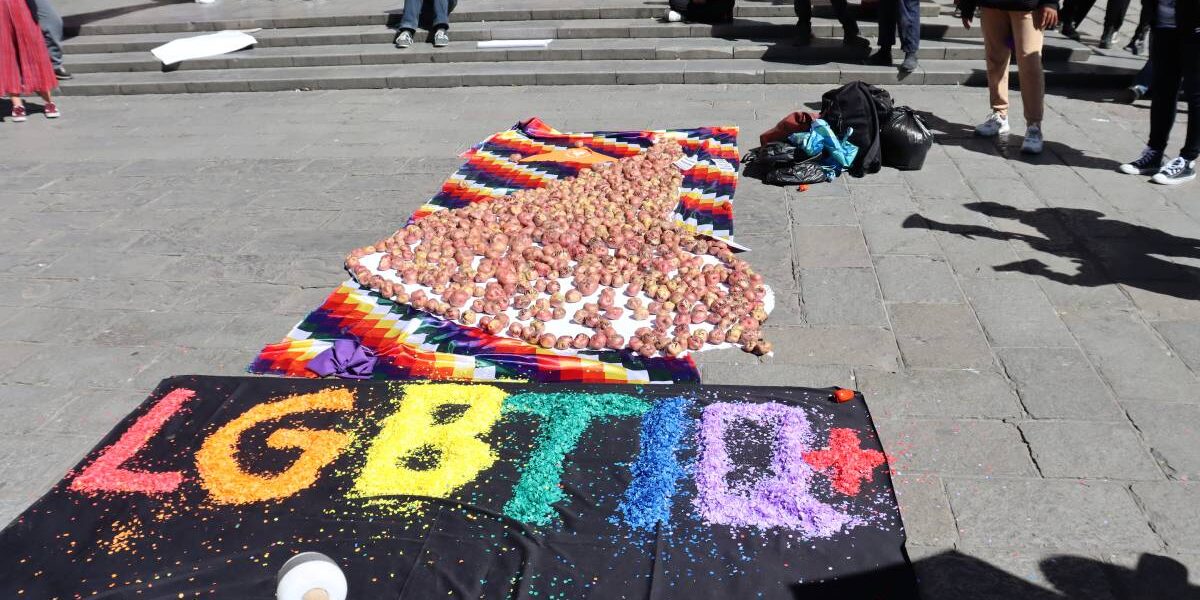
LA PAZ, Bolivia. The Maricas Bolivia Movement and diversity organizations welcome activists from Peru, Argentina, Chile, Bolivia and Brazil to the Third Plurisexual Reunion “Transfeminist Borders, Racialized Bodies, Anti-Capitalist Territories”.
The event takes place from May 13th to 17th and provides a space for debate and the exchange of experiences from across the region. Our media partner, La Nota, spoke with Edgar Solís Guzman, a member of the Maricas Bolivia Movement , one of the groups organizing this gathering.
Edgar is a Quechua migrant, born in Oruro, but he has lived in La Paz for over 15 years. He refers to himself as "poor, Indian, and faggot," twisting the insult into a political statement. He has been a member of the Maricas Bolivia Movement .
“We don’t seek to represent everyone; we speak from our own perspective, from an embodied, intersectional, Indigenous, and queer standpoint. Our movement addresses the lived experience of sexuality in Indigenous communities, but also the urban experience of those of us who migrated from those territories. We question imposed, naturalized customs, the LGBTIQ+ institutions centered on large cities, and we propose other ways of being,” said Solís Guzman.
Between the community and the urban
– What is the state of activism in the country?
I've been part of the Maricas Bolivia Movement since its inception. Over time, we've fostered ruptures and discussions about bodies and subjectivities from a politics of indigeneity, which we understand as a form of resistance against a Bolivian society that continues to aspire to hegemonic whiteness. This aspiration reproduces a contemporary coloniality that attempts to erase us. Although the Plurinational State has recognized 36 Indigenous nations and the rights of sexual minorities since 2009, racism and violence persist, as do homophobia, lesbophobia, and transphobia. The law may be written, but it doesn't always translate into transformations in daily life.
In Bolivia, other LGBTIQ+ organizations exist, such as the Bolivian LGBT Collective and the Coalition of Organizations. These have achieved significant legal advances, such as the Gender Identity Law (807) and Article 14, Paragraph II of the Constitution. But as in other countries, laws are not enough. Murders of trans women, corrective rapes, and violence in schools persist. Our struggle is to dismantle the colonial mentality that reproduces binary thinking, compulsory heterosexuality, and structural racism. Laws are not enough if colonialism remains in force.
We come from rural communities, from mid-sized cities, from Indigenous territories. There are also gay men, trans women, and butch women there. Dissident sexualities that move between the communal and the urban. Sometimes they are integrated, other times they are subjected to violence. But what matters is that they resist. That they activate memories of ancestral sexualities, that existed before the genocide, before colonization. Our struggle does not seek to be institutionalized or validated by academia or the city: it seeks to open fissures from names that marked us and displaced us—Q'iwsa, Orkochi, Q'iwa, Qarimacho, and Marimacha—and that we now reclaim to generate thought and rupture.
"We fight for everyday life"
–What are your expectations for this reunion?
The third plurisexual gathering— transfeminist borders, racialized bodies, anti-capitalist territories —is conceived as an opportunity for our struggles to converge. This is not an LGBTIQ+ institutional space, nor does it revolve exclusively around demands like marriage equality. We, the queer, butch, and trans people of migrant communities, fight for everyday life: for territory, for education, for resisting the violence that arises in response to our sexual disobedience. To come together is to recognize ourselves in another struggle, a more vital, more embodied one.
That's why we're organizing this reunion, following those held in Calilegua and Tilcara. It's a huge undertaking in the context of Bolivia's economic crisis, where sustaining activism and cultural management is increasingly difficult. The meeting will take place between El Alto and La Paz because we understand that queer desire, dissident bodies, traverse that everyday border.
From the Andes to La Paz
The gathering begins at the Tambo Quirquincho Museum, a former indigenous way station now a museum, to discuss spiritualities and archives of gay, lesbian, and transgender memories. It will then move to various locations in La Paz. The event will conclude on Saturday, May 17—the International Day Against Homophobia, Transphobia, and Biphobia—with a march in El Alto and a plenary session broadcast on the radio from the Wayna Tambo House of Culture. The venue for the next gathering will be decided there.
“It will be a gathering of dissident bodies that travel, that climb the Andes, that recognize themselves as Indigenous and fight from that identity. We recognize ourselves in our marks, in our stories, and in the desire to transform—however utopian it may seem—those dynamics of violence that persist in our communities. Because there, too, the battles of the present are fought,” concluded Edgar Solís Guzman.
*This article was originally published in our partner publication, La Nota.
We are present
We are committed to journalism that delves into the territories and conducts thorough investigations, combined with new technologies and narrative formats. We want the protagonists, their stories, and their struggles to be present.
SUPPORT US

FOLLOW US
Related notes

We are present
This and other stories are not usually on the media agenda. Together we can bring them to light.