

What impact did Pope Francis have on sexual diversity?
How has Pope Francis impacted the relationship between the Church and LGBTQ+ people? We asked LGBTQ+ activists and leaders, who reviewed achievements, critical moments, and outstanding issues.
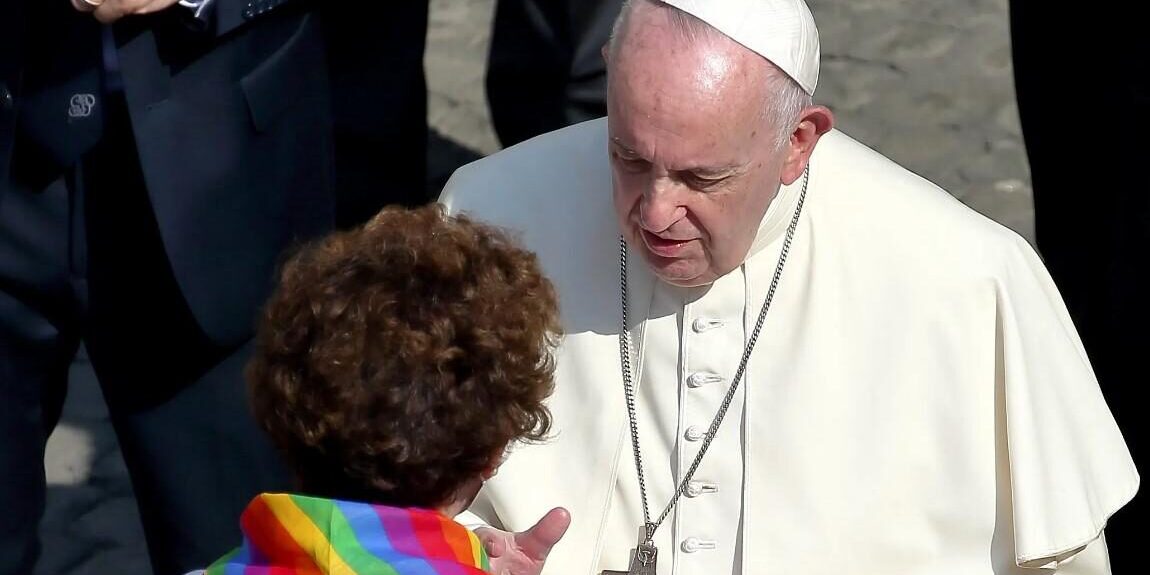


Share

The death of Pope Francis Bergoglio, as all farewells do, amplifies the stature of the Argentine Pontiff, the first from Latin America. It positions him as one of the few people capable of forging a global consensus across an extremely broad political spectrum, and a figure of reference beyond those who profess the Catholic faith. He was praised by Lula in Brazil, Claudia Sheinbaum in Mexico, and Donald Trump in the United States, who also ordered that flags on government buildings in that country be flown at half-staff. The Arab League highlighted his stance on the Palestinian cause. Even those who declared open war on him want to take a stand and pay him homage, such as Argentine President Javier Milei, who announced he will travel to his funeral at the Vatican.
Pope Francis, as the millions of farewells on social media one way or another attest, brought a touch of humanity to the world stage of an institution trapped in its dogmas and outdated in its precepts. He made many gestures of openness and spoke out to draw attention to sectors punished by neoliberalism and the rise of the right. Today, the photo of him washing the feet of migrants is circulating everywhere. Writer and filmmaker César González also shared it, recalling that when he was still a cardinal, Bergoglio would visit the juvenile detention center where he was stationed once a month and speak with the young inmates.
Despite his fragile health, in his final days Pope Francis called the Holy Family parish in Gaza, besieged by war, as he had done regularly since October 2013. He addressed numerous current affairs and human rights issues throughout his 12-year papacy. In his speeches, he spoke about climate change, homosexuality, abortion, and same-sex marriage. In Argentina, some criticize him for not scheduling a visit to his birth country at a time when the far right was gaining ground.
Many believe he could have gone much further in several areas, moving beyond mere rhetoric to promote fundamental transformations from within the Church itself. What impact did his papacy have on sexual diversity? We asked LGBTQ+ activists and leading figures, and reviewed some critical moments.
Mónica Astorga Cremona: “She insisted that God loves trans people”
“Today I feel like I’ve been orphaned,” said Mónica Astorga Cremona, known as “the Trans Nun,” when she heard the news. She dedicated almost forty years of her life to serving as a contemplative nun at the Monastery of the Holy Cross and Saint Joseph of the Discalced Carmelite Order in the province of Neuquén. From there, she spearheaded various projects to improve the lives of transvestites and transgender people, such as the first housing complex specifically for members of this community . All of these projects had the blessing of Pope Francis, who was also a friend of the former nun.
“I always told him he was my father, my pastor, my brother, and my friend. He accompanied me in this fight to make trans people visible. He received many of the girls, and he called others on the phone. He always told me, 'You can count on me.' He insisted that I tell them that God loved them, that they should never give up, and he had great respect for the LGBT community ,” she expressed in an interview with Presentes.
On her Instagram profile, Mónica recalled the first letter Francis sent her from Rome. It was in response to another letter Mónica had sent him along with trans women from Neuquén, who wanted to share their best wishes for this new chapter. He replied: “Dear Sister Mónica: Now, let's move forward… with prayer and the frontier work that the Lord has placed before you. Tell them from me that I do not condemn them, that I love them, and that from my heart I accompany them on life's journey, praying for them. But please, pray for me. Tell them that I am grateful they pray for me, and that Jesus and the Virgin love them; they should not doubt this. I'll leave you now. Please don't forget to pray for me. May Jesus bless you and the Blessed Virgin watch over you. Francis.”
In the last two years, Pope Francis has welcomed nearly 100 transgender women, many of them sex workers, into the sacred spaces of the Vatican. Several activists have shared that when they asked him for support for projects protecting trans women, he showed his solidarity. Maju Burgos, one of the founders of “Hogar Dignidad Trans” (Trans Dignity Shelter) in Mar del Plata, recounted in this article for Presentes how she contacted him. “I got his email address in April of 2021, and in June he replied very warmly, saying we could count on his help. It was so kind of him. He addressed me as ‘dear Maju,’ and as I tell you this, look… (she shows her arm with goosebumps) I’m not Catholic, I’m Buddhist, but he’s a role model, and with the history we have… At that moment, I remembered my childhood, I remembered when my mother kicked me out, and now the Pope is answering me. And I said to myself, ‘Well, that’s it, I can leave this world in peace because nothing is impossible.’”
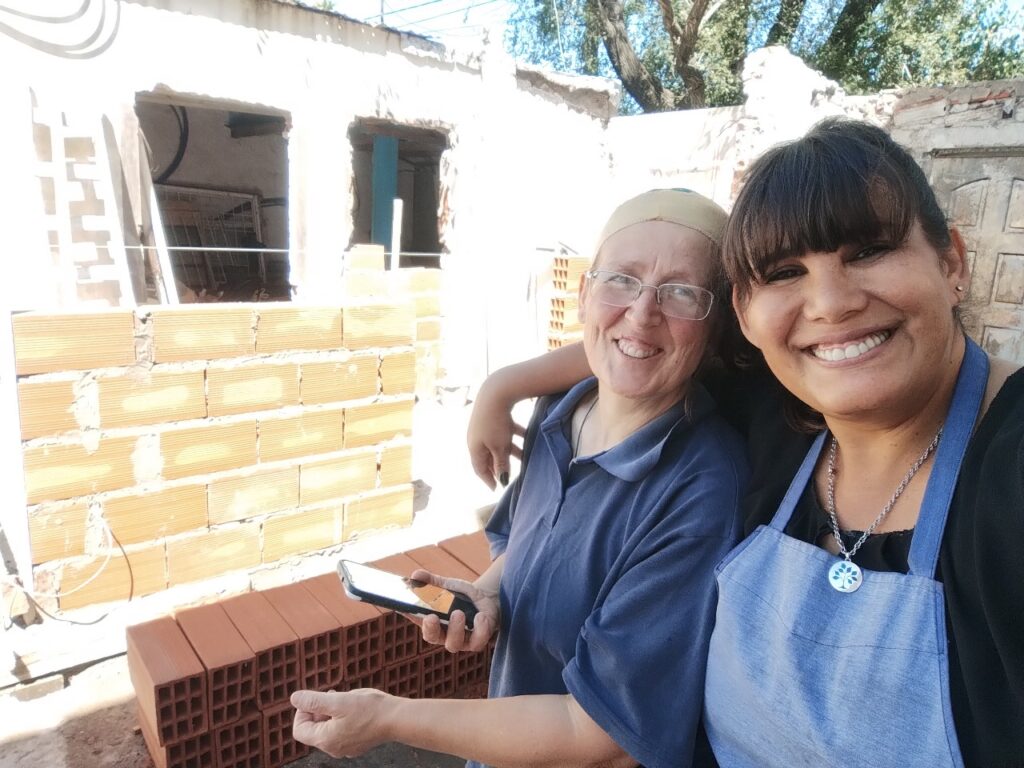
Monica recalls that “he was everyone’s shepherd. He didn’t discriminate, he didn’t reject anyone for anything, and certainly not for their sexuality.” She also acknowledges that Pope Francis made some hurtful statements at times.
Before he became Pope Francis, when Argentina was debating the Equal Marriage Law, approved in 2010, Bergoglio was one of its main opponents. And although in December 2018, the Vatican authorized the blessing of same-sex couples for the first time, he asked that it not be confused with marriage. "Homosexual people have the right to be in a family. They are children of God and have a right to a family. Nobody should be thrown out or made miserable because of it," the Pope said in the documentary Francesco . And in 2023, he reiterated his messages on homosexuality in various journalistic interviews.
“He apologized, and that’s what’s valuable. He was there to support and welcome. Every Wednesday they welcomed groups of trans women ,” Mónica shares.
Regarding the passing of his friend and pastor, he hopes that the next Pope will continue his legacy. “I hope he doesn’t destroy all that Francis has accomplished, that we don’t go back thirty, fifty years, or even a lifetime. That he continues what Francis has begun to pave the way, and above all, the fight to integrate the entire LGBT community.”
From queer theology
Hugo Cordova Quero is a queer theologian and a professor of theology in California. He states that it's important to distinguish between Catholicism and Christianity, and that Pope Francis belongs to the Roman Catholicism that has become outdated.
He emphasizes, “Within Roman Catholicism, it’s a great achievement that the Pope is no longer Italian or another European, as has been the tradition. But it doesn’t make much difference to the rest of Christianity. Because within Christianity, they have been working brilliantly with people from diverse backgrounds for many years.”
“When Francis says that God accepts everyone but we cannot ordain you, we cannot marry you, we cannot call it marriage, you cannot adopt children as if they were a family and all these things, he is making a distinction between citizens but with a series of very well-crafted statements that make it seem as if everything is going to change, but it was not so.”
He also emphasizes that “access to holy orders is not conditioned by sexual orientation or gender. That hasn't yet happened in Rome, and Francis missed the opportunity to make it so . He made some very good statements, but in practice, he failed to change anything at all. Women are not ordained, something they were in the first-century church. LGBTQ+ people are not ordained to the priesthood, something they were for 11 centuries in Christianity. LGBTQ+ people do not marry within Roman Catholicism, something they did in fifth-century Christianity. Roman Catholicism has many outstanding issues that other Christian churches resolved decades ago.”
Miguel Angel Aguilar Arreola: “He made many of us feel welcomed”
The Teresa de Cepeda y Ahumada Collective , a Catholic LGBT community in Mexico, recognizes Pope Francis as a key figure. They emphasize that "until the very end, he was a very challenging figure. He tried to open doors despite his own circumstances and shortcomings, but he was a figure who made many of us feel welcomed ," explains Miguel Angel Aguilar Arreola. The Collective highlights his critical stance against the current wave of neoconservatism and his commitment to social justice, working together from "small places rooted in difficult realities."
They emphasize that, although the Pope's closeness to the LGBT community "wasn't as strong as we expected in the 2020s," it was still significant. Unlike his predecessors, "he didn't put the brakes on LGBT Catholic communities or groups of LGBT Catholics. Nor did he punish priests and nuns who accompanied these communities," something that did happen with his predecessors. "I think Francis's legacy is that he let things happen. He helped to promote change from the ground up, and what in other places was a cause for condemnation could now be seen as a blessing," Migue tells us.
The main legacy of Pope Francis, according to this group, lies in his ability to guide grassroots change and his commitment to social justice. Many advances, however small they may seem, take on special significance due to the doctrinal and historical weight of the Catholic Church, generating changes that are "very uncomfortable" and continually criticized by conservative sectors.
“He is a Pope who helped things at least keep moving forward. He did not hinder the importance of seeing the diverse realities that exist within the Church.”
Alba Rueda: Earrings and what's to come

“Francis is leaving behind a context where he has left several things unfinished. It’s clear he was thinking about essential political actions to open up the LGBT agenda within the Catholic Church. This process begins with dialogue and with his position as the highest authority,” trans activist Alba Rueda told this publication. She warns that the transformation didn’t end there. “Important steps had to be taken in reforming the institution, because Francis was the Head of State of the Catholic Church. So everything that implies an opening toward the LGBTQ community in the Church should have taken into account institutional reforms. That was certainly lacking, influenced by this plan of dialogue and following the initiation of the transformations.”
Alba Rueda told us that she's left with beautiful images, "like Francis surrounded by trans people on several occasions. With his words not only about us as activists but rather about the entire community. And knowing that Francis also paid a price for reaching out to the LGBT community." She also expressed concern and fear about who will succeed the Pope.
“ This social and political context is terrifying for the trans agenda in the Catholic Church , because of the conservative lobby, especially the pressure Italy is putting on the papacy regarding the opening of the conclave.” Rueda says he is concerned about the far-right lobby within the Catholic Church .
“Francis’s reformism, perhaps a testament to what were hoped for as major reforms, could be deactivated once he dies. I hope the new Pope will also have convictions regarding the LGBT community, but I fear that in the year Trump won, with Meloni in Italy, Milei in Argentina, and the far right celebrating their victories, there is a lot of pressure for progressivism within the Catholic Church. We will see how things unfold, but they must find us knowing that another world is possible and that they have not defeated us. Not only LGBT Catholics, but the LGBT movement globally. The far right must understand and respect that there has been progress this century, and we are not going to give up our rights.”
We are present
We are committed to journalism that delves into the territories and conducts thorough investigations, combined with new technologies and narrative formats. We want the protagonists, their stories, and their struggles to be present.
SUPPORT US

FOLLOW US
Related notes


We are present
This and other stories are not usually on the media agenda. Together we can bring them to light.