

Justice for trans youth in Buenos Aires: they will be able to continue their treatments
A ruling granted the injunction filed by the Argentine Federation of Lesbians, Gays, Bisexuals and Trans (FALGBT) to stop the Argentine government's decree that prohibits hormonal treatment in people under 18 years of age.


Share

A ruling by the Court of First Instance for Administrative and Tax Matters No. 4 of the City of Buenos Aires ordered the city government to guarantee hormone treatments for individuals under 18 years of age. Judge Elena Amanda Liberatori also issued an apology to transgender adolescents for the health problems caused by Decree 62/25, through which the national government prohibited these types of treatments for minors . This is the first setback the legislation has faced amid dozens of legal challenges being filed across the country.
The 82-page document compiles national and international legislation, documentation, and detailed reports on the rights protecting children and adolescents, such as the right to health, identity, autonomy, and the development of a life plan. It responds to a lawsuit filed by the Argentine Federation of Lesbians, Gays, Bisexuals, and Trans (FALGBT) , represented by María Rachid and Flavia Massenzio, against the Government of the City of Buenos Aires.
“It is evident that the 'immediate application' of the DNU (…) restricts, curtails, prevents, obstructs access to health for trans children and adolescents in the City of Buenos Aires, but also prevents the recognition of their own identity and thus excludes them, making it discriminatory,” says Judge Liberatori’s ruling.
In this context, it resolved to order the Buenos Aires government to "fully guarantee, through the public health sector providers (Hospitals, Mental Health Centers, CESACS, etc.), the continuity of hormonal treatments in progress before the enactment of DNU 62/2025 and access to new treatments after said regulation.".
Gender Identity Law
National government Decree of Necessity and Urgency (DNU) 62/25 modifies Article 11 of the Gender Identity Law (No. 26,743), which expresses the right to free personal development. It replaces it with a text that prohibits treatments for minors. “Persons under eighteen (18) years of age may not access the interventions and treatments referred to in this article,” the decree states.
When questioned by the Judiciary about its stance on the Emergency Decree, the Buenos Aires City Government responded that it had implemented it “immediately.” It also attached a statement from the Argentine Society of Pediatrics, in which the organization argues that treatments should continue and suggests developing a national research protocol that includes adolescents eligible to begin hormone therapy. In response to this statement, which contradicts the decision to implement the Emergency Decree, the judge stated that it is incomprehensible that the Court is aware of it while the City Government's own Ministry of Health is not. The judge also failed to provide details regarding what was meant by “immediate implementation,” nor did she clarify the City Government's position on whether or not to continue treatments.
Regarding this matter, at the meeting of the Federal Health Council (COFESA) last Monday, authorities from the National Ministry of Health and health representatives from the provinces stated: “With respect to Decree of Necessity and Urgency No. 62/2025, we interpret that it does not apply to minors under 18 years of age whose hormonal treatments began prior to the date the regulation came into effect. These treatments may continue according to the treating physician's instructions.”
However, this distinction between those who have already begun treatment and those who would be starting it for the first time “is arbitrary,” argues Judge Liberatori. “(It is) based solely on a before and after Decree 62/2025, without considering individual circumstances or the recommendations of treating physicians.”.
In addition to seriously infringing the right to gender identity and the right to non-discrimination, the implementation of the decree violates the progressive capacity of children and adolescents in relation to access to health and care of their own bodies, the ruling states.
Decision regarding the bodies
The 2015 reform of the Civil and Commercial Code established in Article 26 that, from the age of 16, adolescents have full capacity to make decisions regarding the care of their own bodies. Those between 13 and 16 are capable of making their own decisions regarding non-invasive treatments that do not compromise their health or pose a serious risk to their lives. In cases of invasive or risky treatments, consent must be given with parental assistance.
This progressive autonomy is valued by the Inter-American Commission on Human Rights (IACHR), as is the right of children and adolescents to be heard and for their opinions to be taken into account in all proceedings that affect them.
Regarding the importance of gender “transition” processes, the IACHR explains that “they are not merely aesthetic matters, but rather involve the personal realization of one’s own identity, how each person sees themselves and how they wish to be seen by others. They are mechanisms that allow trans and gender-diverse people to fully exercise their right to the free development of their personality in accordance with their own gender identity and expression.”.
Testimonies from families
This identification with a gender different from the one assigned at birth can occur at a very early age. The recent study conducted by the Trans Children and Adolescents Care Group (GANAT) at Durand Hospital —cited in the ruling—revealed that in 54% of 90 patients, the age of “disclosure” was before 10 years old, while 42% reported ages between 11 and 14 years old. Similarly, the “Report on the Current Situation of Trans Children’s Experiences” (2021) by the Civil Association Infancias Libres showed that the first expressions of an identity different from the gender assigned at birth occur primarily between the ages of 1 and 4 (42%), and secondarily between the ages of 5 and 8 (36%).
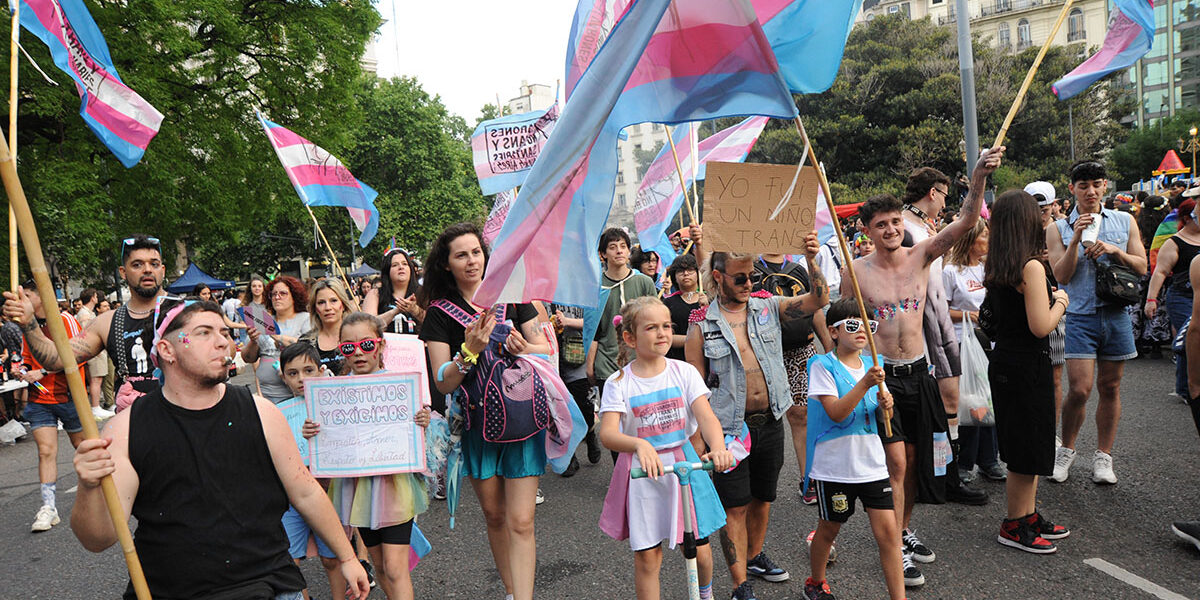
“You can’t say a kid doesn’t feel this way. Many end up committing suicide, falling into depression. Kids don’t lie: they feel this way, and that’s who they are,” Jaqueline Correa, a 43-year-old woman and mother of Gabriel, a 17-year-old trans youth, shared with Presentes . She is one of the plaintiffs in the legal challenge against the decree.
Jaqueline and Gabriel participate in the NNA Trans Secretariat , which provides free support to diverse children, adolescents, and families. “They have a small group for each age group. And the kids started saying, ‘We’re losing everything,’ others were depressed or afraid, and the parents were too,” Correa shared.
“My son’s endocrinologist had told him on the very day the decree was published that they were increasing his testosterone dose and that he would be able to use the injections in three months. When that hope arrived, it was dashed because he only has enough medication for three months,” she continued.
The impact of disinformation
The current context, in which misinformation about sexual diversity proliferates from government officials and the president, creates fertile ground for violence. Following a speech by Gabriel in the Chamber of Deputies in which he asked that “the children be heard,” his mother was subjected to a barrage of insults.
“That we parents mutilate our children, that we let them do abhorrent things. A president has to take care of his citizens, not generate hatred among the population. Especially not among children and adolescents who are in a difficult stage of their lives,” he shared.
He also warned about other problems related to this situation: “Doctors are afraid. There are young people over 18 whose surgeries have been canceled. They're going after everything. We can't live in a country where we're afraid to be who we are or where doctors can't practice medicine properly.”.
Actions across the country
Throughout the country, various organizations, families, and volunteer lawyers filed injunctions against the decree.
“We filed a lawsuit in the Federal Court for the entire country, then a collective one in the City of Buenos Aires, another in the Province of Buenos Aires, and in several other provinces. We made the injunction template available to volunteer lawyers in at least 14 provinces who have offered to litigate. More will be filing in the coming days,” said María Rachid, from the FALGBT board of directors.
In addition, the Pride and Struggle Front, together with organizations and families, promoted three injunctions in the province of Buenos Aires, involving 14 teenagers, and one in the City of Buenos Aires, involving four young people under 18 years of age.
“In Tucumán, we at the Transforming Families Foundation—where we support trans people and their families—have filed a collective injunction, advised by the lawyer from the Women for Women Foundation. We have already obtained the court's approval, so we are on the right track,” shared Laura Quintana, a member of the board of directors of Trans Formando Familias .
In La Pampa, two injunctions were filed in provincial and federal courts. “The injunctions were requested not only to nullify the decree, but also to have it declared unconstitutional. And the precautionary measures were sought to prevent its implementation,” Milagros Martin, a professor of Constitutional Law and Human Rights at the National University of La Pampa, told Presentes. She is also a member of the Self-Convened Lesbian Identities Network (RILA) , which organized a meeting with families and Pampa Trans to analyze strategies in response to the decree.
“Several medical studies and health organizations, such as the Argentine Society of Pediatrics, the World Association of Professionals for Transgender Health (WPATH), and the Pan American Health Organization (PAHO), have warned that the abrupt interruption of hormone therapies in trans adolescents can generate serious physical and psychological consequences, including severe depression, anguish, and an increased risk of suicide,” the organizations warned.
For the time being, the Neuquén Ministry of Health reported that the province will continue to guarantee access to comprehensive healthcare for the trans population at all stages of their lives. They explained: “Under no circumstances will any ongoing treatment be discontinued. For individuals under 18 who begin medical and surgical gender-affirming treatments, it will be necessary to notify the Undersecretary of Health so that they can be evaluated, always prioritizing full access to the individual's rights and the assessments of the relevant healthcare teams.”
We are present
We are committed to journalism that delves into the territories and conducts thorough investigations, combined with new technologies and narrative formats. We want the protagonists, their stories, and their struggles to be present.
SUPPORT US

FOLLOW US
Related notes

We are present
This and other stories are not usually on the media agenda. Together we can bring them to light.