

“Tehuel, a banner of struggle”: a podcast to spread the story of the missing young trans man
Through the voices of Tehuel's mother, trans and travesti activists, and lawyers, the podcast reconstructs the search for the young trans man who disappeared on March 11, 2021. It examines the approaches taken by the justice system, contextualizes the living conditions of the trans and travesti population, and critically analyzes the lack of systematization in the search and the shortcomings of the missing persons search system in Argentina.



Share

BUENOS AIRES, Argentina . Tiempo Argentino and Agencia Presentes jointly published the podcast “Tehuel, a flag of struggle”.
Through the voices of Tehuel's mother, trans and travesti activists, and lawyers, the podcast reconstructs the search for the missing trans youth. It examines the approaches taken by the justice system, contextualizes the living conditions of the trans and travesti population, and critically analyzes the lack of systematization in the search and the shortcomings of the missing persons search system in Argentina.
This project originated at the public university as a graduation project by Aldana Somoza and Giselle Schneider, students of Social Communication Sciences at the University of Buenos Aires (UBA). The podcast was produced as part of the Final Integrative Project Seminar (TIF) “Disappearing and Dying in Democracy,” taught by journalist and professor Adriana Meyer.
“Tehuel, a Flag of Struggle” reconstructs the story of Tehuel's disappearance and focuses on the search process. It features expert voices that highlight the shortcomings of the missing persons search system in our country. It also analyzes the living conditions and lack of job opportunities faced by transgender people in the job market.
The podcast also delves into the legal process, marked by the recent decision of the Oral Criminal Court (TOC) No. 2 of La Plata, which granted one of the defendants (Oscar Montes) the possibility of a jury trial. This concession means that the 90 witnesses expected to testify in the first public trial will also have to do so in the second trial, which has not yet been scheduled. This will result in the revictimization of the family, who will have to endure the same ordeal twice.
The students' work is being published just hours before the start of the first trial, in which Luis Alberto Ramos is the sole defendant. Ramos is the one who offered Tehuel a job and is one of the last people to see the missing young man alive. In the public trial, he is accused of aggravated homicide motivated by hatred of gender identity.
Why a podcast about Tehuel?

“We chose to tell Tehuel’s story for two reasons: the first and most concrete is to raise awareness of the case in the lead-up to the trial against the accused, with the intention of reaching a wider audience beyond the LGBTQ+ community. And secondly, because Tehuel’s disappearance allows us to talk about the chain of violence and structural inequalities in our society that are now being exacerbated by the dismantling of public policies implemented by Javier Milei’s government, ” says Aldana Somoza, one of the filmmakers.
Giselle Schneider highlights the production process that allowed them to achieve an intimate result with journalistic rigor: “ The podcast tells his story from a personal and emotional perspective . This was partly achieved by going to San Vicente to interview his mother. This gave us a glimpse into his living conditions. We visited the house where Tehuel lived and were able to hear Norma speak from a more intimate place. His personality, dreams, and struggle are present in his mother's voice. We show a side of Tehuel that hadn't been portrayed in other media,” she emphasized.
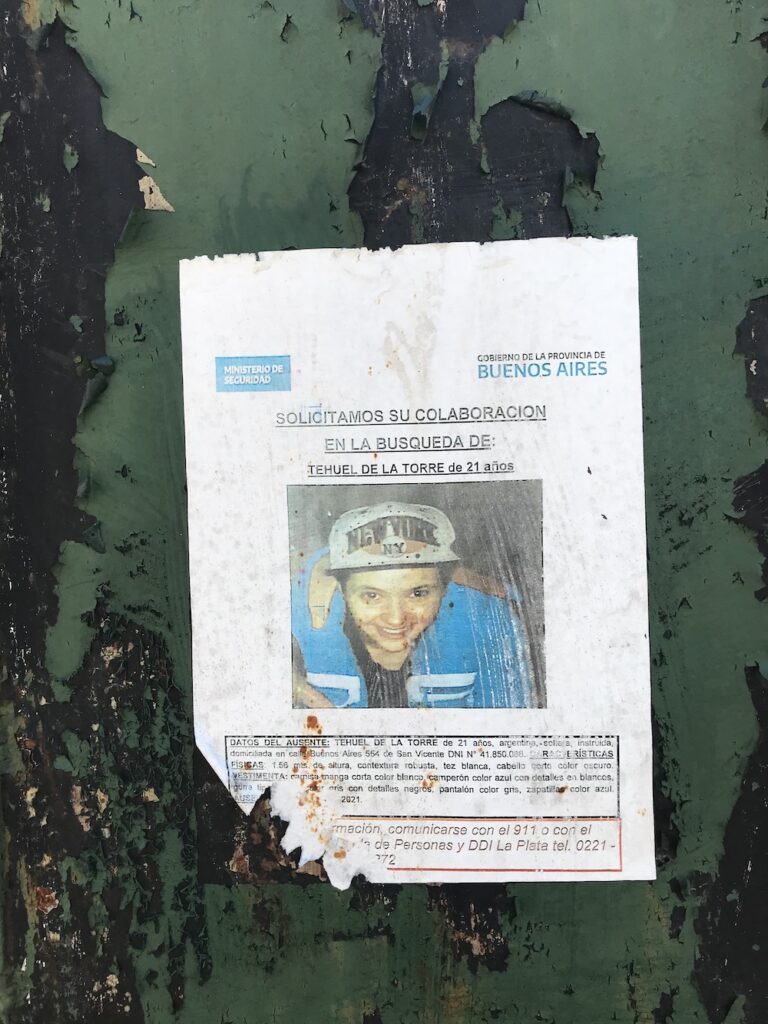
In addition to Norma Nahuelcura, Tehuel's mother, the work includes the voices of the lawyer for the case Flavia Centurión, the forensic anthropologist and member of the Collective for Intervention against Violence Celeste Perosino, and the former Undersecretary of Diversity Policies of the –now dissolved– Ministry of Women, Gender and Diversity, Agustina Ponce.
“Tehuel disappeared while looking for work. Luis Alberto Ramos had promised him a job as a waiter, and so he went, at 21 years old, heading to Alejandro Korn, and he never returned. This situation highlights the reality faced by many young people in the greater Buenos Aires area when trying to find formal employment, and even more so for transvestite and transgender people. Tehuel embodied all the factors of exclusion and inequality,” the filmmakers add.

The work highlights the importance of the Lohana Berkins Diana Sacayán Transgender Employment Quota Law. This law establishes a quota of 1% of positions and posts in the National State for the transgender community, a law that is not only not being enforced, but is now clearly being undermined by the dismissals carried out by the national government.
In two episodes averaging 15 minutes each, the podcast aims to contribute to the existing body of work on people who have disappeared in democratic times. It serves not only as a document but also as a tool for rethinking current public policies on human rights. Some of the interviews and the voiceover were recorded at the La Homero Manzi Cultural Center, and the final editing process took place at the CEPIA (Center for Research and Documentation) of the Faculty of Social Sciences at the University of Buenos Aires.
You can listen to it on Tiempo's Spotify channel by clicking here .
This article was co-produced between Tiempo Argentino and Agencia Presentes and is published in both media outlets as part of an alliance.
We are present
We are committed to journalism that delves into the territories and conducts thorough investigations, combined with new technologies and narrative formats. We want the protagonists, their stories, and their struggles to be present.
SUPPORT US

FOLLOW US
Related notes



We are present
This and other stories are not usually on the media agenda. Together we can bring them to light.