

Against mafias and exclusion, thousands of women marched on March 8th in Paraguay
"Climate justice for all," "Church and State, separate matters," "In defense of our rights, memory and dignity" were some of the slogans of the 8M march in Paraguay.


Share

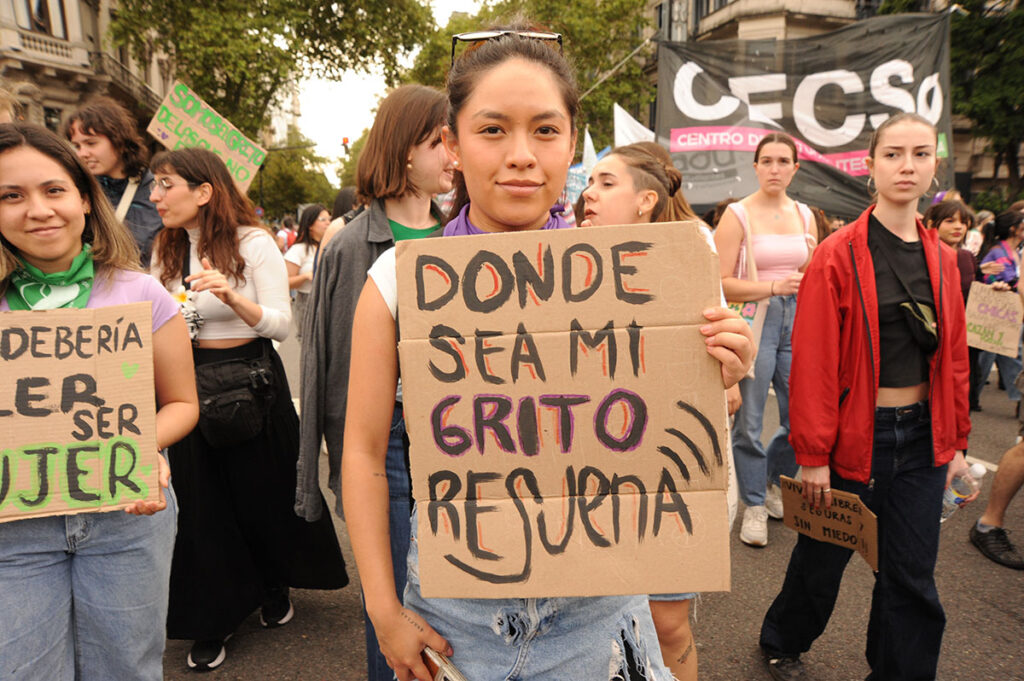
This year, the #8MPy (International Women's Day) in Paraguay focused on the precarious working conditions of women. The slogan "Working women united and organized, defend our rights!" brought together thousands of women and gender-diverse people who gathered under the trees in Plaza Uruguaya. From rural areas to cities, they demonstrated against the mafia and organized crime that have seized power in the state in recent years. The march in Asunción once again highlighted the multiple forms of violence and exclusion that women face in the country.

The gathering began with a fair featuring various self-organized groups and artists, and they marched to Plaza de la Democracia at 7:00 PM. The Paraguayan Feminist Network denounced precarious working conditions, the climate crisis, and impunity in cases of harassment and gender-based violence. Emancipa Paraguay organized the Sapukai stop, a hydration station with music by Flashtima and a participatory mural by artist Carmela Caballero that displayed slogans such as “Climate Justice for All,” “Church and State, Separate Matters,” and “In Defense of Our Rights, Memory, and Dignity.”


Media and political violence
One of the central themes was support for the journalists and media workers who accused journalist Carlos Granada of sexual harassment at Albavisión. They demanded justice in the trial that begins in April and called for workplaces free of violence. “ Regarding my case, the labor case, which is unfortunately being delayed by legal maneuvers and other judicial tactics, but we are also supporting many other cases every March 8th . The most important thing is to keep fighting,” said journalist and media worker Angie Prieto about the oral trial against Granada.


Political violence against women was also identified as a strategy to exclude them from positions of power. The use of aggression, threats, and smear campaigns to silence their voices, both within political parties and in public debate, was denounced. Former Senator Kattya González, removed from office amidst political violence, spoke with Presentes and referred to a regressive political context that is also hateful and misogynistic. “We must not take for granted any of the gains we have made during this period of democratic transition. They are showing us that they can take away what little we have achieved, and that is why I am here today,” she stated.


The march concluded with the reading of the Feminist Articulation's manifesto, which denounced the repressive rhetoric and policies promoted by anti-rights sectors and championed by leaders like Trump and Milei. These policies, they argued, have strengthened a conservative movement in Latin America and threaten progress in women's rights. The climate crisis emerged as a key demand of the Articulation, highlighting deforestation and water scarcity, which disproportionately affect rural and Indigenous women.

Trans women expressed that they continue to face constant attacks, without access to public policies that guarantee their rights, such as access to a state-recognized identity. “We trans women marched demanding an equal and humane right for all. It is a right that the state has denied us our entire lives,” says Yahaira López, from the Association for Human Rights Education and a member of the National Trans Roundtable.

Finally, they demanded that education and dignified employment be promoted and guaranteed for women, sexual minorities, and young people in public and private institutions, as well as in individual activities, and that these opportunities be supported by unions and social organizations. Abuela DJ, Jazzy K, Gea Pataki, and Rossin took the stage at the end of the night and got the women who had taken to the streets to mobilize dancing.
We are present
We are committed to journalism that delves into the territories and conducts thorough investigations, combined with new technologies and narrative formats. We want the protagonists, their stories, and their struggles to be present.
SUPPORT US

FOLLOW US
Related notes



We are present
This and other stories are not usually on the media agenda. Together we can bring them to light.