

Javi Marra premiered the play Trunco: "There are people who are still alive but inside they are empty"
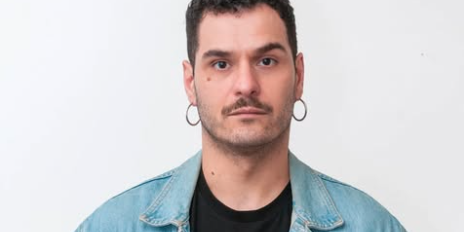
“Trunco”, written and acted by Javi Marra, premiered in Buenos Aires. It tells the story of a love between two children from a small town in the 90s.


Share

Javi Marra is an Argentinian actor with a background in various variety shows, circus acts, and theater. In 2023, he appeared as the poet and performer Fernando Noy in the series about the life of Fito Páez: El amor después del amor (Love After Love) . We interviewed him about Trunco , a one-man show he wrote and performs, directed by the experienced Lisandro Penelas, in which he tells the first-person love story between two small-town children in the 1990s.
– Is this the first time you've written something?
– This is the first time I've written something so long. It turned out I had some loose images that I kind of pieced together. I wanted support in the writing process, so I sent what I had to Lisi [Lisandro Penelas, the director]. There were things that appeared like glimpses of what it ended up becoming, but at the beginning, it was nothing like that.
– Didn't you have the story clear from the beginning?
– No, not at all. I had images of my grandmother sitting on the sidewalk, waving to her grandson. My grandparents were from a town called Vedia. I used to go there a lot when I was little. I wanted to bring up the contrast between town and city. And then the text kind of came together naturally. At first, I remember it started with, “I have a lot of things in my pockets.” And we sort of dissected what that person had in their pockets until there was nothing left but bread. It was a huge commitment to the text, because we met every week for a year and a half. Lisi would tell me yes or no, or she'd send me to do research. And it was good.
– How does the anecdote come about? Because when you see the work, it seems like it could be a biodrama.
– Totally, but no. It emerged very gradually. The first thing that appeared were the grandmothers. The idea of condensing my two grandmothers into one and creating a kind of magical universe around that was the first thing that emerged most clearly: the universe of knives. My grandmother actually taught me how to sharpen kitchen knives when we were little, and she taught me to throw them at a plum tree we had in the backyard. And the same with the character of Nahuel, who is like all my boyfriends and all my real and imagined loves condensed into a single character. And the feeling of incomplete, unfinished love.
– One looks at the work and the ending seems to be defined from the beginning, even from the title. Was that something that appeared from the outset when the narrative emerged?
– Yes. The first image appeared very quickly, and the challenge I faced writing it from Lisandro's perspective was: “You're telling me the premise, and that's the conflict, and that's it. How do I make this interesting?” That's why it started filling up with little anecdotes that build that universe. I am that journey, that path. We started asking ourselves questions. We didn't have the answers either. Lisandro would ask me, “Why is this happening?” And I would just think… And the text itself asks for only what it wants. It's not like three aliens suddenly appear. I think the anecdote itself is very small if you isolate it. Like my mom's voice messages: if you take away all the noise and get to the important part, it's: “Come here at four for a snack.” The anecdote itself is very small, but no less intense or interesting for that. And then it was a matter of how to fill it out.
– Did you always know it was going to be a one-person show?
– Yes. I always knew it was going to be a one-person show. I honestly had no idea what the result would be. Because also…because the text itself is very literary.
Yes, it stands on its own as literature.
– I gave it to a group of people I love and whose vision I trust a lot, and they told me that the text is very literary and said, “What a challenge to make it theatrical.” And for me, that challenge has been met, also thanks to Lisandro’s perspective.
– So they worked on the text first, and then the rehearsals…
– When we were writing, I had a bit of an anxiety attack, mainly about what to do next. I asked Lisandro if he wanted to direct it, and he said, “We’ll see later.” And when the text was finished, it was pretty obvious he was going to direct it. I asked him again, and he said, “Let’s do it.” I think he fell a little in love with the text during the process. And I got to know myself, because at first, I didn’t really know myself. It’s strange to put it this way, but there’s a kind of prejudice about what I can bring to the table as an actor if you don’t know me very well, or if you’ve only ever seen me in the image of Javi Varieté or Javi in heels presenting things… This is like a different job.
– What was the rehearsal process like?
– Everything felt very natural. We formed a really lovely group. While we discussed everything, I trusted his perspective, his vision. I also feel it's a very sensitive story, and that almost the entire team, or the vast majority, are women, and that Lisandro's perspective as a cisgender heterosexual man telling this story interested me. He has a very beautiful sensitivity, and the text has it too, so that combination appealed to me. It's a love story, after all, so…that he would see it and guide it seemed interesting to me.
I saw a series of his works and I liked what I saw. I found it very sweet that he directs his wife and she directs him. I thought, "If he can direct his partner and not kill himself in the process... I'm interested." And I wrote to him without knowing him, almost as if I were asking him out directly. If he wanted to go out with me. (laughs). It could have been a surprise for both of us, and along the way we could say, "This is it." But no.
– What was it like tackling the topic of sexuality in childhood and pre-adolescence? Were they treated like any other subject, or did they require special attention?
– For me, it was easier to write some things, and for Lisandro, who has children, the logic behind naming sexuality in childhood and adolescence was different. There are things that I, as a gay man, experienced more naturally. For me, it's part of my anecdotes from adolescence and pre-adolescence, obviously denied. It was more natural. A friend who saw it said it was a gay porn tragedy… But above all, she really liked the idea of talking about sexuality in two children without it seeming strange. And that it came across as very moving.
– And very innocent.
– Exactly. It wasn't an intentional search to talk about that. In that journey of anecdotes between two people, at some point those two people had sex. How was it? When was it? In what way? It's not overly descriptive either…it's more poetic how it's constructed. I see that these two characters fall in love, but they justify it based on the mistake and the circumstances. Nothing is planned. It just happens.
– Fiction protects you, but you also lend it things…
– It's the first time I've performed alone, just you and your little body with your story. And the truth is, we did two preview performances for friends and family, and it was very emotional for me. At the preview, my dad and my mom were sitting in the audience, and even though they always come to see everything I do, it was very powerful. There were lines I was saying with my dad sitting in front of me, it was very intense, the part with the grandmother waving on the sidewalk, because she's his mother. That's when my dad started crying uncontrollably. In fact, they're coming back now, and he told me, "I want to see it without crying." I feel like there was a loving gaze from the audience, supporting what was happening. I'd also like to know what happens with people I don't know at all. On the first day, a very old gentleman sitting in the front row caught everyone's attention. Nobody knew him; he was very serious throughout the first part, and then he broke down in tears, it was awful. Afterward, I kept wondering who that person was, why they came, who told them to come, what had affected them so deeply to leave them so distressed. A friend's boyfriend, a straight guy, messaged me a few days after they broke up: “Thanks for helping me understand a lot of things. I was probably the one who was bothering and beating up the guy on that side. Thanks and sorry.” It's not my intention to go around lecturing people. But it seems something really touched him.
– I was going to ask you if you were expecting or anticipating a reflection….
– It often happens that when I finish a play, people offer me condolences. “Oh, all this happened to you.” And no. I also think that there are people who are still alive, but inside they're empty. And not just in a sexual sense; there are people who want to be lawyers and never could. A friend told me that what weighed most heavily on her was how many lives are cut short, out there on the street, right next to you, and you don't even notice and just go on with your day. There's something about that truncated, incomplete life that I was interested in exploring.
– Have you ever felt burdened by homophobia in the theater world?
– Not in independent theater. I feel it's a theater that takes risks, that has incredible, brilliant people with interesting things to say, and that evolves in relation to the times it's in. Commercial theater, for me, is something else entirely. There's a lot of clichéd confusion these days, and it makes you angry that it keeps being perpetuated, but I don't feel that in independent theater. There's playfulness, there's risk, there are tons of gay men, lesbians, trans people doing what they want to do and telling their stories, which I think is wonderful. Before, it was confined to a underground scene , and now that's migrated to other places that I find much more interesting. There are people telling amazing stories that need to be heard.
TRUNCO. ONE OF FLOWERS AND KNIVES can be seen at 8:30 p.m. on Fridays, February 21 and 28, and Sundays at 12 p.m. from March 16 onwards at Moscow Theatre .
Technical and artistic specifications
Playwright: Javier Marra
Performers: Javier Marra
Set Design: Julieta Capece
Sound Design: Dino Pérez
Lighting Design: Soledad Ianni
Photography: Ezequiel Demaestri
Graphic Design: Veronica Viejo
Assistant Director: Jennifer Permuy
Press: Carolina Alfonso
Production: Dos Lunas Productora, Lucía Marquez
Co-production: Moscú Teatro
Direction: Lisandro Penelas
We are present
We are committed to journalism that delves into the territories and conducts thorough investigations, combined with new technologies and narrative formats. We want the protagonists, their stories, and their struggles to be present.
SUPPORT US

FOLLOW US
Related notes
We are present
This and other stories are not usually on the media agenda. Together we can bring them to light.