

They denounce that the trial of the Mapuche community Winkul Mapu is no longer public and demand the defense of the rewe (sacred site)
The trial—theoretically oral and public—began on February 25th in the courts of General Roca/Fiske Menuco and is proceeding behind closed doors. The head of National Parks—the plaintiff in the case—filed a legal motion to remove the sacred ceremonial space, the rewe.


Share

Members of the Lof Lafken Winkul Mapu Mapuche community and their lawyers, facing a second trial for allegedly trespassing on land in the Villa Mascardi area of Nahuel Huapi National Park (Río Negro province), are denouncing irregularities in the proceedings. The trial—theoretically oral and public—began on February 25th in the courts of General Roca, but since the second hearing on the 26th, it has been conducted behind closed doors. Furthermore, in what appears to be a provocative act, the president of the National Parks Administration, Cristian Larsen—a plaintiff in the case—filed a legal motion to remove the sacred ceremonial space—the rewe—so that it would fall under his jurisdiction. However, the rewe is protected by a court order, even though it is located within the territory from which the community members were evicted.
The new trial has already had three hearings and appears to be a replay of the one the community faced in September 2024, also accused of usurping the same territory they claim. In that instance, several of the defendants were already convicted, and one of them, the machi Betiana Colhuán Nahuel, was acquitted because she was a minor at the time of the events. But today they are back in the dock with the same charges, combined with other cases.

According to the prosecution, after the failed eviction attempt of Winkul Mapu in Villa Mascardi in November 2017—during which the Coast Guard shot and killed the young man Rafael Nahuel—"they reoccupied the property." In this trial, the list of defendants included Celeste Ardaiz Guenumil (who also spent eight months in prison after another violent raid in 2022) and Matías Santana , a witness in the Santiago Maldonado case . Additional charges were also filed for the illegal occupation of several properties claimed by both National Parks and private landowners.
A trial without an audience or media present
While the previous trial took place at the Gendarmerie barracks in Bariloche with an operation involving more than 200 officers, this one is being held entirely virtually. In the courtroom in General Roca are Federal Judge Alejandro Silva, Federal Prosecutor Rafael Vehils Ruiz, and the plaintiff's attorney, Natalia Cardoso (representing National Parks), facing a pile of empty chairs.
The other plaintiffs, the defendants, and the lawyers from the Bar Association are all on the Zoom screen. The public and the press were only allowed to participate during the first two hours of preliminary proceedings. When the witness testimonies began, the court stopped broadcasting. With no one in the courtroom and no virtual transmission, it ceased to be a public trial. The media is also unable to cover it live.
They denounce that they allow the reading of witness statements

Laura Taffetani, from the Lof Winkul Mapu defense team, led by La Gremial de Abogadxs, has no doubts: “ It’s clear the verdict will be guilty. The trial process is moving at this pace. It inexplicably stopped being public, because the various YouTube broadcasts were already scheduled, and suddenly they ceased . The previous trial was fully broadcast, with witnesses and everything. Here, they don’t want to show how things are being handled .”
The lawyer points out other irregularities: “The second: allowing witnesses to read their testimony. It’s unheard of. The code is very clear that this is not allowed,” she explains. When the defense objected on this point, the judge replied that he would always allow the reading. When they persisted with their objections, the judge threatened to mute the defense lawyers’ microphones. Taffetani adds that in today’s hearing, the third: “something serious happened: adding a witness who wasn’t a new situation, a witness who was already in the case. They had never offered him before, and now they’re adding him; it’s not right.” But with no press or public present in the courtroom, none of this could be seen.
“Article 363 of the Procedural Code establishes that the trial is oral and public under penalty of nullity,” explained the Lawyers' Association in a statement. “Now, the public and the press are being prevented from seeing and hearing the outrageous statements made by witnesses of racists, supremacists, and the State.”
While the trial is taking place behind closed doors, the director of the National Parks Agency, Cristian Larsen, filed a document with the Bariloche Court requesting the removal of the rewe , a ceremonial site, from the territory, and that National Parks be able to dispose of the space.
What is the rewe?
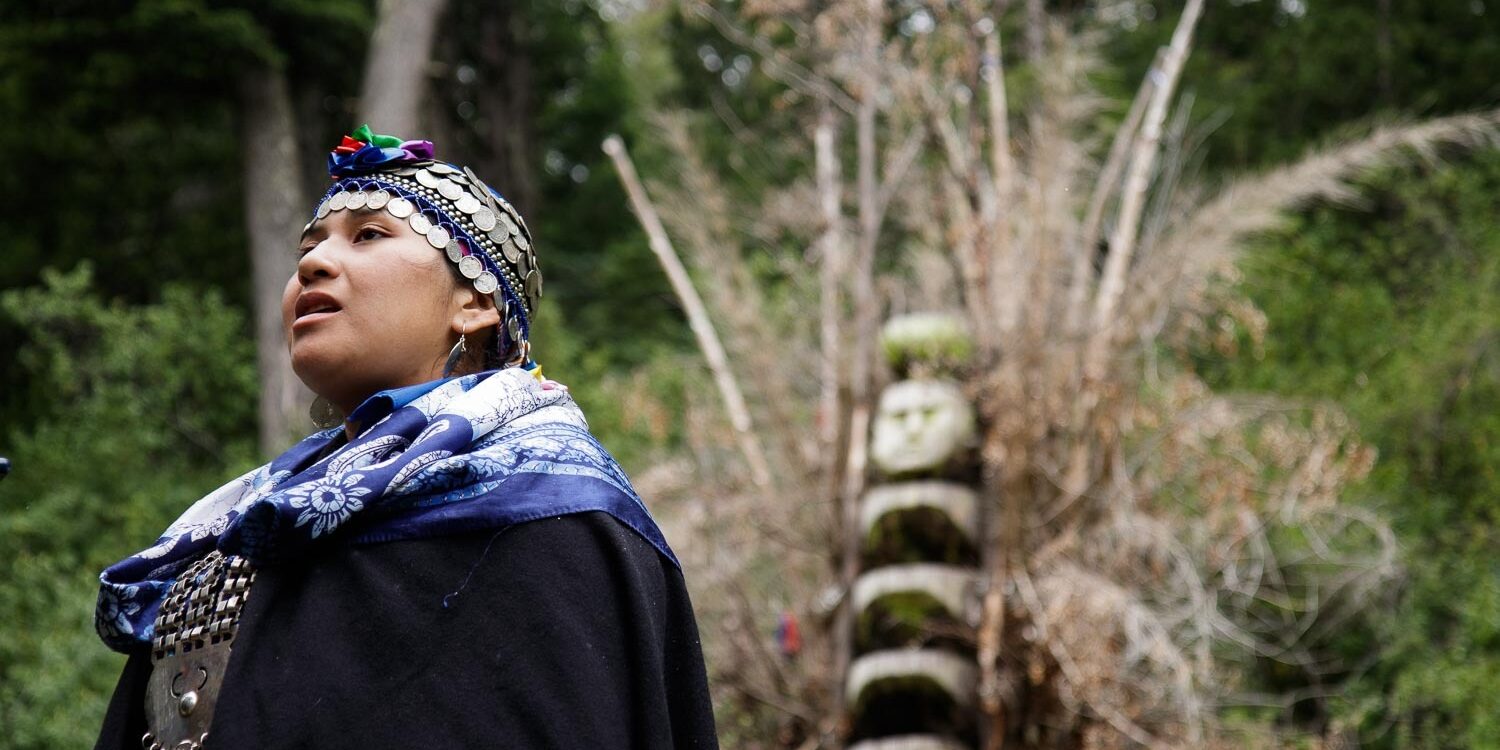
The Lafken Winkul Mapu community reclaimed the territory in 2017 with the explicit purpose of establishing a machi (spiritual leader) there, the first on this side of the Andes in many years. Since then, the rewe, or ceremonial space, of machi Betiana Colhuán Nahuel is the only one with that significance in Argentina.
There is considerable confusion surrounding the term "rewe" itself. It refers to the sacred site, but the term is often used to describe the spiritual elements located there, primarily the che mamull , a carved tree trunk several meters tall. However, officials generally use "rewe" to refer to the che mamull .
Following the violent eviction of October 4, 2022 , during which Mapuche women and their children were arrested, Federal Judge Silvina Domínguez ordered the "restitution of the properties" to the National Parks Administration and several private landowners. However, she entrusted the National Parks Administration with the protection of the rewe (sacred site) because it is a sacred site for Mapuche spirituality, and with the preservation of "the anthropomorphic carving (referring to the che mamull ) and the surrounding area" because it is an object of Mapuche worship.

Larsen, in the context of the previous trial, stated, “For us, it is a totem,” using a term from the Ojibwe language, spoken by an Indigenous people of North America. “Removing the totem means that these communities will go and perform their sacred rites there.” For the Parks Service, the possibility of spiritual ceremonies implies “being subject to confrontation,” as if respect for pluralism and freedom of religion were not a right.
“Judge Dominguez ordered the Parks Department to preserve the rewe, something they never did and now want to overturn,” explained La Gremial.
“In the Rewe we become one with everything else again”
For almost two and a half years, the communities have claimed that “protecting” a sacred Mapuche site should be the responsibility of the Mapuche people and not the State.
The Lafken Winkul Mapu community issued a statement and a call for support in defending this crucial space for their health. “We urgently raise our voices once again in the face of the seriousness of the attack that National Parks is attempting to inflict upon us by requesting the removal of our Rewe from the Relmulafken territory, where our Machi maintains our Mapuche Lawen.”.
What is the meaning of the rewe? “Our entire being, our existence, and our becoming are connected to it. It unites us and commits us. It is in the rewe where we become one with everything else again. Our rewes return to us our spirituality, our language, our memory, and our kimün (knowledge). They bring us alliances, solidarity, and trafkintun (exchange). All of this emerges when we are gathered around our rewe,” the community explains. Their rights are protected by the National Constitution, the American Convention on Human Rights, Article XII of the Inter-American Commission on Human Rights, and an OAS declaration (to which Argentina adhered) that states: “Indigenous peoples have the right to their own health systems and practices, as well as to the use and protection of plants, animals, minerals of vital interest, and other natural resources for medicinal use in their ancestral lands and territories.” They are calling for the urgent defense of this sacred space.

At yesterday's hearing, the judge did not allow the defendants to display a sign in front of the Zoom camera demanding "Return our rewe ." "The judge's audacity is astounding. He allows the statements to be read aloud and, in many cases, has helped to fix testimony riddled with contradictions. Despite this, he reprimands and threatens our lawyers when, in demanding our rightful return, we display a sign in front of the camera that reads 'Return our rewe !'" said Matías Santana, one of the defendants currently under house arrest in this case. "We know the sentence is a foregone conclusion; we have no doubt. Even so, we are all facing this purely political trial with dignity, in defense of our rewe and our territorial political rights," he added.
The Mapuche community of Lof Winkul Mapu demands the recognition of the rights enshrined in the National Constitution, ILO Convention 169, the American Convention on Human Rights, and Article XII of the Inter-American Commission on Human Rights. We also demand compliance with Declaration AG/RES. 2888 (XLVI-O/16), which in its Article XVIII establishes:
“ Indigenous peoples have the right to their own health systems and practices, as well as to the use and protection of plants, animals, minerals of vital interest and other natural resources for medicinal use in their ancestral lands and territories ,” says the American Declaration on the Rights of Indigenous Peoples.
The agreement that did not materialize
The recognition of the ceremonial space was also formalized in June 2013 through an agreement with the State. After a series of dialogue sessions involving various institutions and the National Secretariat for Human Rights, an agreement was signed that not only recognized the ceremonial space but also guaranteed the evicted community access to the sacred site for their spiritual practices . Furthermore, in the same agreement, the State committed to building three houses: one for the machi (spiritual leader) and her family, one for her assistants, and one for her patients and medicine storage. The rest of the community was to be relocated near Lake Guillelmo, to a site to be determined in the coming days. None of this came to pass.
The arrival of Javier Milei to power , a president who glorifies the genocidal Julio A. Roca, worsened the situation for Indigenous peoples in general and for the Mapuche in particular. Security Minister Patricia Bullrich is the same official who, during Mauricio Macri's administration, violently repressed the Cushamen community, where Santiago Maldonado disappeared and was killed, and days later, the Winkul Mapu community, where Rafael Nahuel was murdered, shot in the back.
The campaign of stigmatization and persecution against Indigenous peoples extends far beyond Winkul Mapu. In Chubut, two weeks ago, a series of 12 simultaneous raids, disregarding protocols, stormed communities and a community radio station . As a result, Victoria Núñez was arrested in Lof Pillan Mahuiza, and her release continues to be demanded. The Chubut government, led by Ignacio Torres, held a press conference around that time in which it accused Mapuche women of being terrorists.
In Argentina, the law and the Constitution guarantee the rights of Indigenous communities to land, education, health, and participation. However, at a UN assembly in November 2024, the country was the only one to vote against a resolution to protect the rights of Indigenous peoples.
We are present
We are committed to journalism that delves into the territories and conducts thorough investigations, combined with new technologies and narrative formats. We want the protagonists, their stories, and their struggles to be present.
SUPPORT US

FOLLOW US
Related notes


We are present
This and other stories are not usually on the media agenda. Together we can bring them to light.