

Second trial against Lof Winkul Mapu: keys to understanding another case of persecution of the Mapuche people
Keys to understanding a trial that for the second time brings to the dock five Mapuche women from Lof Winkul Mapu (Río Negro) who were deprived of their freedom, already a crucial witness in the Santiago Maldonado case.


Share

On February 25, a second trial for land usurpation began against six members of the Lafken Winkul Mapu Mapuche community . Five of the defendants are women, and the other is Matías Santana, the only person under house arrest in this case and a crucial witness in the Santiago Maldonado case . Winkul Mapu is a community in the Villa Mascardi area, 28 kilometers from Bariloche (Río Negro province). It has suffered violence, repression, and judicial persecution since beginning the process of recovering and defending its territory in 2017. That year, it suffered its first repressive operation, publicized by the Ministry of Security, then headed by Patricia Bullrich. In 2022, another operation took place in which the women now on trial spent eight months in jail before being released by the courts after signing an agreement with the State in 2024, an agreement that the current government has disregarded.
This trial will take place in a highly hostile political and judicial context, where the national government, with the support of some provincial governments, the judiciary, and the National Parks Administration, is determined to blame the Mapuche people for the fires. In public statements, various officials, as well as media outlets, label them as terrorists, criminals, arsonists, and usurpers. They omit crucial parts of the story, including the two violent raids suffered by the community and a series of humiliations and mistreatment inflicted upon the women on trial and their children.
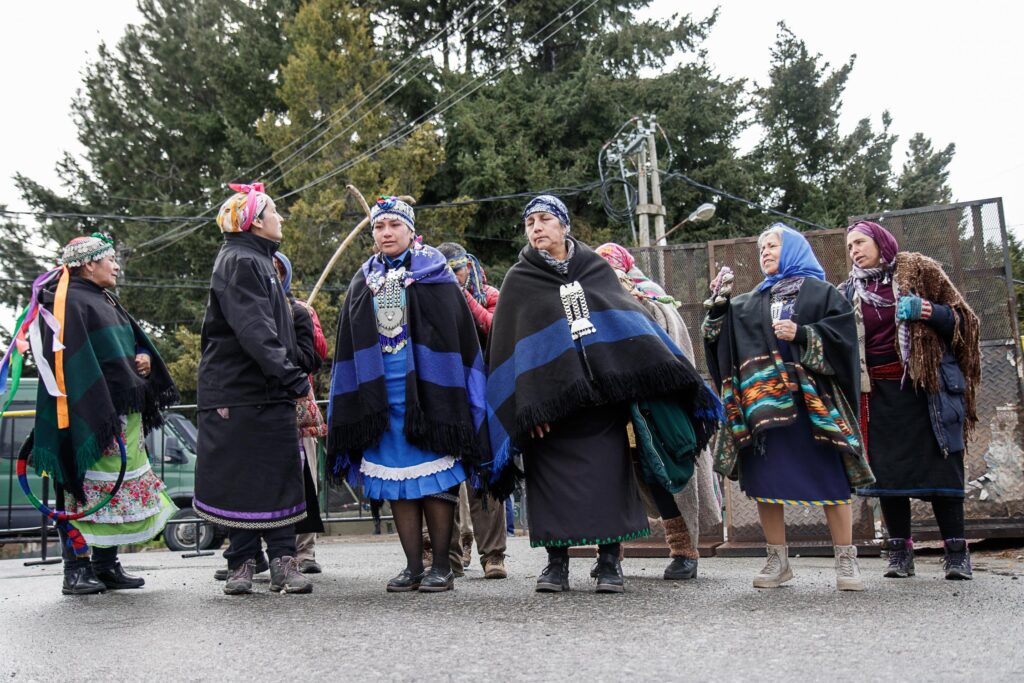
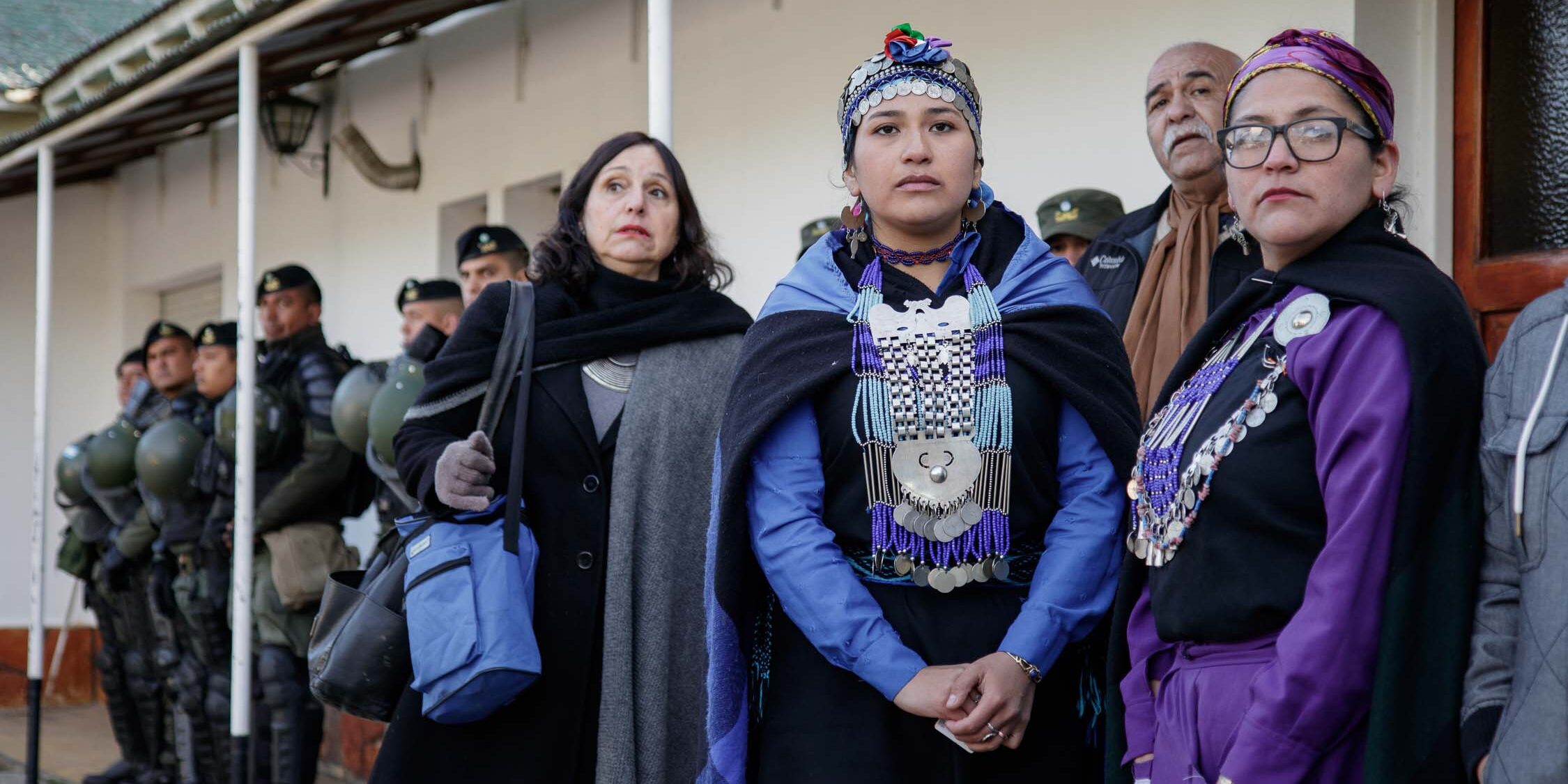
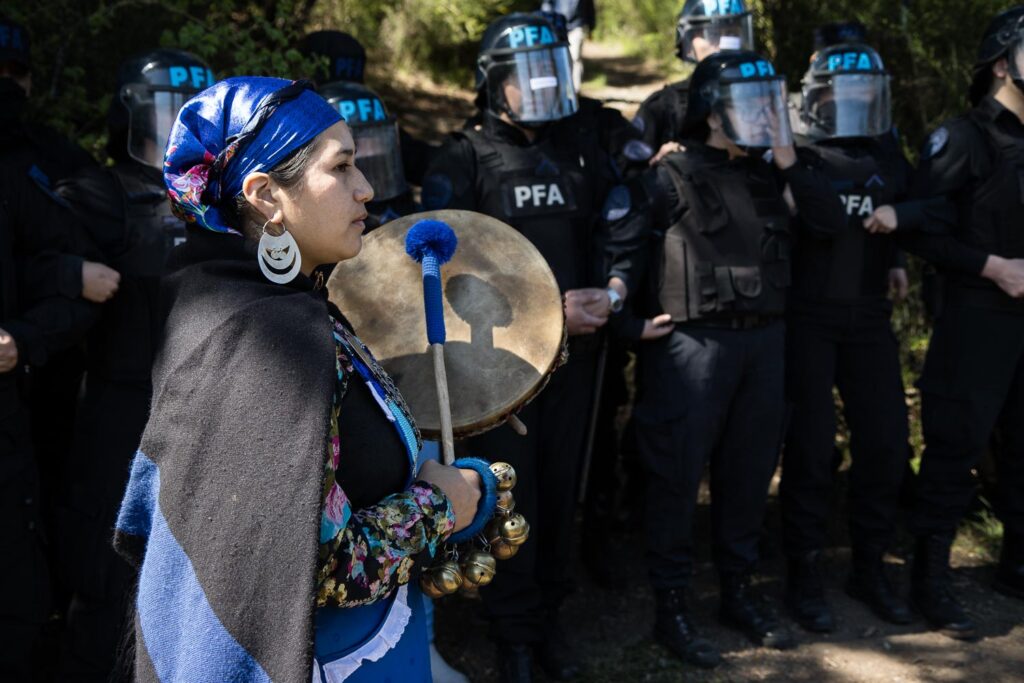
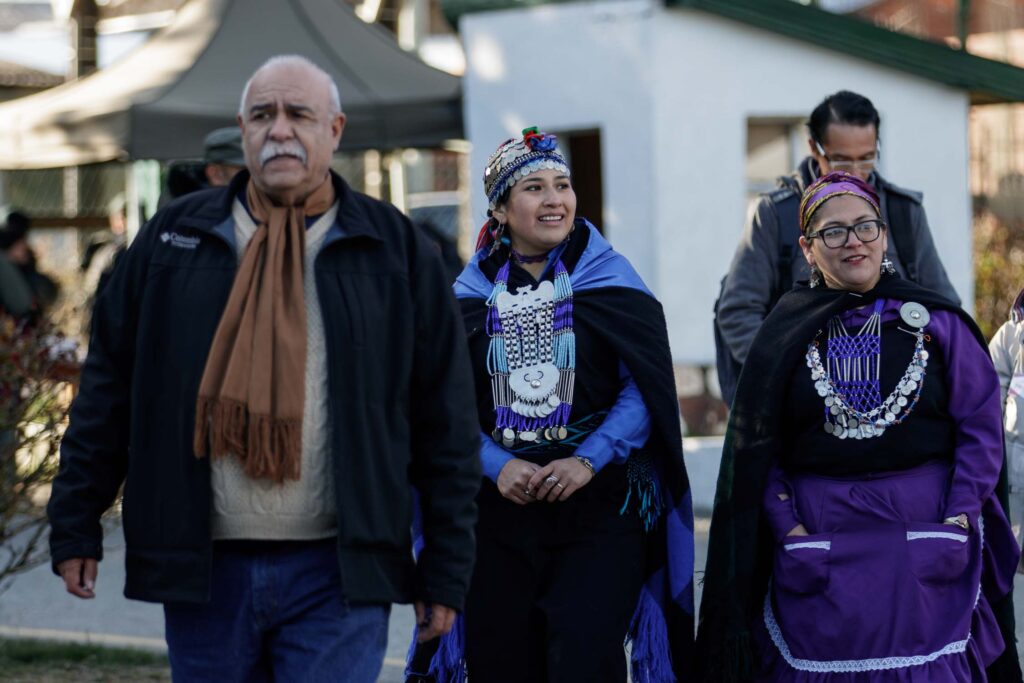
In this trial, held in the General Roca/Fiske Menuco courthouse (in Mapuzungun), Machi Betiana Colhuan, along with lamien Romina Rosas, Luciana Jaramillo, Yéssica Bonnefoi, Celeste Ardaiz Guenumil, and Matías Santana, are accused of land usurpation and a series of events between 2017 and 2023, which were consolidated by Federal Judge Silvia Domínguez. The accused, with the exception of Ardaiz and Santana, were already tried and convicted a few months ago, in September 2024, for land usurpation. Machi Betiana was acquitted on the first day of the trial because she was 17 years old in 2017, at the time of the events. The photos accompanying this article are from that trial, where they declared: " We cannot be usurpers of our own territory ."
Although the trial is based in Roca/Fiske Menuco, only the judicial staff will be physically present there and the other parties -plaintiff, witnesses, defendants- will follow it by videoconference.
“ In neither case is there any evidence against the community ,” Matías Santana stated from his house arrest in Bariloche, where he has been since October, after spending eight months in prison in Esquel. He was identified in Bariloche in February 2024, when he was taking his wife, the Mapuche spiritual leader Betiana, to a local fair with their children. He was arrested in an operation heavily publicized by the Ministry of Security. His departure to attend the trial from an ATE (Association of State Workers) headquarters in Bariloche is his first.
“We didn’t cut any fences, there weren’t any. There is plenty of evidence to prove that there is no usurpation. We need to make the judge understand that we didn’t usurp anything. It’s about returning to a territory where the forces we need exist,” explains the Lof Winkul Mapu community.
The community's defense is being handled by a team of professionals from the Lawyers' Association, who also represented them in the previous trial.
Keys to understanding the case
-The first operation in Lof Lafken Winkul Mapu was in 2017. On November 25 of that year, two days after an unusually violent deployment to evict the community, the young Rafael Nahuel was murdered from behind by personnel from the Prefecture and the elite Albatros group.
During those days, Santiago Maldonado was being mourned, following his disappearance and death—which remains unsolved—during a repressive operation against the Mapuche people by the Gendarmerie in Lof Cushamen . Six years later, in November 2023, the Rafa 's death were convicted in a trial in General Roca—Fiske Menuco in Mapuzungun—but received only lenient sentences.
In 2017, the first case for usurpation was opened . It's called "the mother case" (26511), and it's the one that went to trial last year. Among those in the dock were his mother, Maria Nahuel, and his sister, Johana. Johana was with Rafael Nahuel and was shot the day he was murdered . The trial took place in 2024 at a Gendarmerie barracks in Bariloche, with heavy security during those days.
–In October 2022, another violent operation was carried out by a Unified Command of Federal Forces during the administration of Alberto Fernández, resulting in the arrest of only women and their children. Their arrests disregarded basic human rights protocols. The detainees later recounted being shackled, mistreated, and four of them transferred to a prison in Buenos Aires, 2,000 km from where they had been detained. Due to public pressure, they were returned to Bariloche. One of them was pregnant, about to give birth, and denounced obstetric violence, being forced to give birth without respect for her worldview. On the eve of the Plurinational Meeting of LTTNB Women, these arrests prompted the resignation of the then Minister of Gender and Diversity, Elizabeth Gómez Alcorta.
The women were eventually granted house arrest, but Betiana Colhuan, Luciana Jaramillo, Romina Rosas, and Celeste Ardaiz Guenumil spent eight months in jail, accused of trespassing, even though it is a bailable offense . The courts only released them after a dialogue reached an agreement with the national government to find a solution to the conflict.
The Plurinational Gathering of LTTNB Women in 2023 was held in Bariloche, in solidarity with the cause of the Mapuche women who had been detained. Betiana Colhuan was one of the speakers at the opening. At the end of the Gathering, a visit was made to the property from which the community had been evicted.
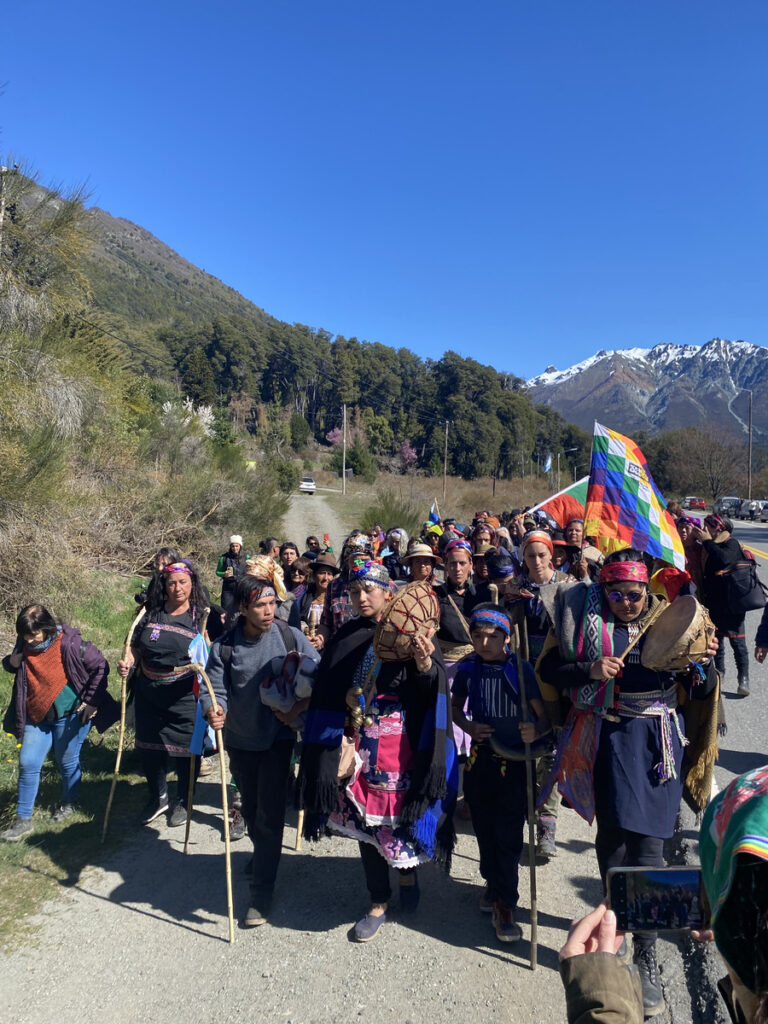
-The machi's rewe is there, but since it is guarded by security forces, it is unlikely that the machi will be able to access it to perform ceremonies.
-The lawyers of the Union call the investigation that was opened from this operation of the Unified Command of Federal Forces the "Fake Case" (16149) "because it was an invention of the government, the court and the federal prosecutor's office from the fire of a Gendarmerie trailer (for which later all the people detained were free of merit); and it was used as an excuse for the eviction and the subsequent barbarities," they explained.
The trial
The trial that starts on the 25th unites a series of cases that began in 2017 and extend to 2023.
-The oral debate will take place on February 25, 26 and 27 and will continue in March, on the 11th, 12th and 13th in virtual mode before the Federal Oral Court of General Roca Fiske Menuco.
-The judge in charge of the oral debate is Alejandro Adrián Silva.
-The prosecution is being led by Attorney General Alberto Rafael Vehils Ruiz, who has already intervened in other conflicts. The district attorney will also be involved.
-The National Parks Administration is the plaintiff.
Expectations for the verdict: "It's already written"
“At what point were we consulted or guaranteed the right to defend ourselves?” the defendants ask. “The sentence was already written the day of the eviction.” They doubt “ that due process or the rights we have established as a people will be guaranteed. Rather, it will be a power play to highlight the criminalization against us,” says Matías Santana shortly before the first day of the trial begins. He believes that the process, more than seeking justice, will attempt “to make an example of the rest of our brothers and sisters with a conviction.” He recalls that in the recent raids on Mapuche communities in Chubut, “ they attacked those who have been supporting territorial conflicts and taking a stand. We believe that this process will intensify with these convictions. That is what the political and judicial powers want.”
“The Winkul Community has been one of the most attacked and savagely repressed by all governments without any action of violence on the part of its members being proven.
For the government, the judges, and the prosecutors, the Winkul community is part of Mapuche terrorism . It is obvious that the court will apply what we call Enemy Criminal Law .
Those who go to trial also have short but suspended sentences due to a previous trial for trespassing. If they are convicted again, they may be charged as repeat offenders.
Without the right to identity
The community explained to Presentes that their right to identity is being denied. “In reality, these territories are pristine, to put it in spiritual terms, and it is where, logically, in this process of decolonization, we must carry out our work as Mapuche people, to root ourselves to the land. We are like a tree without roots. We need to be rooted where there is life, medicine, where the rewe, the sacred ceremonial space, is located, which is now being violated. The aim is to demonstrate this before the judge so that he can guarantee ILO Convention 169 (which guarantees the right of indigenous and tribal peoples to determine their own priorities) and implement the 1994 reform once and for all.”
Matías Santana says that “the government isn’t giving us any room for a real solution to these conflicts. They’re distracting society to persecute the Mapuche people. In Chubut, they’ve targeted communities in conflict with hydroelectric projects, as is happening in Corcovado with Santa Elena. They’re practicing state terrorism, instilling terror in society so that tomorrow they can come in with their projects and you’ll have to keep quiet.” He cites the arrest of Victoria Núñez in Lof Pillan Mahuiza as an example.
He also cites the case of the Nahuelpan community, which was raided and criminalized. He adds: “Nahuelpan, a community with a long history of identity formation, known throughout the region for its ceremonies, had never been touched before. They are labeled as fake Mapuche because they don't wear chiripá (traditional Mapuche trousers) and calf-leather boots. But the real issue is the land. What they want to exploit, and what we are defending. The fires were intentional and harmed people who are not Mapuche. We are defending the water sources and the mountains. They are lying. Time will tell the truth.”
The community and the Guild that attends Winkul Mapu invite everyone to follow the debate through the links of the broadcast on Youtube.
We are present
We are committed to journalism that delves into the territories and conducts thorough investigations, combined with new technologies and narrative formats. We want the protagonists, their stories, and their struggles to be present.
SUPPORT US

FOLLOW US
Related notes



We are present
This and other stories are not usually on the media agenda. Together we can bring them to light.