

Persecution of human rights defenders: Mapuche communities deny being part of the RAM
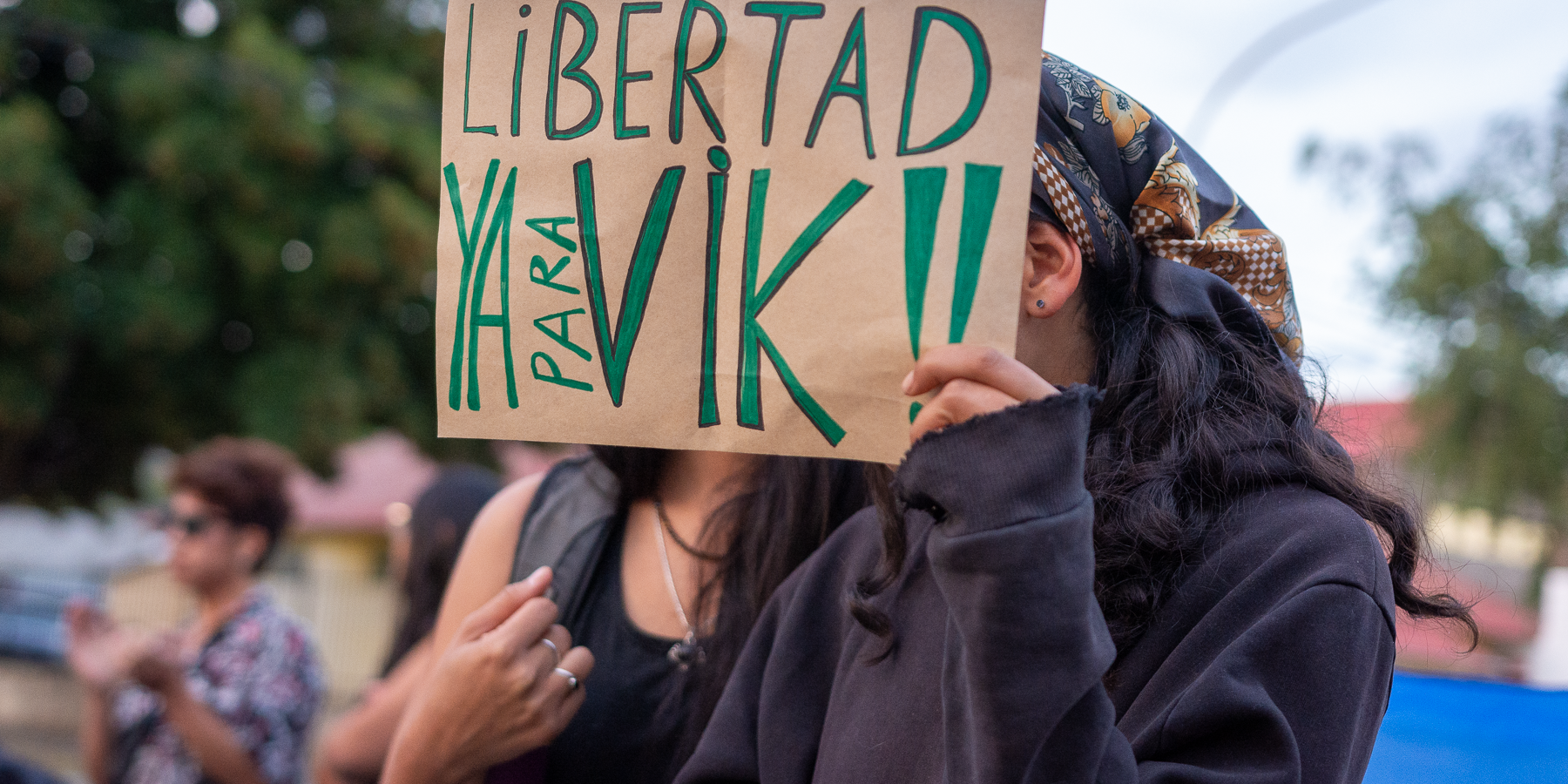
The judicial and media persecution of Mapuche communities in Argentina continues. After evidence was presented, Victoria Núñez Fernández, arrested during a raid on the Pillán Mawiza community, was placed under house arrest.


Share

After Judge Jorge Criado ordered, at the request of the Public Prosecutor's Office of Chubut, the preventive detention of Victoria Núñez Fernández – arrested in the raid on the Pillan Mawiza community – she was granted house arrest.
The public defender, Valeria Ponce, presented technical georeferencing evidence demonstrating that on the night of the fire, Victoria's vehicle was in Corcovado, approximately 80 km from the site of the fire at the Amancay Ranch. Given the compelling evidence and Victoria's detailed testimony about her life in the Pillan Mawiza community and her daily activities, Judge Jorge Criado granted her house arrest for 60 days.
In this context, members of the raided communities denied being part of the Ancestral Mapuche Resistance (RAM), which was recently declared a terrorist organization by the Minister of Security, Patricia Bullrich.
The order was issued on Friday the 14th, less than 48 hours after the official conference given in Esquel by the Governor of Chubut, Ignacio Torres; along with the mayor Matías Taccetta; the Minister of Security and Justice, Héctor Iturrioz; the Attorney General of Chubut, Jorge Miquelarena; the Attorney General of Esquel, María Bottini; and the prosecutor Ismael Cerdá, among others.
Defamation campaign
There, Torres accused leaders and members of the Mapuche-Tehuelche communities of being “criminals, swindlers, frauds” and “responsible for the fires.” The PowerPoint presentation given by the governor and the prosecutors is not very different from the report by the Ancestral Mapuche Resistance (RAM) prepared under Patricia Bullrich's administration in 2017.
For her part, the Minister of National Security also disseminated the accusations on social media. The Network for the Support of Indigenous Peoples (RAPI) expressed its condemnation of the actions taken by the National Government in response to the fires in Patagonia. “We are concerned about the conduct and statements of Minister of Security Patricia Bullrich, who, with unfounded accusations, is fueling the stigmatization of Indigenous peoples seeking to reclaim their territorial rights. Through her biased public statements, she advocates and promotes disproportionate operations against the local population, and especially against the Mapuche-Tehuelche communities.” They pointed to the violent raids in Chubut as evidence of this, “incited by media coverage, hate speech, and the latest resolutions and decrees issued by the national government that undermine the rights recognized and acquired by Indigenous peoples.”
Moira Millan, from the Lof Pillan Mawiza community, was labeled by the governor as “the self-proclaimed leader of the Mapuche-Tehuelche resistance” and linked to threats and responsibility for the fires in the region. In response to these accusations, last Monday Millan, along with her brother Mauro and members of the Nahuelpan Community, appeared at the prosecutor's office and the public defender's office in Esquel. There, she was able to confirm that, at that time, there were no charges or arrest warrants against them. Minutes later, she announced at a press conference that she would be filing a lawsuit against Ignacio Torres for slander, libel, and racist remarks.
Without freedom
Victoria remains in custody. Meanwhile, in Río Negro, Nicolás Heredia, a worker who was on vacation in El Bolsón and joined volunteer firefighting brigades, is being held in pretrial detention for 30 days, accused of starting a fire in the Mallín Ahogado area. “They arrested me and threw a bottle of gasoline at me, which they claimed I was carrying, but I never touched it. My backpack only had food, nothing but food,” he explained to Judge Ricardo Calcagno, who, despite acknowledging contradictions in the statements of the witnesses accusing Heredia, ordered his pretrial detention.
The communities denounce that there is a network beyond the particular causes, and that it aims to dismantle the solidarity between indigenous communities and spontaneous organizations in the face of the advancing fire, the State's negligence and the economic interests on their territories.
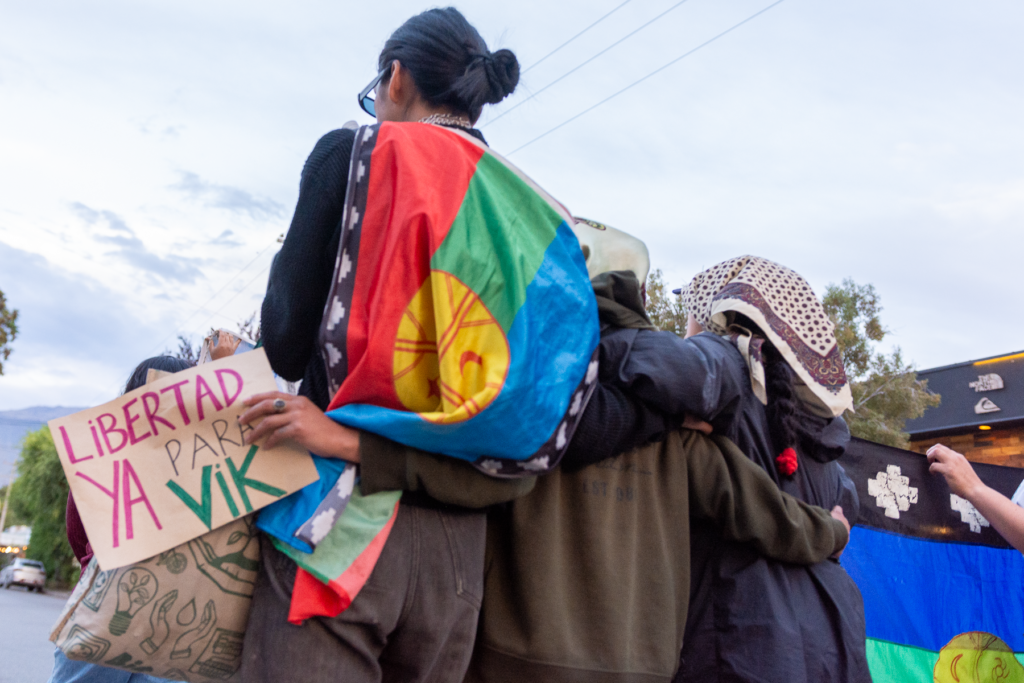
Irene Quilaqueo, a member of the Nahuelpan Mapuche-Tehuelche community, stated at a press conference in front of the Esquel courthouse: “What they are criminalizing here is solidarity. Just as we are here today, all the communities gathered in response to the raids, we will also be meeting together in a trawun (community assembly) to decide what we can do as a people. How we unite, how we work together, how we continue the struggle. You will see us all together, and it is because of the solidarity we have as a people that they are criminalizing us.”
In both provinces, faced with the lack of state response to the fires, the precariousness of workers and the defunding of fire management devices, the modus operandi is repeated: The media creates scenarios -without having evidence- conducive to the hate speech of governors and provincial and national officials; then the judiciary contributes its share to the media show.
The RAM in the register of terrorist organizations
Finally, the Minister of National Security, Patricia Bullrich, incorporated the Ancestral Mapuche Resistance (RAM) into the Public Registry of Persons and Entities Linked to Acts of Terrorism and its Financing (RePET).
The legal and technical report that underpins the resolution highlights that the Ancestral Mapuche Resistance (RAM), associated with the Arauco Malleco Coordinator (CAM), represents a threat to national security. The resolution identifies Mapuche leader Facundo Jones Huala as the organization's leader.
Among other arguments, it is stated that “from 2010 to the present, when the intentional fires claimed by the leaders of the RAM devastated the ancient Patagonian forests, hundreds of events with terrorist characteristics have occurred”.
However, just a few weeks ago, Jones Huala made statements distancing himself from the forest fires: “We have never attacked our environment or the people. They say we are setting fire to the forests where our people live. All lies. We have never done it, nor would we, because it makes no sense to harm ourselves. We would never attack poor people.” Nevertheless, he defended “the arson attacks and sabotage of the infrastructure of the capitalist system.”
The reality of the communities
Although the national and provincial governments insist on blaming them for the forest fires, many of the Mapuche communities, including those that suffered raids last week, suffered the passage of fire through their territories.
In a recent public statement, the Cañio family expressed: “During 2021, our community was affected by the fire that came from Las Golondrinas through the Piltriquitrón mountain range. We spent a month fighting the fire behind us. Today, we find ourselves involved in false accusations that fall apart in light of the evidence and circumstances. We hope that racism does not cloud the judgment of those who have the power to decide and of society in general.”
Furthermore, they clarified that the Lof Cañio community is not affiliated with any organization. “We are completely unfamiliar with what they call RAM and have nothing to do with whoever claims to be their ‘leader.’ We know this is being orchestrated by the government itself to criminalize us, imprison us, and seize our lands.”
In this regard, they recalled that they have inhabited the territory for more than six generations and that throughout the lives of Virginio and Gladys, two elderly members of the community, they had never been "violated and involved in an absurd and unjust persecution."
The Lof Catriman Colihueque community, located near Laguna El Martillo and adjacent to Los Alerces National Park, also suffered from the intense forest fires in February 2008, which ravaged the area, causing irreparable damage.
The fire not only reduced the community's house to ashes, but all the sheep and half of the cattle of the lof died as a result of the flames.
In 2023, fire once again passed close to the community. This time, members of the now-criminalized communities assisted, cared for, and created firebreaks to protect the elderly Isabel, her nephew Gregorio, and their territory.
On the other hand, Irene Quilaqueo told the media in Esquel that her brother is hospitalized with severe burns he suffered while trying to extinguish a fire that accidentally got out of control in his own community. “They keep saying we’re part of the RAM, they link us to something we don’t understand, why, or what it is. Why so much hatred for our people?” asks the daughter of the lonko (chief) of the historic community.
At the time of writing, flames are ravaging the forests near the Nahuelpan Community. "We ask that you please hold a guillatun ceremony to ask for rain, for the wind to calm, and for the fire to stop affecting our Nahuelpangui," they requested on social media.
We are present
We are committed to journalism that delves into the territories and conducts thorough investigations, combined with new technologies and narrative formats. We want the protagonists, their stories, and their struggles to be present.
SUPPORT US

FOLLOW US
Related notes



We are present
This and other stories are not usually on the media agenda. Together we can bring them to light.