

“It is an aberrant social setback,” deputies, activists and LGBT organizations rejected Milei’s decrees
Members of parliament from opposition blocs and LGBT activists participated in the debate against the proposed amendments to the Gender Identity Law, convened by the Gender and Diversity Committee. They are calling for the decrees to be annulled.


Share

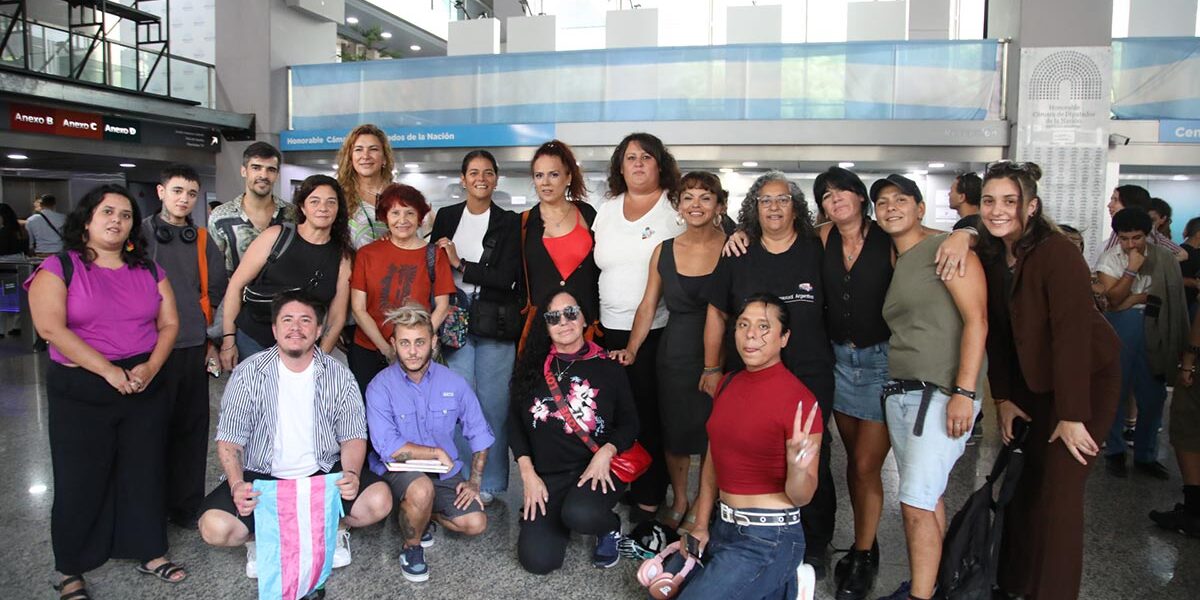
“Clearly, the purpose of these emergency decrees is discrimination and the exclusion of our community,” said Cristina Montserrat Hendrikse emotionally in the annex of the Chamber of Deputies. The meeting, convened by the Women and Diversity Commission, chaired by Mónica Macha, took place there on Tuesday afternoon, the 11th.
The presentation lasted approximately four hours and was attended by over 100 activists, leaders, and social actors from the LGBTQ+ community, as well as members of parliament from all political blocs except La Libertad Avanza. Their demand was unequivocal: to push for the annulment of the decrees signed by President Javier Milei that modify the Gender Identity Law.
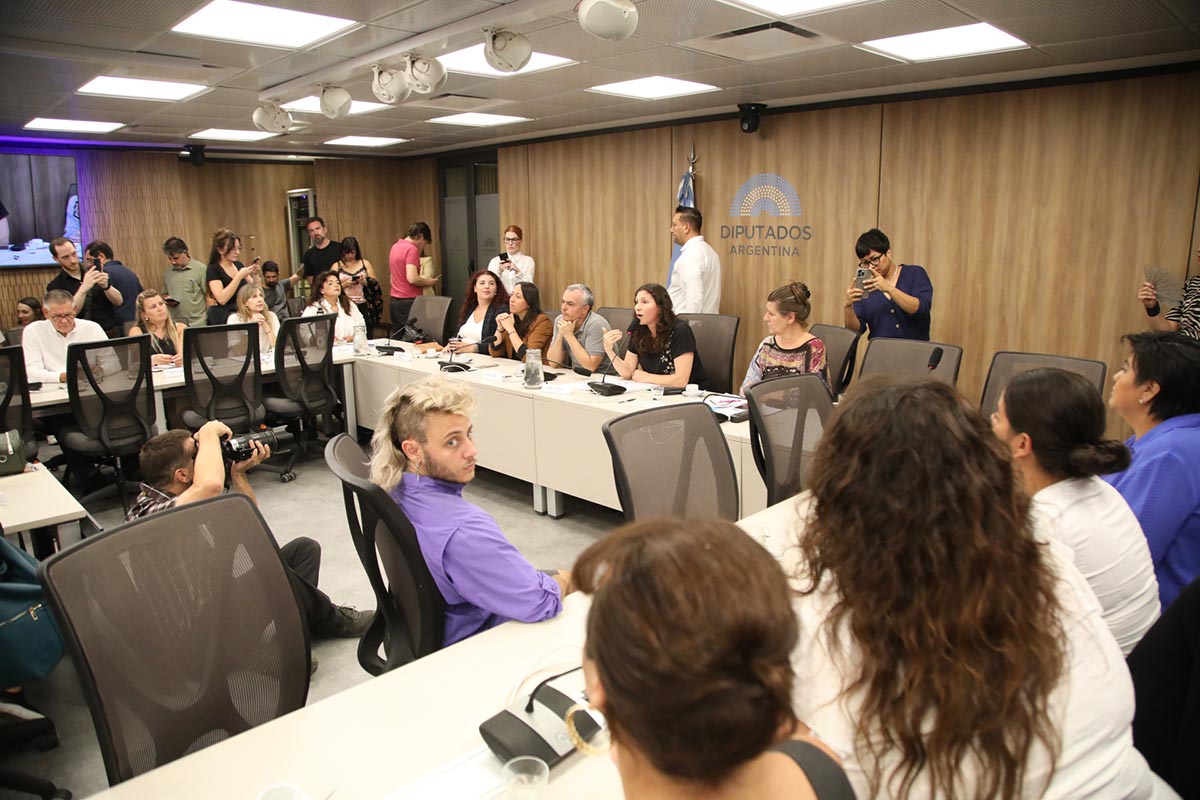
A meeting for several voices
At the opening of the meeting, Macha stated: “The ‘mileismo’ movement claims that it doesn’t want to interfere with what people do in bed, but it does interfere in their public lives. This is an aberrant social regression. What we want is for each person to be able to live with dignity and freedom, building their own happiness—in bed, at school, at work, on the street, wherever .
For his part, Representative Esteban Paulon, vice president of the Women and Diversity Committee, highlighted the presence of representatives from the various blocs that make up the lower house. He added, “ The mechanism this government is trying to promote is to instill fear in us—fear of being ourselves, of going out, of expressing our opinions, of dissenting. Anyone who dissents, goes out, or expresses an opinion is disciplined. They are sent to the guillotine. We will not accept any social guillotine, nor will they try to lock us up within four walls.”
During the lengthy meeting, Macha emphasized that the meeting provides the framework within which the commission can function. “This is a branch of government that is connected to parliament, to our voices, to being able to listen to each other; it is an essential part of this task. It doesn't change at all because there is a body with the Executive branch. I believe that each colleague who speaks is responding to invitations from all the representatives. There is a specific articulation of Congress and the last remaining national institutional body for discussing women's and diversity issues and for addressing the rights that are at risk.”
“An emergency decree has taken control of our bodies”
“With a savage and cruel lie, the work of many professionals who work in trans health was erased,” said Adrián Helien, founder and head of Transgender Health at Durand Hospital (the first team to provide trans health care in Argentina and Latin America). He emphasized that there is also a great deal of fear in the medical field due to the legal vacuum that exists regarding the Gender Identity Law.
Regarding the presidential decree affecting transition treatments, she stated: “There is an emergency decree that has seized control of bodies, identities, and even medical knowledge. The decree is based on a study we were never allowed to see. There is no evidence. Our teams were not consulted.” She added, “We have decided to continue providing care. There is a principle in medicine that is to never abandon those who consult us, and another is to do no harm.”
Cristina Monserrat Hendrikse, a lawyer, trans activist, and official in the Labor Court of the Province of Buenos Aires, and a member of the Argentine Forum Against Transphobia, also spoke. “Using an exceptional tool such as Emergency Decrees, a law that was debated and consulted with many representatives of the people is being modified (…) Clearly, the purpose of these Emergency Decrees is discrimination and exclusion of our community,” said Monserrat Hendrikse.
“They want to base rights on biology, which sometimes doesn't align with the bonds of love. I'm a trans mother, I'm an adoptive mother, I have an adopted daughter, not a biological one. It goes against biology, doesn't it? Is she not my daughter? Are they going to issue a decree so she's not my daughter because she's not my biological daughter? I don't know what the legislators are going to do with these emergency decrees. I want to tell them that whatever they do, biology will continue to produce trans people.”
In her presentation, Gabriela Mansilla of the Civil Association Free Childhoods and Luana's mother, stated: “I don't want children to learn to resist what the adult community is supposed to guarantee them (…) We are demanding rights, human rights.” She also pointed out the fear among transgender children of going out in public.
“Neither forget nor forgive the dismantling of the Bonaparte hospital”
“What the government is doing is spreading misinformation. I want to call on all healthcare professionals, not only those of us who care for people in the LGBTIQ+ community but also those who have important information and knowledge, to come forward and share it. This government is creating a problem for us that we didn't have before,” said Noelia Tuliano, a general practitioner and member of the comprehensive healthcare team at Bonaparte Hospital .
“It goes beyond the attack on children. They use concepts and exceptions to apply them to the rule, and disinformation is a giant monster. It’s time to speak out about what is happening.”
Tuliano denounced the lack of access to hormone therapy, “with the resulting tragedies for not only physical but also mental health.” “The government claims to care about children and adolescents, so let them explain why 65% of children live in poverty and don't eat every day. The government denies the existence of patriarchy, yet Argentina ranks 50th in the world for sexual violence against children and adolescents. The Ministry of Justice reported 14,424 cases of abuse between 2017 and 2022, with almost 60% involving children. Eighty percent of the perpetrators are family members. These cases reach the Laura Bonaparte Hospital, where 106 patients have been left without treatment due to over 200 layoffs. Eighty percent of walk-in cases are related to childhood sexual abuse,” she emphasized.
She added that the government stigmatizes trans identities and the Gender Identity Law “when 47% of trans children have expressed feelings of death or a desire to die; 64% of trans adolescents have expressed feelings of death or a desire to die; in health clinics, 80% of trans children and adolescents acknowledged that they did not receive the answers they expected, which is why the Bonaparte Hospital is so important. We were left without care in the comprehensive health and children's health system; they dismantled the system and the hospital. The hospital is not functioning today because they themselves emptied it,” the professional continued, adding: “I will neither forget nor forgive the dismantling of the Bonaparte Hospital.”
The young people
The voice that could not be missing was, of course, that of the trans teenagers who were present.
“We can’t feel safe because we’re afraid of what they might say or do to us. It’s important that we continue to be told about the essential laws that protect us,” said Manuel Sinde of El Teje. “All the people who speak ill of us, who say we’re forced to be trans, are people who have never spoken to a trans child or teenager in their lives. They’ve never taken the time to learn about our lives, they’ve never given us a voice, and they’ve always spoken from ignorance and hatred. We want to be heard.”
They also clarified that the president's statements "reflect practices that don't exist or happen anywhere in the world. Trans people are not hormones or surgeries. We are much more than that."
For her part, Cecilia Turquet, Director of Rights Protection at the Gender Secretariat of La Matanza, shared her presentation with two transgender teenagers who recounted their experiences. “I am a 15-year-old trans boy, and I am being affected by the Emergency Decree issued by the current president of the nation. Before my transition, I felt uncomfortable with my body, aspects like my voice, my sexuality, or the fact that I menstruate, and thanks to the love of my family and peers, I was able to feel free. Freedom doesn't come from hate; freedom comes from love. I never felt very comfortable being a girl. My parents helped me, supported me, and studied a lot to be there for me. I never doubted that I am Matías.”
For his part, Lautaro, a 17-year-old trans man, said, “I am a trans man in the street and all the time. There isn't a moment in the day when I stop being one, and I'm not referring to gender roles, I'm referring to my identity. I didn't choose to be trans, I chose to accept what I felt and what was happening in my life.”
Talking about politics
The first speaker at the meeting was Dora Barrancos, who spoke in general terms about the policies of the new right wing worldwide. “We are determined to give our all to defend human dignity in its most fundamental aspect: gender and sexual integrity. We will not give up because our lives depend on it. Do not use nature and biology as a moral standard .”
“Having to sit here again giving explanations is exhausting,” said Florencia Guimaraes, a member of Furia Trava, the La Casa de Lohana y Diana Civil Association, and the Pride and Struggle Front, who was referring specifically to the Trans and Travesti Employment Quota Law. “We are facing a government that aligns with international discourse; it is a puppet government, but the lives of trans and travesti women are particularly worrying . A government like this comes to power, and we have to live in fear because hate speech is becoming a reality in our lives.”
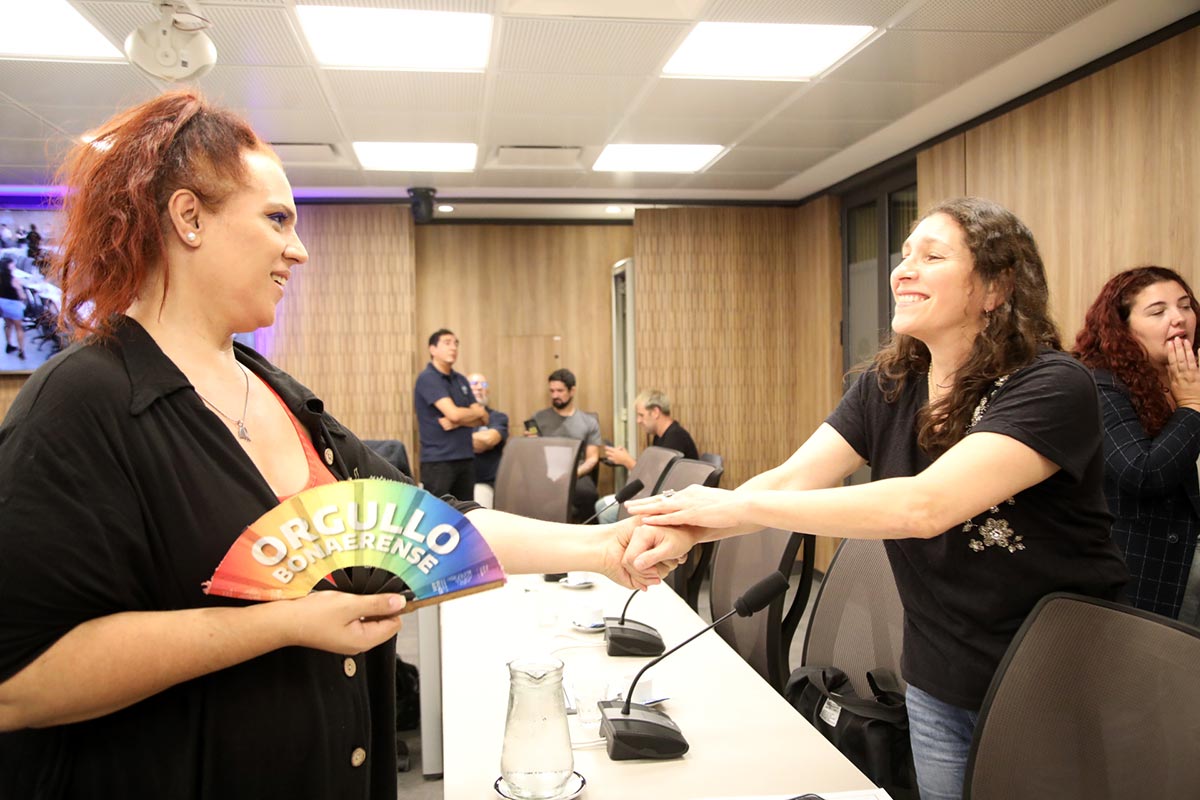
Ese Montenegro, from Columna Mostri, one of the organizations that participated in the massive call for the Federal March of Antifascist and Antiracist Pride, was also part of the meeting.
“We want to take advantage of this meeting to raise some demands we want to bring to this House. One of them is that Decrees 61 and 62 of 2025 have countless formal problems because they represent a regression in human rights and violate numerous international pacts, conventions, declarations, and principles to which the Argentine State adheres. But we are here to ask why the Permanent Bicameral Commission has not called a meeting to reject these decrees that are destroying the lives of transvestites and trans people throughout the country,” she stated.
During his speech, Montenegro called for a march on March 8th, International Women's Day, and another march on March 24th, the Day of Remembrance for Truth and Justice.
Against the decrees
During the four hours of debate, complaints were made about the lack of reaction from legislators in repudiating the two decrees that modify two fundamental articles of the Gender Identity Law.
One of those who protested was trans activist Marlene Wayar. “What are we doing here? How are you going to contribute? What are you going to demand from your parties so they don’t abandon us again?” Wayar asked.
The activists, around 40 in number, demanded that the Chamber of Deputies push for the annulment of the two decrees.
Who participated?
The meeting was attended by deputies Mónica Macha, Germán Martínez, Paula Penacca, Magalí Mastaler, Brenda Vargas, Ana María Ianni, Esteban Paulón, Maxi Ferraro, Sabrina Selva, Carla Carrizo, Marcela Coli, Hugo Yasky, Varinia Marín, Carolina Yutrovic, Gabriela Estevez, María Sotolano, Natalia Sarapura, Vanina Biassi, Nicolás Del Caño and Cristian Castillo.
Also present were the organizations Frente Orgullo y Lucha, FALGTB, Comunidad Homosexual Argentina (CHA), SIGLA (Sociedad de Integración Gay Lésbica Argentina), Furia Trava, Asociación de Travestis, Transexuales y Transgéneros de Argentina (ATTA), Red de Identidades Lésbicas Autoconvocadas, Asociación Civil Agrupación Munay, Foro Argentino Contra la Transfobia (FACT), Juventud Movimiento Travesti Trans Argentina, Asociación civil infancias libres, Pan y Rosas, El Teje – Adolescencias Trans, ATE, Frente Renovador Diversidad, UCR Diversidad, Movimiento Evita, Nuevo Encuentro, among other organizations and activists.
The article was published in Tiempo Argentino.
We are present
We are committed to journalism that delves into the territories and conducts thorough investigations, combined with new technologies and narrative formats. We want the protagonists, their stories, and their struggles to be present.
SUPPORT US

FOLLOW US
Related notes



We are present
This and other stories are not usually on the media agenda. Together we can bring them to light.