

Interview with Gabriela Wiener about her latest novel "Atusparia"
In her new novel, writer Gabriela Wiener offers a portrait of some of the political struggles in the history of Peru and, by extension, Latin America. “In this book, romantic betrayal is almost indistinguishable from political betrayal,” she states.


Share

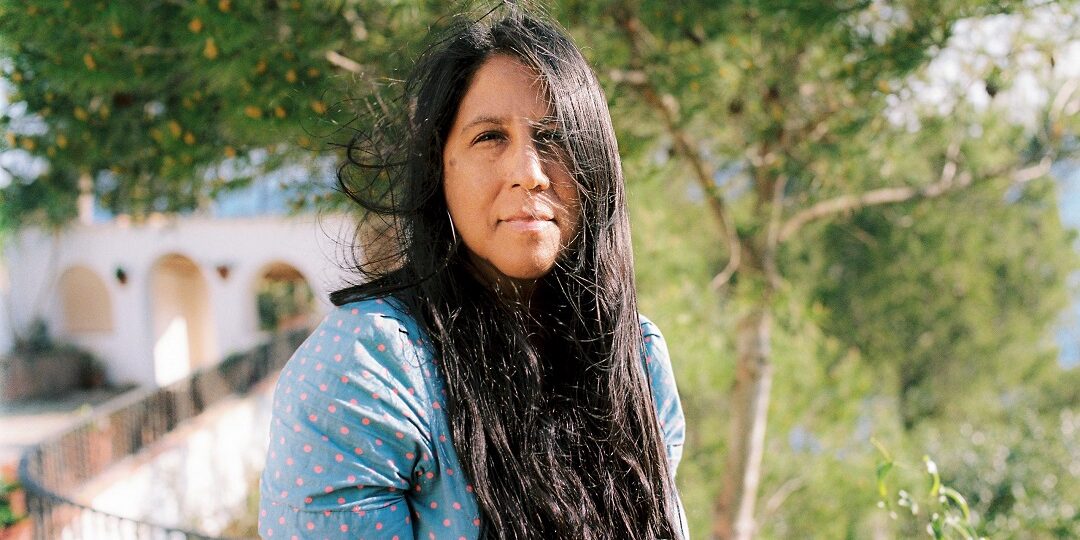
She appears with poise. The flower room at La Sinsorga is packed, awaiting her arrival. Before beginning the presentation of Atusparia in Bilbao, and after giving a radio interview, she poses for photographs for a newspaper. The publication of Atusparia Gabriela Wiener 's new novel has sparked interest among both readers and the media, and has garnered praise.
With long, straight, flowing hair, she dresses in black, matching her hair. She answers with poise everything related to her new book, her least autobiographical work, she says, although she has lent her childhood school to the protagonist. “The key to the personal being political here has another dimension. Intimate conflicts have the power to demolish spaces, communities, collectives, activism, dreams, ideals, even a country,” she shares. And although lawfare appears Atusparia , so does lesbian drama, a touch of dystopia, and a great deal of history. This interview was conducted in three parts: it's part of the presentation in Bilbao in December, a bit of the subsequent, more private conversation, and an exchange of emails during the Christmas holidays. Despite her firmness, Wiener reviews the nuances and reconsiders her answers.
– Atusparia is quite a provocative name, one that sparks curiosity. Atusparia was a 19th-century indigenous revolutionary leader from what is now Peru; it was also the name of a school, and now it's even more: a novel and a character. Who is Atusparia?
Atusparia is the name of an indigenous leader and the name of a school in Lima that operated in the 1980s and paid tribute to Pedro Pablo Atusparia . It's the school where I studied until the fall of the Berlin Wall, and I've lent it to my character. I always wanted to write about that school because it was so unique: founded by people who had studied in the USSR and subsidized by the Russian Fishermen's Union who frequented the Pacific waters, it tried to fuse Soviet Russia with Peruvian indigenous identity. It was another world; there were two sides, not just one as there has been since capitalism triumphed. This girl, who isn't based on me, studies at that school. This is perhaps my least autobiographical book. In fact, this girl has no name and doesn't talk much about herself, but rather about her school and its ideology: there, the dictatorship of the peasantry was not advocated, but rather that of the proletariat; they read José Carlos Mariátegui , the most important Marxist in Latin America, and indigenous literature such as that of José María Arguedas and Manuel Scorza . Atusparia is also the name the protagonist of this story adopts when she begins her activism and political involvement. The novel follows the journey of this leftist woman, from her education at that school until she ends up in prison for trying to become the people's candidate.
There is a fascinating character who demonstrates how important school and teachers are in childhood.

A lesbian teacher, no less. Asunción Grass represents the counter-power, the dark and revolutionary reverse side of Atusparia; she is both her nemesis and her teacher. She is her Literature teacher, the one who teaches her to read the indigenous classics. She is more than a teacher because she also acts as a mother to her. The school, in general, nurtures Atusparia because she comes from a dysfunctional family; she is one of the few girls in the school who wasn't born into a politically active household. Given her vulnerability, the school and Asunción have become her primary guardians. But when the Berlin Wall falls and the school begins teaching English, and revolutionary ideals are swept away across the Pacific Ocean, she also experiences adolescence, which is to say, her own perestroika, a drift that distances her from the revolutionary ideals of her childhood. This is how the book represents the arrival of capitalism in Atusparia's life. The action shifts to the neighborhood, to this place known as La Resi, a kind of urban slum very similar to the cities abandoned by communism—terrifying, haunted, post-apocalyptic. There, she surrenders to rampant consumerism, indulging in the consumption of bodies, sex, and drugs, discovering desire, romantic love, and evil. She reunites with Asunción much later, in Puno, a city in southern Peru, amidst a social uprising, and they become comrades. And they fall in love, not only with the revolution. A moment will come when politics will separate them, and although different, both paths will be one of no return: Asunción will take the path of clandestinity and armed struggle, and Atusparia that of liberal democracy. For her, agreeing to play the game of democracy by its own rules will mean persecution, lawfare , and prison. In a way, the novel positions itself outside the chessboard where the two protagonists' dispute takes place, and from that perspective, it becomes clear that as long as they remain within the system's game of chess, neither will achieve their goals.
“There are lesbian dramas that have undermined struggles”
It's a lesbian drama that only one of the parties experiences, which is also common. For me, it was very interesting to work on Asunción's grief in political terms; it came very naturally, it flowed like a dark vomit. I translated almost all the references to heartbreak into political language. It's clearly an attempt to translate the discourse of romantic love into revolutionary love that is betrayed, beaten, and wounded. Asunción speaks from that political wound, which is why I say that the betrayal of love is almost indistinguishable from the betrayal of politics in this book. I think she's the most literarily secure voice in the book. I trembled many times while writing this book, but not in that part; I was very clear about what I wanted to say. The key to the personal being political here has another dimension. I wanted to talk about when the personal destroys something more powerful than love itself, something that goes beyond it and involves more people. How intimate conflicts have the power to demolish spaces, communities, collectives, activism, dreams, ideals, even a country. What happens between them truly puts a country at risk. We all know that there's no coming back from those sorrows and those griefs. We know that, because of broken loves, ruined desires and friendships, and disrupted communities, movements have fractured and transformative horizons have been thwarted. Lesbian dramas that have undermined struggles. All that personal burden that gave identity to anti-racist feminisms also made us more vulnerable. And the enemies know exactly where to aim to neutralize us; it's incredibly easy, we handed it to them on a silver platter. So, how little politics the personal can have. In the novel, of course, there are other perspectives as well. Attempts to neutralize what is transformative, what questions structures, can come from within, from our self-destructive impulses, and from without, through strategies like lawfare or the criminalization of protest.
– “A left-wing politician, a victim of lawfare, finds herself imprisoned in a high-security jail deep in the Amazon rainforest.” That’s the first sentence on the back cover. Without giving away too much of the book, there’s not only lawfare but also a bit of lesbian drama, isn’t there?
“Right now my country, which nobody cares about, is being governed by a dictator who has a four percent approval rating.”
Why did this book come about? Because of the need to talk about Peru after your previous novel, Huaco retrato , or because of everything that happened in Peru a couple of years ago, such as the violence against the indigenous people in Puno, which you covered as a reporter.
– Huaco Retrato is told from here, from a migrant identity. Beyond Peru, there was a history of broken, lost, erased identities that goes beyond a Peruvian or Latin American identity. In Atusparia, there is more of Peru's history, but insofar as that experience allows me to speak of a series of broader struggles, or those that resonate at a continental level—internationalist, anti-imperialist struggles. For example, the struggles of the Latin American left in the 60s and 70s, when they had to confront murderous dictatorships, when we were the backyard of the United States—though we still are in many ways—but also the sham of the 90s. I wanted to remember that solidarity among sister peoples and the memory of the Indigenous movement, which ranges from anti-colonial struggles, from the uprisings of Túpac Amaru and Atusparia, Micaela Bastidas and Rita Puma , through the struggles for agrarian reform and peasant revolutions against extractive multinationals, to the Zapatista, Mapuche, and Aymara, Colla, and Andean and Amazonian Quechua resistance of today. What is denounced in Atusparia is how the State has historically had, and continues to have, only one way of resolving Indigenous conflict: with massacre. The quintessential colonial strategy. Right now, my country, which no one seems to care about, is being governed by a dictator with a four percent approval rating. Two years ago, in Puno, a region with a huge Indigenous population, Dina Boluarte didn't hesitate to order the deaths of more than 60 people, for which no one has been held accountable to this day. A month after that massacre, I was sent as a journalist to cover the protests. As I wrote the article, I kept thinking about how to bring that part of my country's history, of our territories, into fiction, what literature could say about it, how literary language could contribute to understanding our conflict as it was unfolding, our pain as it was hurting. If there's one thing suffocating Peru, it's the highly effective strategy of Fujimorism/fascism to criminalize the left, popular movements, and social movements, reviving the specter of terrorism whenever it suits them electorally—as in this case, everything is blamed on ETA—what we call "the terrorism of the terrorism movement," and the impossibility of bringing the internal conflict to a close and achieving national reconciliation. The current repression and massacres of Indigenous people and land defenders are connected to these strategies.
– You create a narrative of the country, which is a narrative of the continent, which is a narrative of the left…
– I think it's all of that. There are those stories and memories, more or less collected. I wanted to write a book about what breaks us from the outside, but also about the internal experience of activism, where we hurt each other. I wanted to revisit those struggles, to question the role of power, of institutions, of what divides us, of whiteness, of leftist patriarchy. I wanted to talk about what it's like to experience politics from the inside by telling a woman's story. It's a left wing—which could be Peruvian, Latin American, or global—as a place that has atomized due to its sectarianism until it has been reduced to its bare minimum. I offer my critiques from a lighthearted, loving perspective. I'm interested in addressing issues of this political moment, in which we see the right and the far right appropriating the language of social struggles. How can you allow Milei to call himself a revolutionary? They've been quite successful at criminalizing and plundering the experiences of struggles that aren't their own, cultures that aren't their own, epistemologies that aren't theirs. Perhaps the world can no longer be explained through the Western left-right dichotomy. At one point, Atusparia speaks of other experiences, like that of the Zapatistas, and of those other possibilities for doing politics without seeking to seize power, but rather by building autonomy and communitarianism from the margins. I also wanted to draw a connection between the old anti-colonial resistances of leaders like Túpac Amaru or Atusparia and those of the land defenders, who are currently putting their bodies on the line for life and the planet's continuity.
“Elections are won by shouting ‘I am a rapist’”
– You portray the left, and now we're learning about cases of sexual abuse within left-wing organizations and parties. Does it surprise you that this is happening with people with whom you supposedly share a certain ideology?
No, the left, like the right, is full of macho men. The problem is that cases like Errejón's make you think that only the former pretend not to be. And hypocrisy could seem like political suicide. It turns out that electorally today, shamelessness, brutal honesty, Ayuso-ism, and Trumpism are valued. It turns out that elections are won by shouting "I'm a rapist" or "I'm a president who murders the elderly." I think Errejón should return to politics as an experiment; I think he could be incredibly successful, by acknowledging who he truly represents. You'd think that someone who committed harassment or abuse once, who becomes a representative of the people, especially if the white feminist left voted for them, would moderate; but what we see is quite the opposite, they become worse. Power grants impunity, hence the reason why there's a MeToo wave every now and then to remind them, at least symbolically, that women remember and together they can bring them down spectacularly. But oh, women! It was also said that more women needed to be put in power to achieve change, but now we can see that some of the main figures of the far right and the most recalcitrant status quo Meloni , Le Pen, and our colonial legacy, Dina in Peru. Let's see if we can bring them down once and for all. Nothing—not being an ally, a comrade, a woman, a lesbian, a queer person, a sister, an Indigenous person, a Black person, or a person of color—absolves you of doing evil. Hopefully, we can question leadership within our movements, among like-minded people, doing so internally in the least destructive way possible, on the path toward another kind of justice, without being accused of playing into the hands of the right wing. In this process, we must understand that these people are not interested in women's rights, Indigenous rights, or the rights of migrants, or the rights of people in general. What they want is to overthrow the revolutionary of the moment and perpetuate their own power. If a powerful figure suddenly grabs headlines about gender violence, it seems like everyone cares, but they don't care at all. Does the downfall of one improve the lives of the vast majority of women? If these years of struggle have taught us anything, it's that there are other revolutions underway that we need to engage with and organize around. We have to be able to work with others, able to nuance and delve deeper, to listen to those who are arriving, to allow ourselves to be transformed by what we don't yet understand. We have to stop hierarchizing violence and suffering, as racism has always done. You know what surprises me most? That the left in government isn't thinking about improving the lives of migrants. Well, it doesn't surprise me anymore; I'm used to it. Let's talk about the other forms of violence and the other victims too, about how migrants, who already suffer administrative violence, economic violence, and labor exploitation, are raped, and nobody takes to the streets for them. People are dying at the Melilla fence because of the State, and Marlaska remains firmly in his post. That gives you an idea of the level of elitism within these struggles; which struggles receive preferential treatment, all the television coverage, all the media outlets, and all the platforms, while the struggles and victims are relegated to second-class status. Who gets the blame and who doesn't? And who benefits from all this political maneuvering?

- “Literature is where history is re-judged, where the case is reopened. (…) Atusparia, I know that one day literature will reopen your case and justice will be served. Don't lose faith. I would be waiting,” you write in the book. Does this book seek justice?
– Asunción Grass, the author of the novel, greatly admires Manuel Scorza, who presents literature as the last resort when all other avenues have failed. Scorza truly succeeded in this; one of his novels tells the story of a peasant leader who confronted a ruthless, extractive oil company and was imprisoned. A left-wing dictator, Velasco Alvarado , read Scorza's book and decided to free this peasant leader. He knows what he's talking about when he says that literature can be a key to unlocking a prison.
– And do you think literature can judge history?
Obviously. I've given quite a few headlines about that, basically to counter the infamous number of headlines about how literature shouldn't serve any purpose, that it should just be literature and that's it. We have to keep making books that open doors.
– Continuing with the importance of literature and how important it is that it opens doors, what is Sudakasa?
– Sudakasa is the village house of the "sudacas" (a derogatory term for South Americans), a house in Castilla-La Mancha, an hour from Madrid, that aims to be a space for migrant creativity. We got tired of Spaniards not inviting us to their towns, and since our people are crossing the Atlantic, we decided to create our own. We've managed it thanks to books, prostitution, and returning the gold. We are several writers and artists, all migrants, all "sudacas." We've reclaimed the insult, transformed it into resistance, into pride, and we have several projects running there. There are residencies, gatherings, feasts, workshops, mentoring; we have a very large support network of all the contemporary Latin American women writers, and it's a way for us to be self-employed and to do something collective, which sounds very strange with literature, because we've been sold the idea that it's a solitary job, the blank page, you and the window facing the sea. All lies. We want to create together. We're having a good time there and we hope to get more serious to deliver a lot more political discourse from there, which is needed in the publishing world, in the book industry in general; there's a lot to say about regulation, justice, identity and racism.
– One thing that has worried me about the book: there's a moment when you imagine a future and Putin keeps appearing!
– It's dystopian, but only slightly; it speaks of an almost immediate future. Besides, I said it's my great Russian novel, so how could Putin not be in it?.
We are present
We are committed to journalism that delves into the territories and conducts thorough investigations, combined with new technologies and narrative formats. We want the protagonists, their stories, and their struggles to be present.
SUPPORT US

FOLLOW US
Related notes

We are present
This and other stories are not usually on the media agenda. Together we can bring them to light.