

Interview with Lu Ciccia: why it is necessary to question sex as a biological category
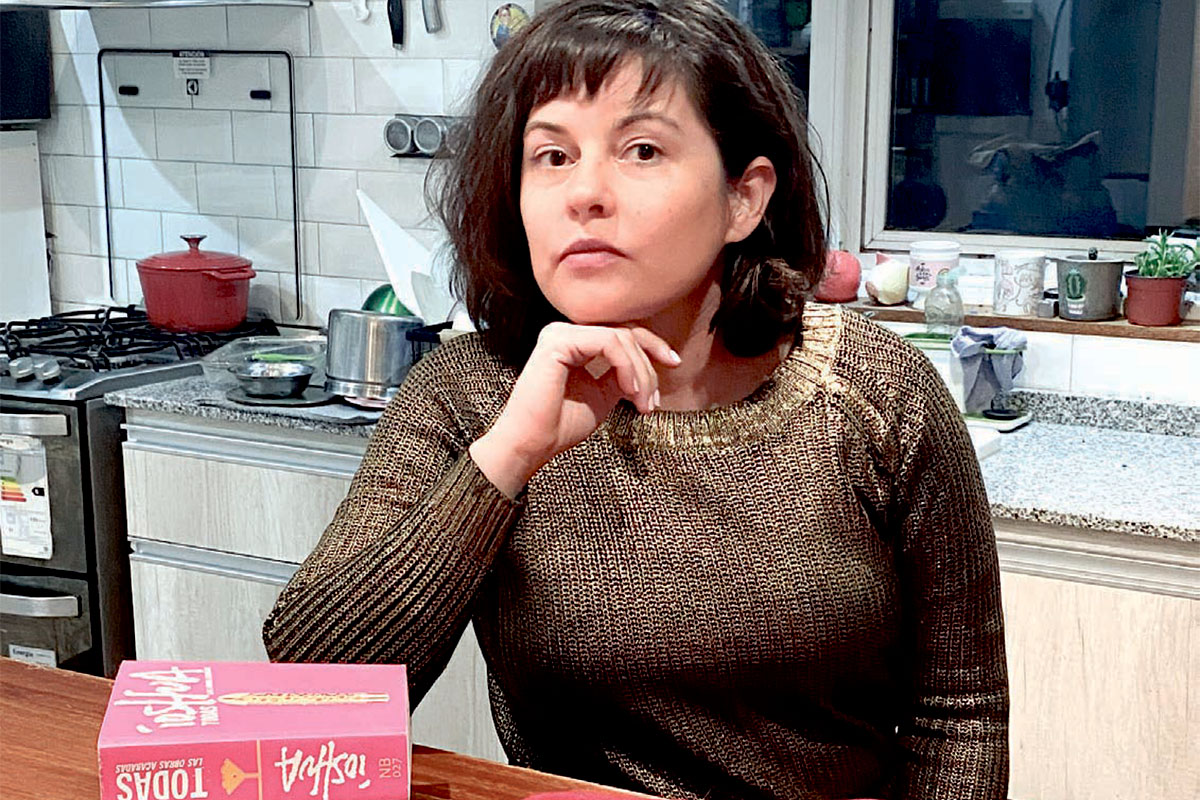
Researcher Lu Ciccia edited a new book in which she raises the need to rethink sex as a biological category.



Share

Lu Ciccia is an Argentinian researcher living in Mexico. When I met her some years ago, she immediately clarified that she wasn't from Buenos Aires and that she researched neuroscience and gender. I gathered the former from her anecdotes about the Wild(e) neighborhood, and the latter from her first book, * The Invention of the Sexes: How Science Implanted Binarism in Our Brains and How Feminisms Can Help Us Get Out of There* ( 2022).
As a new release, and a Christmas gift for 2024, came his second book, Against Sex as a Biological Category: How to Dismantle the Sexist Premises that Limit Our Lives . The book arrives with a bang for 2025, offering much-needed arguments to combat misinformation in the field of sports.

The meaning of a category
-You start with a powerful assertion in the title of your book, which you then develop across different fields: medicine, sports, history, and the so-called "hard " sciences. What purpose does the category of sex serve for us today?
-There are different uses. But in a general sense, the category of sex serves certain institutions that have been paradigmatic in emphasizing the hierarchical reading of bodies: sports and medicine.
In these contexts, sex serves to naturalize biological differences. What does this mean? It means that reproductive capabilities are invoked as the cause of a whole range of biological parameters that influence athletic ability. And in the biomedical field, this parameter would explain prevalence rates, for example, of diseases that are more common in cisgender women than in their male counterparts, and vice versa: diseases that are more common in cisgender men than in their female counterparts. So today, sex as a biological category functions as an interpretive framework for athletic abilities and for the prevalence and treatment of diseases.
Sex did not function systematically as a biological variable. This is a criticism that was made during the 1990s regarding the necessity of including sex as a biological variable. Because including all bodies is one thing, but characterizing all bodies as having to be classified according to their reproductive capacity is another. This is something I discuss in the book, also citing other authors.
-So reproduction would have no medical value in explaining biological differences?
It's not that our reproductive biology has no relevance whatsoever in the development of other biological parameters. What I'm pointing out is that it's being given a relevance and omnipresence that displaces social variables. And I'm not saying that these are merely social variables because they're on one side and biology on the other, but rather that these social variables are expressed, or biomaterialized.
My starting point is not to suggest that sex is not biological. What I am saying is that sex as a biological category has many implications that we sometimes overlook. In the book, I revisit these implications, explain them, and point out why our biological reality does not meet the requirements for sex to be considered a legitimate biological category.
In this sense, I say that reproductive possibilities can influence or be related to prevalence rates. Today, when we talk about paradigmatic prevalence rates like breast cancer, we don't have concrete evidence linked to the so-called sex chromosomes, or to different levels of estrogen or testosterone, to explain that prevalence. There is greater complexity, and that's why it's important to put speculation about it aside. What does this mean? To stop claims like autoimmune diseases being more prevalent in cisgender women, and that this is due to XX chromosomes. This is a hypothesis, but is there any corroborated evidence in this regard? The answer is no.
So let's set aside speculation and ask ourselves what other biological variables or parameters are relevant to understanding autoimmune diseases. What parameter is relevant, for example? Intestinal permeability, which doesn't depend on sex chromosomes or estrogen levels. It depends on diet or a body conditioned to stress. Here we move away from a rigid paradigm inherited from a positivist biology based on sex to understand disease prevalence, and we broaden our perspective. Let's not stop considering whether chromosomes are involved, but let's not put them at the center, and let's not make them the only thing we do.
On the nature-culture dichotomy
-I want to ask you a question, like a brother-in-law at Christmas dinner. If you eliminate the category of sex, don't you eliminate a space for enunciating the oppression that women experience?
That's why I say that sex is a historical-political category, and I present it with an analogy to race. It's not about placing categories that imply hierarchy on equal footing. There are precise genealogies for each category, and I don't delve into them in depth in the book for anti-racist studies. We can learn from the genealogies that have been developed from the concept of race, and that's why I cite authors who criticize the current use of the category of race in the biomedical field, and I wonder why we don't question and critique the idea of sex.
Let's take the critique of sex seriously, just as we have taken the anti-racist critique of the naturalization of race seriously. Sex exists as a historical and political category and is biomaterialized because what we do through sex is naturalize sexism . And how do I define sexism? As thinking that there are natural biological differences between cisgender men and women.
My provocation is to question this nature-culture dichotomy already proposed by Donna Haraway, who speaks of a biology that at no point in development exists immune or impervious to culture. Why do we take for granted that culture doesn't impact, for example, the parameters we associate with sex as a biological category? And what I propose is precisely that these social practices, this culture, engage in dialogue with our biology. Sex must be considered a category that guides which variables we develop around gender norms.
–So, is it culture that has historically shaped the body and sex? Is it our gendered world that creates dimorphic biology?
In the book, I say that we are not a blank slate, not that we are a biology without agency, and that culture comes to mold us in its own image. But I point out that we are the least programmed species. What does that mean? It means that we come with a potential that we can learn. When I talk about programming, I don't mean that we are a bastion of innate programming, free from culture; I'm referring to parameters that have stabilized generation after generation through the regularity of our social practices. I'm referring to things that are already stabilized, and we don't know how much they can change because we don't fully grasp the plasticity of our biological makeup.
-Is our biology so plastic that cultural practices can shape it historically?
What I'm saying is that we need to take seriously the fact that social practices are simultaneous with our biology. I'm not arguing that culture causes our biology. What I'm saying is that our social practices are simultaneous with our biology; there's a simultaneous dialogue. Biology can't explain why I'm sad. There may be correlations, but we can't fully understand our mental life without other disciplines like psychology, anthropology, and sociology. And what we've done to date is delegate our explanations to biology in order to understand ourselves. We need to be more critical of neuroscience's causal explanations, take simultaneity more seriously, and stop delegating explanations of our behavior to disciplines that come from the scientific method.
-In your book a key concept is biomaterialization, what is it?
Biomateriality refers to our biological materiality. I take that idea of materialization in the sense that Van Anders uses it, but I take it a step further and want to explore our mental life. How does our mental life materialize? With a concept of mind that doesn't reduce our mental life to the biological, but rather with a concept of mind committed to the idea that if my mental life changes, biology changes. I hold onto this idea that if my mental life changes, biology changes . For example, Sari Van Anders says that when you have sex for erotic reasons, testosterone levels increase, and when you have sex for romantic love, oxytocin levels increase.
This example helps me to illustrate how our sexist psychological states become biomaterial. Why sexist? Because our mental states are naturalized: who are the people who have sex for romantic love? Obviously, cisgender women have that correlation with oxytocin, and cisgender men have that correlation with testosterone. That's a clear example of sexist biomaterialization. Sexist because it stems from naturalizing certain behavioral patterns that have a biomaterial correlation, a biological naturalization. So, biomaterialization helps me to investigate how certain psychological states can translate into biological parameters. In this case, with relevance to sports because I'm analyzing sports.
A category in the world of sports
-How would you classify bodies in the sports world to avoid reproducing what you call testosterone-centrism in your book?
-In the book, I use examples from the sociology of sport. There are authors who have long proposed the idea of using specific characterizations or parameters depending on the sporting event. This has caused problems because what is relevant? In the Paralympics, for example, the focus isn't on the person's life trajectory to understand why they are in a wheelchair, but rather on the functionality of the limbs they will use in the event.
This approach, which also has its problems, has been attempted. My point is that, even if it fails, it doesn't fail any more than sex as a biological category—that is, segregation by sex. To begin with, we wouldn't be violating human rights, because there is a human right: access to sport for all people. Furthermore, the parameters would be more complex and wouldn't be reduced to what I characterize as testocentrism in sport—that is, everything reduced to testosterone. They aren't ideal, but with the levels of exclusion that exist today, they are much more relevant, and in the long run, they could yield much better results. And if we consider these parameters, we would stop seeing an average binary biology. Because we continue to perpetuate binary biologies with our practices, with the biomaterial correlates through those practices.
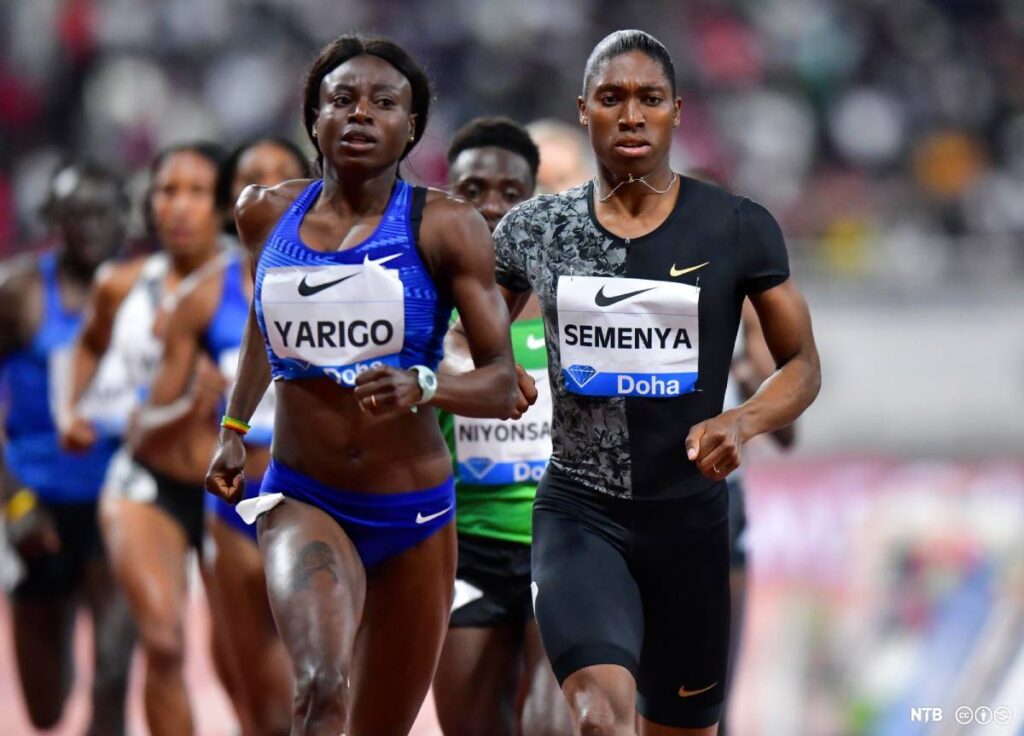
-The case of Caster Semenya encapsulates all these human rights violations. It is a paradigmatic case that transcends sex and race, and in your book there is a strong analogy between the two. Does the fact that the categories of race and sex have a contemporary, modern colonial genealogy make them similar?
The two categories have two main points of contact: first, they developed as biological categories from the colonial period to the present day. Second, this development served to justify a hierarchical understanding of bodies, racial supremacy, and the supremacy of cisgender men within the white population. My approach involves working with certain authors who have criticized race as a biological category, particularly in the biomedical field, and arguing that these criticisms also apply to sex as a biological category. Because if they share this commonality, why do we readily assert that race is not a biological category, yet hesitate to consider the same for sex?
So I play a bit on the idea that this ultimately speaks to a biological legitimacy within the category of race as well. Why? Because the biological parameters associated with sex are racialized. Racism is masked by the idea of sexual dimorphism because it is itself racialized. Further work remains to be done with anti-racist studies in the biomedical field: how to problematize the category of race and how we can problematize that of sex so that race ceases to be a biological category in the biomedical field. There is a neo-biologization of race in the molecular era. We can forge alliances to understand that these categories have more in common than we think: the sexist and racist structuring of social life.
We are present
We are committed to journalism that delves into the territories and conducts thorough investigations, combined with new technologies and narrative formats. We want the protagonists, their stories, and their struggles to be present.
SUPPORT US

FOLLOW US
Related notes
We are present
This and other stories are not usually on the media agenda. Together we can bring them to light.