

Eviction of a Mapuche community: The failure of the repressive state
Mapuche weychafe Moira Millán writes about the government's deployment and media show to evict the Lof Pailako in Chubut.
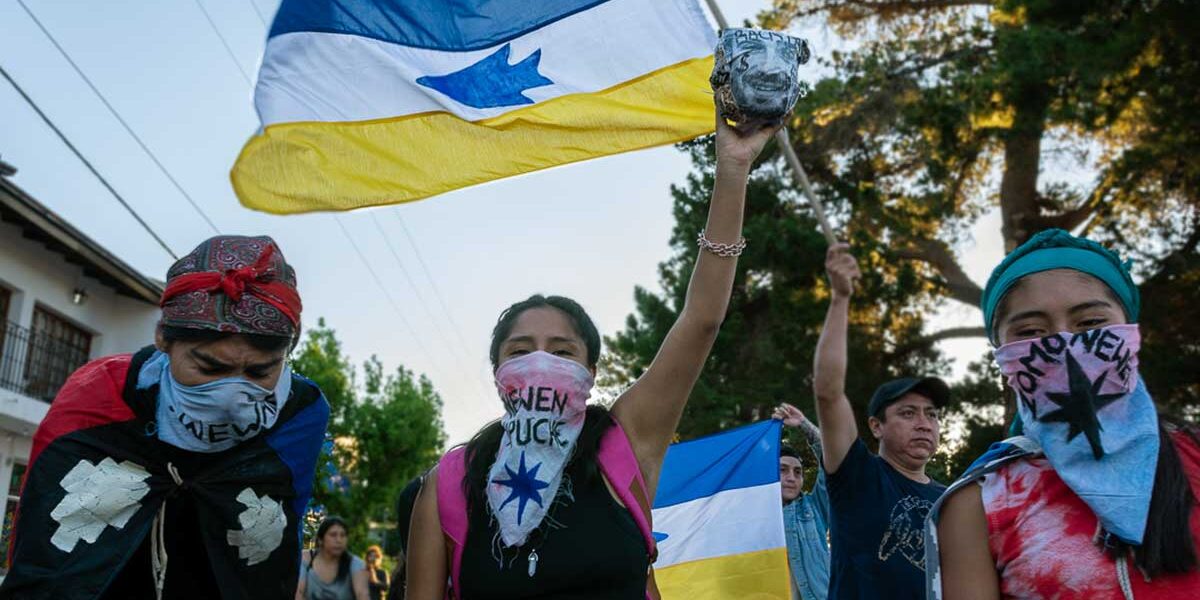


Share

“In front of a party member, the people are silent, like lambs, and praise the government and the leader. But in the street, at night, away from the people, in the café or by the river, you hear that bitter disappointment of the people, that hopelessness, but also that suppressed anger.””
Frantz Fanon, The Misadventures of the Colonial Consciousness.
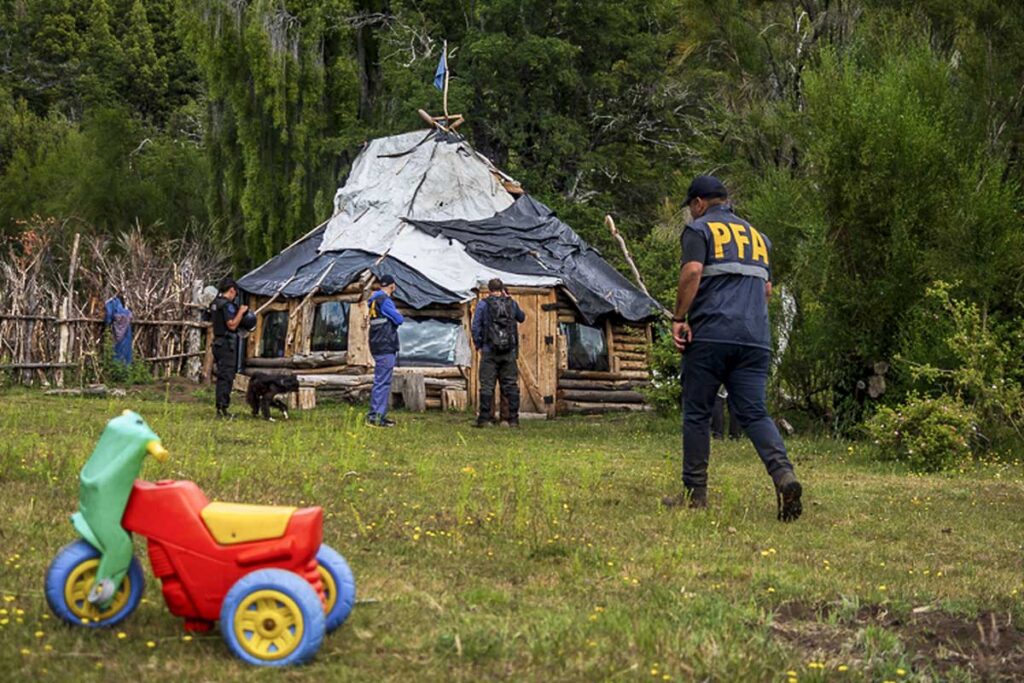
On January 9th of this nascent year, 2025, in Puelwillimapu, Patagonia under Argentine administration, now the province of Chubut, on Lake Futalafken, known as Los Alerces National Park, we witnessed an unprecedented and excessive deployment of Argentine state repressive forces, with Unimogs, amphibious vehicles, trucks, buses, vans, gendarmerie, federal police, and army. It gave the impression that war had been declared against a foreign power, or perhaps the entire spectacle was part of a reality show . However, the absurd and sad truth is that such a movement was carried out to evict three Mapuche families, members of the Lof Pailako community.
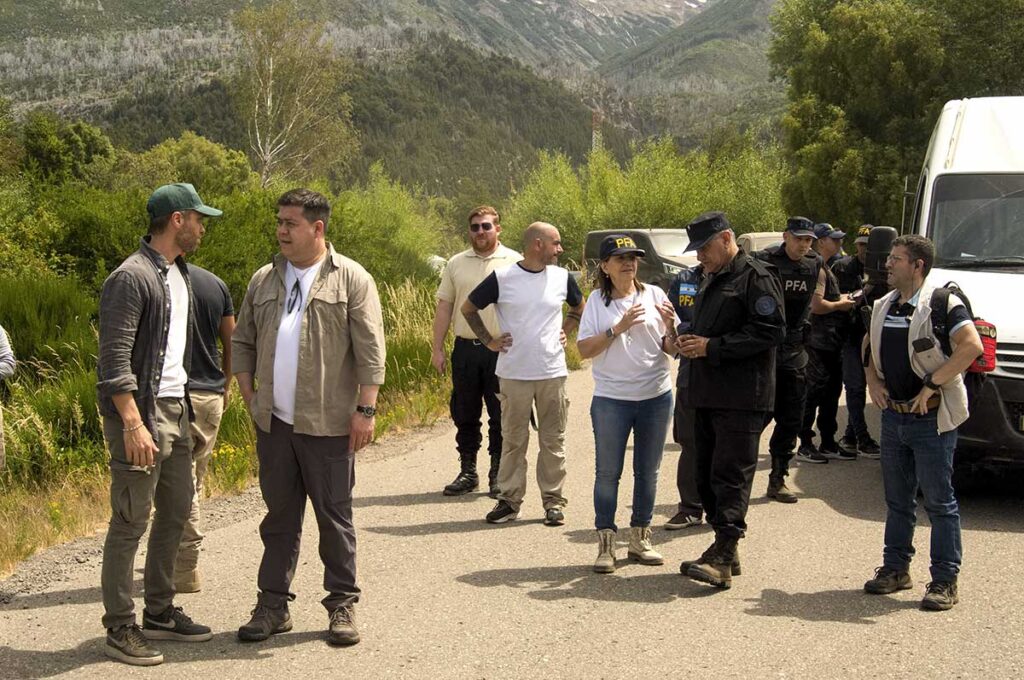
Hundreds of troops arrived at the site, armed and on high alert, perhaps eager to demonstrate their war capabilities. But on their imagined frontier, they found themselves alone: a rooster and a hen awaited them. I don't know if those birds were victims of military frustration. I hope they weren't used as targets to test the weapons purchased from the genocidal state of Israel, weapons that will surely saddle the country with astronomical debt.
A few days earlier, on December 31st, I left my territory to join the Lof Pailako. The New Year's celebrations are foreign to me, the urban customs of confusing revelry with the consumption of fireworks, excessive food, insincerity, and other Christmas trappings. A lamngen (sister) decided to accompany me.
The purpose of inhabiting the territory
We arrived at the territory of the Pailako community, there at the ruka (house), where the children were playing. We gathered to talk while the mate was passed around. I had been there on several occasions, but that day I deepened my observation of everything: the rukas , the gardens, the plants, the small and humble comforts made by hand and sweat. For the first time, everything acquired a sentimental dimension, connecting me not only to my lamngen of the Pailako community but to my people, and with it to the memory of my family, victims of other evictions long ago.
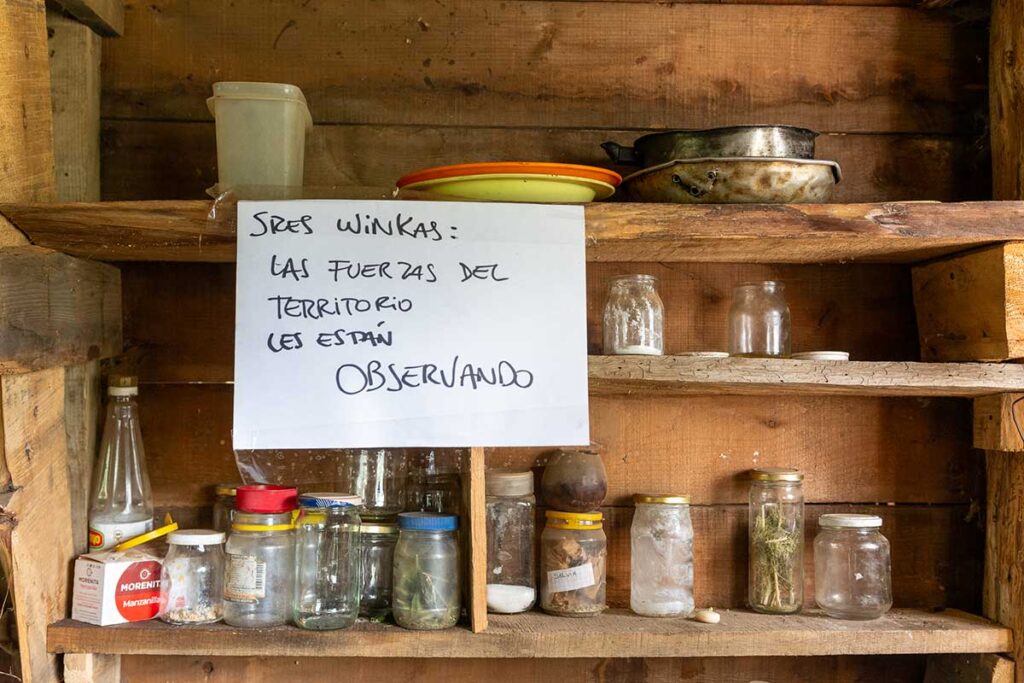
The effort poured into those friendly walls, into every detail of the small rukas (traditional Mapuche dwellings), held within them the dialogues, laughter, songs, and aromas of their inhabitants. One of the lamngen (women) of the Lof (Mapuche community) asks me without waiting for an answer: “What is the purpose of inhabiting this territory?” She pauses and continues: “Here we teach the pichikeches (children) to be guardians of the mapu (land), of nature, to respect it, to speak with the Pu Ngen, the forces of the earth.” As she speaks, her puñeñ zomo (little girl), only five years old, interrupts her ñuke (mother) to tell me about her adventures in this mapu that she recognizes as her home. Listening to her, I think that the true conflict with the State lies in the purpose of inhabiting the land. For the Mapuche people, it is about reproducing the Mapuche world there, a world absolutely antagonistic to the materialistic, individualistic, and necrotic values of wingka (non-Mapuche) capitalism.
The interests behind the eviction
The intention behind the eviction lies in the privatization process of Los Alerces National Park. This was made abundantly clear in the statement by Security Minister Patricia Bullrich. At the end of the day of destruction and land dispossession, she said: “Private property is an important value.” The contradiction in this statement is that Cristian Larsen, the current president of National Parks, speaks of parkland as a space of sovereignty belonging to all Argentinians, but it seems that it will not be for all Argentinians, but rather for those who can pay the exorbitant sums at which the land will be valued.
Behind the absurd accusation that the Mapuche people are usurpers of their territory lies the sole interest that drives the corrupt politicians who have always governed the country: personal gain. Despite their attempts to portray themselves as champions of justice disguised as libertarians, they carry out their extractive policies without any qualms. An example of this is their commitment to the mega-mining industry, which urgently requires the modification of legal boundaries. Some people involved in the anti-mining movement suspect that the new route of Highway 40, which would cut through Los Alerces National Park and is planned to pass through the territory claimed by the Pailako community, is a subtle response to the popular decision against mining projects west of Highway 40—a situation that would be resolved by rerouting the highway . Although presented as a tourism initiative, the government must be monitored to ensure it does not betray the popular will to prevent mega-mining.
The military deployment was extremely costly, a figure we don't know because it has been hidden from the public, and which we will undoubtedly all pay for. The live broadcast of this disastrous spectacle, which we will also pay for, aims to instill in the fragile memory of Argentinians the idea that a highly repressive and bloodthirsty power is necessary to uphold the principles of a nationalist business oligarchy that protects the masses from insurgents who oppose the conservative, white, and employer-dominated country
Thus, these simplistic minds in power foster the idea that this racist dictatorship is backed by history and divine will . As Frantz Fanon says, it symbolizes the decision of the bourgeois caste to govern the underdeveloped country first with the support of the people, but then against them.
A historical setback in terms of rights
The Europeanized colonial regime that has always shaped Argentina's national character, upon entering democracy after long dictatorships, had to acknowledge its historical backwardness in terms of rights, belatedly recognizing, but finally acknowledging, that Indigenous peoples pre-existed the creation of the nation-state. That is to say, before Argentina was born as a country, we were already inhabitants of these territories. The denial of the plurinational nature of the rights that should be guaranteed imposes an unjust, asymmetrical, and oppressive institutional order, with laws that benefit the heirs of the genocidal perpetrators of yesterday, today, and always .
Beneath the oppressive boots of that structure lies a cosmic order, an ancestral wisdom, an empirical knowledge that allows us to develop life in constant movement. Transhumance has been part of our way of inhabiting the world, as one of the women of Pailloako said, "We will not cease to be Mapuche because of an eviction." That is why, on January 9th, two opposing tactics were adopted by the oppressor and the oppressed, with a multi-million dollar budget, a policy typical of a terrorist state, as a heavily armed invading force. This is not something new, as the governor of Chubut boasts; it is the repeated history of all Argentine governments against Indigenous peoples. The government of Alberto Fernández did the same.
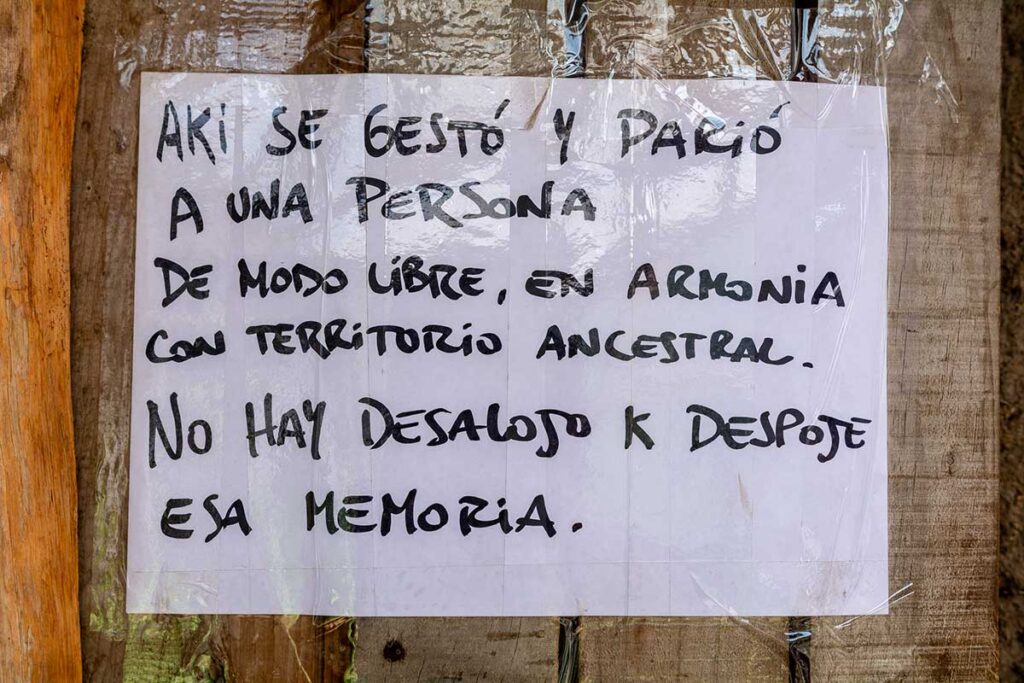
That is why, learning from past experiences, the Lof Pailako, with dignity, protected what truly matters: life. That day, a comment on social media asked: What will become of the war business without war? The Lof's decision to resist was clear and resolute: TO LIVE. When the genocidal dictator desires your death, the most effective form of resistance and re-existence is to survive with all possible willpower.
A few months earlier, a document prepared by psychologist Ruth Vargas was presented to the presiding judge in the case, detailing how the eviction would affect the children of the community. In this important report, the specialist concludes: “The eviction action contravenes international law concerning Indigenous Peoples, the Convention on the Rights of the Child (1989), the United Nations Convention Against Torture (1984), the Inter-American Convention on the Prevention, Punishment, and Eradication of Violence against Women (Convention of Belém do Pará, 1994), and other international instruments.” The Argentine justice system ignored her recommendations.
Between bulldozers and chainsaws
A tyrannical model of governance needs its symbolic counterpart. Like in horror films, where the malevolent character lurks in the darkness of night with his chainsaw to murder the innocent, Milei, with his chainsaw, destroys the small gains of organized communities that the cowardice and mediocrity of previous governments failed to solidify. Bullrich's bulldozer represents hatred of the epistemology of life. Patricia Bullrich, whom no one voted for, yet governs, and she appeared content beside the bulldozer.
I wonder if that indolent woman has ever been a mother. And if she has, what kind of motherhood has she practiced? I remembered my conversation with the women of the community, that afternoon at the beginning of spring, around the fire, when we reflected on mothering from the perspective of identity. What kind of values do we want to bequeath to our children?

These young Mapuche mothers are clear that the non-Mapuche people never had anything to offer us, and we will continue building spaces that strengthen identity for the next generation. The land is our school, our ancestors our memory, and the entire Mapuche territory our educator . The interesting thing is that we are not alone on this path as a people; people from all over the world are awakening, seeking to build a just and better world, in which no bulldozer has the power to annihilate the new paradigm being woven among the Mapuche peoples. Paul Preciado says in his book, *I Am the Monster That Speaks to You *: “ Faced with the epistemic crisis, processes of reform and cognitive hijacking, political renaturalization, and discursive regression are activated from the most conservative spheres. A terminal strategy to prop up the old patriarchal-colonial paradigm . ”
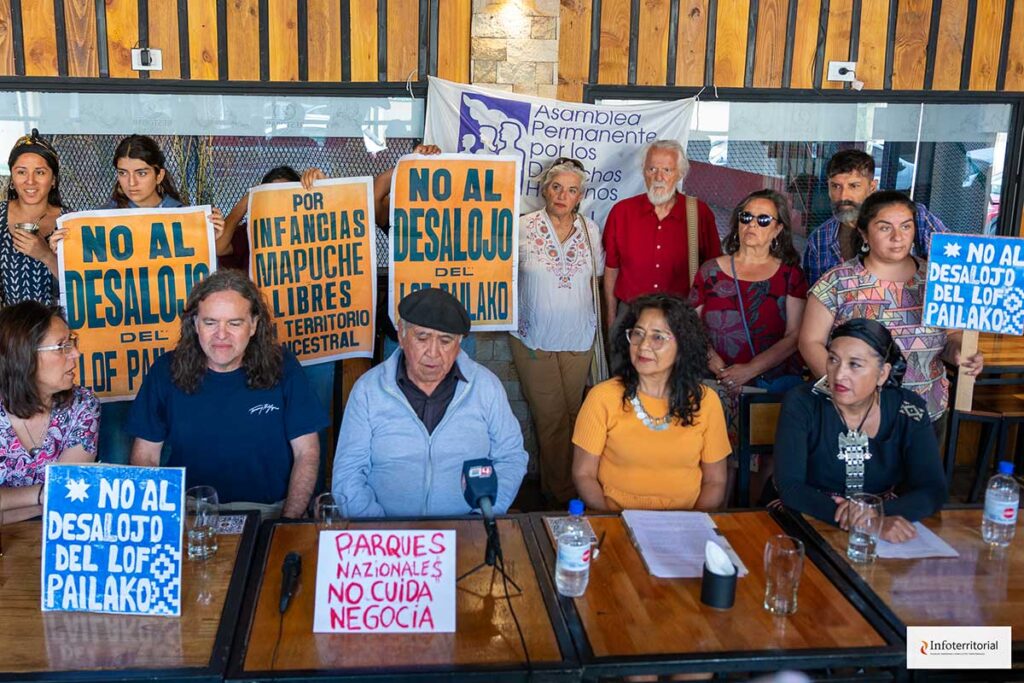
Argentina today is a laboratory for these fascist, racist, and hateful sectors. Governor Ignacio Torres, known for being a Dasneves protégé and a diligent disciple of mafia-like politics, accuses a sector of the Mapuche people of being misfits . We might think that the fascism he represents is that of those misfits within the great movement for collective rights, the rights of nature, and the fundamental rights of peoples, but it is also true that we, the Mapuche, are incapable of adapting to policies of death, of continuous aggression against all forms of life; that is to say, we will never adapt to Terricide, and they, the Terricide perpetrators, will suffer our rebellion time and again. How long will this go on? Until we restore the sacred bond with all life.
There was no eviction; only the land decides who lives there and who must leave. How long will the architects of death continue their earth-killing attempt? Governments come and go, but the land and its people endure.
We are present
We are committed to journalism that delves into the territories and conducts thorough investigations, combined with new technologies and narrative formats. We want the protagonists, their stories, and their struggles to be present.
SUPPORT US

FOLLOW US
Related notes

We are present
This and other stories are not usually on the media agenda. Together we can bring them to light.