

Stop the violence against sex workers: "We all get burned here"
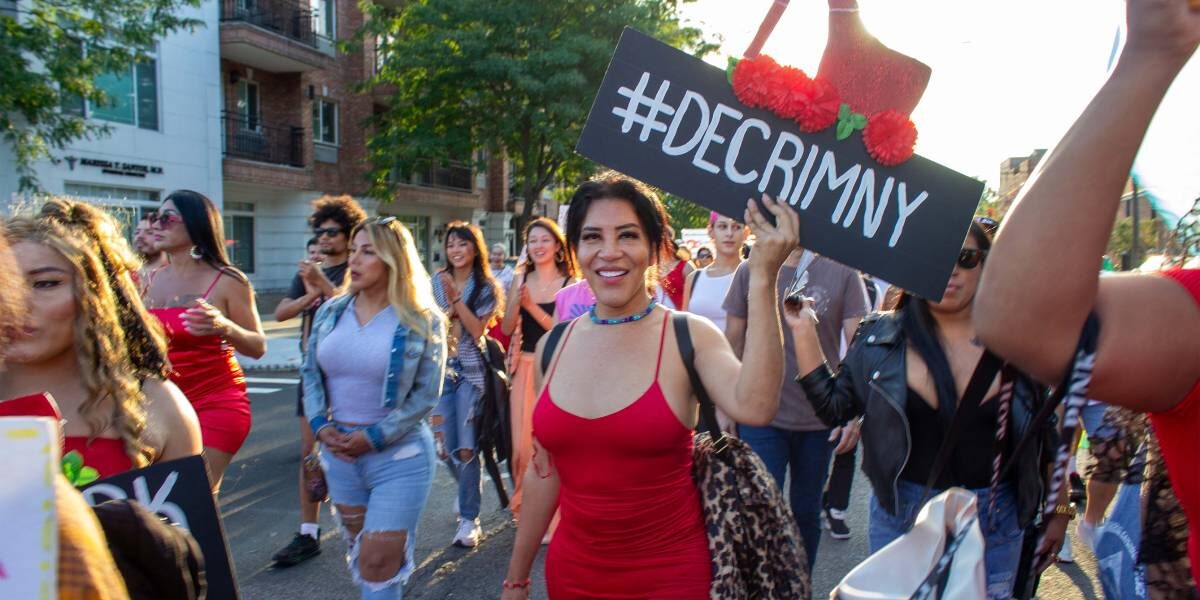
On the International Day to End Violence against Sex Workers, Natalia Lane portrays the lives of transvestite sex workers.


Share

In a few days I'll be 35, a significant age for any street trans woman. I feel like I've lived many lives, and yet I still don't have enough time. I've used up more blanks than you'd expect from a sex worker.
I feel old because deep down I know that we trans women who live life in the fast lane. I transitioned eighteen years ago, a whole adolescence, when there was nothing. Literally, my predecessors and those of my generation toiled in almost barren land.
When I confess to people that I'm tired, some reply, "But you're so young! You're only in your early thirties." What they don't realize is that I'm not referring to my adult years; transvestite years are counted differently.
As the writer Camila Sosa Villada rightly says, trans women age quickly. And when it comes to sex workers, things get even worse. Here on the street, there's no time for a normal life. We don't plan for the future.
I still remember the words I said to my mother when I left Naucalpan 17 years ago: "I'm going to leave and I'm never coming back." I think I've kept my word, and far from making me feel good, that makes me think about what I missed out on because I had to face life on the streets from a very young age.
This week marks the International Day to End Violence against Sex Workers . We've talked a lot about institutional violence, police violence, state violence, and criminalization. But what about the violence that affects us from within?
A few days ago we had a meeting to plan our activities for 2025 at the Prostitute Labor Coalition, the sex workers' collective we launched this year, which now has over a hundred members between Mexico City and Mérida. Obviously, the meeting ended in a drunken stupor, and many of the grievances we colleagues have been carrying came to light.
Because being a prostitute still hurts in this country. No matter how many progressive human rights speeches we hear from governments, no matter how many feminist slogans shout "we were all there"—we know that prostitutes don't belong there. We're uncomfortable even within feminism.
That same week, there was a discussion in a WhatsApp group for sex workers about a girl who charged a client an exorbitant amount of extra money because he smelled like poop and didn't have his own condoms. We were all there, debating whether the other woman should give him his money back or not because the guy was already starting a huge fight.
Other times in the group we argue about what's up with condoms, how much we should charge if the client wants to pay without one. As if the more expensive we are, the less of a whore we are. Some even brag about how they treat clients; it seems that the more you mistreat them and the more requirements you impose, the less of a whore you are.
It reminds me of the fights I've left behind on Calzada de Tlalpan , where we'd get into fistfights over gossip about whether the woman next to you gave you a dirty look or if you were charging less than the others and you earned the reputation of being a "louse."
I've worked in both environments, online and on the street, and I can say that despite being different, there are many similarities. Perhaps the most difficult thing is that none of us want to be cheap prostitutes. We use pseudonyms to disguise our work—escort, companion, some even call themselves erotic professionals.
The truth is that I don't want the stigma to affect me, because when it does, I always end up getting hurt.

So I go back to drinking with my CLaP! , and we talk about some really messed up things that have happened to us with clients. The least of it is getting yelled at or having someone try to strangle you; the worst part comes afterward. The aftereffects it leaves on your body memory. Your nervous system learns to be on high alert all the time , even when you're not swearing.
You swallow all that crap because there's no alternative, yeah. But there's another kind of crap that I'm not even sure there's a word for. It's a mix of shame, of feeling inadequate, like when you're coming back from an epic morning binge on public transport and you feel that burning sensation inside, you feel like everyone is looking at you with judgment and disgust.
I've never been able to completely let go of that feeling, because when you come out as a whore in spaces like feminism and the human rights movement, people treat you condescendingly . And don't even get me started on your own family; you become the black sheep. But it's not the money you give them to soothe the shame you feel for being who you are that's truly awful. It's an unspoken agreement: you're a whore, but I'll accept your money in exchange for—affection—and not asking so many questions.
People treat you as if their lives aren't as broken as yours . And they're not, in many ways they probably aren't, but it makes them feel superior when they tell you they don't charge because they don't know how. As if you needed permission or a prescription to eat and not starve.
I belong to a generation of transvestites who have reptilian, chameleon-like skin. When I hear other, younger trans women complaining about stupid things, I feel like beating the crap out of them and showing them how things are resolved on the street. Obviously, my politically correct side stops me. That's why I want to talk to you about the raw, unadulterated power of transvestites that burns inside you.

Iram Massiel had just arrived from Berlin, and I remember being introduced to her for the first time in the VIP area of the Híbrido, in the Zona Rosa. She was wearing a stunning lilac dress, the most iconic of her whore career, her blue eyes inquisitive and made up under a layer of fake contact lenses, because we old-school whores loved contact lenses.
Massiel belonged to the generation of trans women who carried themselves with a powerful presence. The world could crumble before their eyes, and they would remain unfazed. We exchanged few words; I was incredibly nervous because she was so tall and her mere presence was imposing. She bought me some drinks, and we took a picture. It was 2012.
Twelve more years passed. I was back out prostituting myself in New York when I checked my phone and found out her boyfriend had stabbed her in Huamantla, Tlaxcala. The last time I saw Massiel was this year in the plaza outside the Cuauhtémoc borough hall. She was standing in line to receive financial assistance as part of the trans health program. The cynicism of that trans woman I'd met at El Híbrido was gone.
I'm telling you, the life cycle of transvestite prostitutes is overwhelmingly fast. It doesn't take long from the time you get your first breast augmentation and rhinoplasty until you realize that other, younger girls, who are better looking and more brazen, are arriving at the sex work scene.
My sister Oyuki, head of the first public clinic for trans people in Latin America, always talks about capitalist bodies, about consumable bodies. She says that when you get older on the streets, things get even harder. As if the shit we have to put up with every day as a transvestite hustling on the streets weren't enough.
And even if we refuse to admit it, deep down we know that younger, prettier colleagues will come along, colleagues not as scarred by violence as we and our predecessors. It's almost like an epiphany. So many of us have to suck it up and start making room for resignation. Of course, we won't stop being vain and we'll say that we're prettier than the younger ones. That we were more cunning and less foolish when it came to getting paid.

"Prostitution isn't what it used to be, the streets don't pay anymore," Nicky Castelan, an iconic trans woman who started working as a prostitute in the Revolución area before she even had a voter ID, tells me. We're sitting over there in the Colonia Guerrero neighborhood; she now has cancer, but that doesn't stop her from being a true queen.
She posts photos on Facebook all made up and wearing blue contact lenses, because, as I already told you, contact lenses are important for trans women of my generation. Nicky tells Laura and me that she feels like the chemo is burning her up inside. And I can't help but think that we sex workers are burning up inside. And there's nothing we can do about it.
As I said, I'm about to turn 35, and I'm not going to waste another minute explaining why I chose the streets. No trans woman deserves to carry that burden. Let them think whatever they want, whether it's white feminists with a savior complex or other trans women with moral panics who judge us for choosing prostitution , as they call our lives.
There are no happy endings here, no hopeful phrases. We whores will continue to fracture the world and probably burn inside. That's the price we have to pay for living a wild, hurried life. But let it be very clear that our fire will burn you too. Because there's no place in the world where the whore stigma doesn't reach us all. So here, we all burn .
We are present
We are committed to journalism that delves into the territories and conducts thorough investigations, combined with new technologies and narrative formats. We want the protagonists, their stories, and their struggles to be present.
SUPPORT US

FOLLOW US
Related notes


We are present
This and other stories are not usually on the media agenda. Together we can bring them to light.