

Milei's year: the removal of rights for the public and abandonment
Lawyer Alejandro Mamani analyzes the setbacks in the twelve months that have passed since Javier Milei took office.


Share

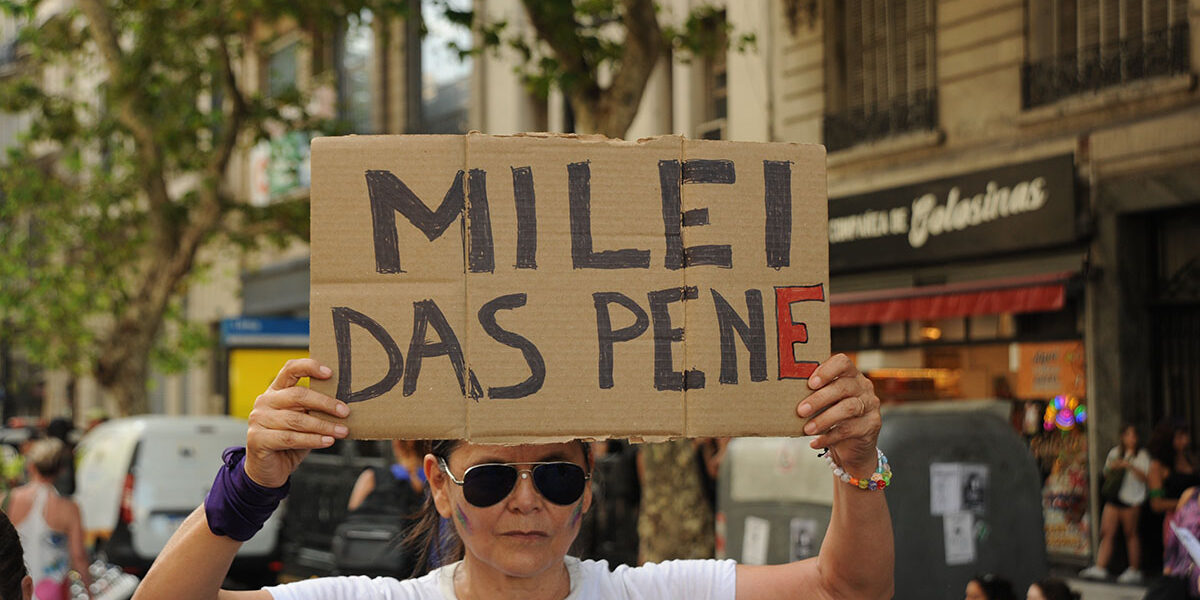
It's been a year since Javier Milei took office. To discuss his administration, it's crucial to understand that, within the framework of the republican state we live in, his government entered the democratic system in a novel way. It formed coalitions, but faced a climate of widespread social discontent. This situation is multifaceted, and while traditional media may play a significant role, it's not the sole determining factor.
There are multiple factors that explain why this accumulated anger isn't entirely unique to Argentina as a country; we're not so special. It's part of a broader international situation in countries where, despite significant progress in human rights, there has been a setback. And we can talk about countries ranging from Nicaragua to the United States. These are societies that haven't found answers to their long-standing demands on a wide range of issues under traditional governments.
In the Latin American case, there are super strong figures who have worn down over time and no legitimate successors have been born or built in this regard.
Towards conservatism
A year later, Milei's policies, perhaps not in a fundamental way, but certainly through the coalitions formed and indirectly, show a classic line within the structure regarding positions related to the LGBTIQ+ community and the rights of the population.
There are lines of alliance with the government, such as those with conservative sectors in the provinces. Or even conservatives within the Catholic Church, which is not uniform; and other conservative churches that have generated a kind of backlash against social movements like feminism or the LGBTQ+ movement. This is also part of what can be analyzed to understand the breeding ground in which certain issues are currently simmering.
The setbacks
On a more specific note, we can analyze next year's budget for the HIV program, which is lower than last year's, without considering the year-on-year increase in the number of people living with HIV. This is part of the budget cuts, if you will, and I think it's a very serious issue because it involves a population at risk. Organizations like AHF Argentina and Act Up Argentina, among others, are constantly denouncing this.
Then we have lines of thought that follow a logic perhaps a bit closer to internet dynamics. And in that vein of baiting, of generating headlines, or creating noise, in factual terms at the population level, the impact is confusing. For example, the statements regarding the elimination of the non-binary ID card. One may agree or disagree with something, but when the State moves forward in terms of rights, the international human rights principle of pro homine is non-retrogression, and this is part of what is supposedly going to happen.
If this happens, people with ID cards ending in X would be left in a kind of legal limbo, orphaned. This legal security, which is so often advocated, is precisely what disappears with the issue of non-binary ID cards. There are numerous bills concerning transgender people, such as those that reduce gender identity protections for children and adolescents, and the issue of private health insurance and its deregulation. In addition, there are the problems faced by people with HIV and transgender people who constantly report a lack of coverage or, through surreptitious means, their expulsion from private health insurance plans.
Being old in the Milei era
Older people have been the biggest victims of this government. For example, with the elimination of 100% medication coverage and the freezing of pensions. LGBT seniors are part of the elderly population. They are among those who were able to retire, many working precarious jobs or only recently securing a pension, and now they see everything cut back.
It's so complex at a macro level that the constituency within the LGBTQ+ community absolutely requires a prior statement at the macro level. I can't deny that even within this diverse group—and we're not all uniform—there have been and still are people from diverse backgrounds who have campaigned for Milei, voted for Milei, and are part of this group that is dissatisfied and angry with traditional political parties.
It is possible to go back
There are generational social groups that were born or grew up with an already established structure of rights, such as same-sex marriage, the gender identity law, decades of activism for the destigmatization of the positive population, and who at this time do not accept that this could be lost.
A large part of the population doesn't realize that rights can be rolled back and that this is a problem. Then there's also the issue of the loss of purchasing power, the decline in the quality of healthcare, and the diminished responsiveness of institutions, including the disappearance of INADI (National Institute Against Discrimination, Xenophobia and Racism). Many criticisms can be made of these institutions, and perhaps some very valid ones, but eliminating them doesn't lead to more rights; quite the opposite. A reorganization of an institution, at best, can be seen as strengthening the protection of rights, not its elimination.
And I believe there's a social climate that has enabled, if we want to call it that, these institutional punishments. From cuts by institutions that haven't been able to fulfill the purpose for which they were socially created, to budget cuts that are symbolic in terms of what's "cheap" because sometimes the economic impact isn't real, but the feeling of being punished by a social sector certainly is.
The bait as a starting point
I think it's crucial to understand that many news stories related to diversity and trans identities, including transvestites, non-binary people, gay men, and lesbians, generate a huge amount of buzz on social media. And that these stories are often used to saturate certain areas with news while obscuring other issues.
I think it's crucial to understand that much of the attack on the LGBTQ+ community, while stemming from the historical roots of what we might call conservatism, homophobia, homophobia, transphobia, and so on, also has an added element specific to our times. That element is the instrumentalization of these actions to generate content. We could even talk about generating news.
Against the diverse population
In short, we can talk about the proposed laws concerning the trans and gender-diverse population, the reduction and narrowing of the scope of the law, its limitations, and the rollback of rights for the non-binary population due to the very issue of documentation, which is extremely uncertain. This opens a door to uncertainty. If national identity cards are eliminated, what is the State's response? Change them again? Choose a gender? Render passports and other documentation useless? In other words, the fact that the State has granted recognition and then reverses it is something that could even raise international concerns
What worries me most, at least, is the issue of urgency. And that's where the HIV-positive population falls short. The gay and trans communities have fought hard, first for visibility, then for destigmatization, and then for access to medications and prophylaxis options. I find the current situation quite dangerous.
Then there are all the macro policies not primarily intended to affect the LGBTQ+ population, but which do affect it because diversity is part of society. And that's where the elderly population and people with disabilities come in. People who, in many cases, lack support networks or have fewer support networks than other population groups.
A significant issue is the institutional violence against the transvestite and trans population, and especially against migrants, in that place
The discrediting of institutions
To all this, we must add the erosion of institutional structures. While this already carried a burden of disrepute, in certain places it has now transformed into a rejection of trust. In many cases, this is also understandable: distrust in the justice system or the healthcare system. Today, we have the migrant population and the healthcare system in Salta, which currently charges tuition. There is freedom to charge tuition at universities for the migrant population, while the quality of education declines.
This year's analysis is so complex because it demands both a global perspective and a specific analysis of, for example, the LGBT population. But before that, it's crucial to understand this year within the dynamics of democracy. To understand that there is a very angry segment of the population, and that this anger isn't necessarily due to innocence or ignorance. Rather, there is a collective weariness, perhaps amplified by factors such as social media and news channels. These kinds of feelings are global, and that speaks to the complexity of what we are experiencing right now.
Alejandro Mamani is a lawyer, specializing in Technology Rights and Human Rights.
We are present
We are committed to journalism that delves into the territories and conducts thorough investigations, combined with new technologies and narrative formats. We want the protagonists, their stories, and their struggles to be present.
SUPPORT US

FOLLOW US
Related notes
We are present
This and other stories are not usually on the media agenda. Together we can bring them to light.