

Interview with Julieta Sverdlick: How to write a lesbian novel during a pandemic
Interview with Julieta Sverdlick, author of Whenever You Want You Can Destroy Me (Metrópolis, 2024). The novel narrates the awakening of love between two girls. On the power of representations, bodies, and identities.


Share

“School was no longer a place where I had to survive and pass the time. That building had become my ocean, and I, almost without realizing it, had stopped thrashing and swallowing water. Pen in hand and with a thousand words flowing, I had finally learned to swim,” writes Julieta Sverdlick —actress, singer, writer—in Whenever You Want, You Can Destroy Me (Metrópolis, 2024), her first novel. A life—or rather, two lives—confronted by a challenging reality, which the author masterfully navigates with poetic skill, revealing a love story that banishes the idea of romantic love as a savior. This narrative voice is powerful, its own salvation and no other.
The awakening of love, of sex, between two girls, bodies that meet and part ways; perhaps an unexpected challenge that life rushes them to confront. A profound story penned by Sverdlick that, like the pen of the protagonist in Whenever You Want …, draws her into the deepest waters of the self.
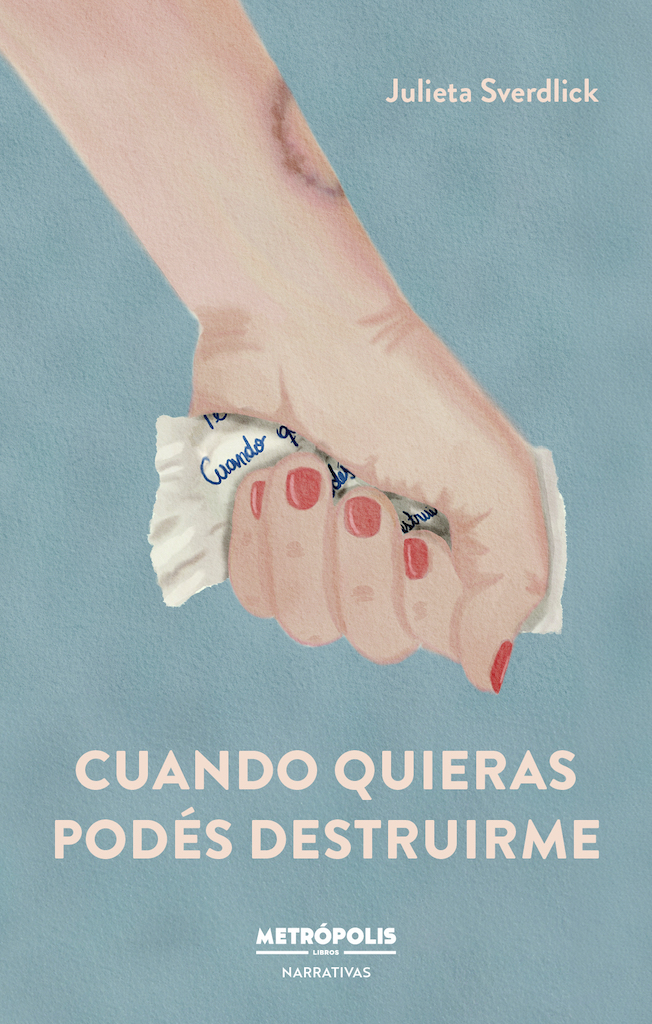
― The book's title is a statement in itself: "You can destroy me whenever you want.".
"It was quite a lot of work. And initially, the text, which was actually written in the workshop, ended up filed away in a virtual drawer. Then, my dad sent me a link to a contest that awarded prizes to projects in progress. It was a chance to rethink everything. I met with Karina, my lifelong teacher, and then I also contacted Luz (Santomauro, her editor). And of all the texts I had, the one that says ' you can destroy me whenever you want' already existed. She liked it as a title. I wasn't completely convinced. I took the texts to her. She told me she saw two possibilities for this book, and I thought, 'What book?'" “We gradually came to the conclusion that the relationship was the central theme, interrupted by these childhood memories that would reveal how this crumbling thing had been formed. The first chapter ended up being the collapse. I wondered where the destruction comes from—whether it stems from a positive place to build something else, or from simply throwing away all the garbage. There's also the idea of surrendering to love, opening oneself to the possibility of these things happening, and exploring to what extent that is love, and to what extent it isn't. It was about trying to redefine that phrase. And this question of the protagonist's self-doubt emerged in different chapters: who is destroying whom?”
«The things one manages to say to others, one doesn't hear for oneself«
― Throughout the narrative, you explore two closely related issues: identity and the body. Today, identities are defined by sexuality.
Sexual identity runs through the book and is its central theme. The part about the body was something I added. The two things looked very different twenty years ago than they do now. Having had a chaotic encounter with my sexual identity during adolescence, it forced me to confront it and take a stand. To choose which story I wanted to tell myself and which story I wanted to accept as true. To construct my own. I appropriated that narrative, managed to feel comfortable with it, and defend it. Although, in terms of body image, I haven't resolved it at all. It's like a more recent internal and external struggle; it's uncomfortable because it's much less settled. There are things I can't change in my thinking, although, you know, one is much more forgiving of others than of oneself. The things one manages to say to others, one doesn't listen to oneself . With this topic, I didn't know whether to delve into it or not because I don't know how far I'm ready, or how much I have to say. It ends up being a central theme for the character, because it also deals with discomfort with oneself, how one stands before others, and how that outside world affects one.
― It's a young adult book. Is it a young adult book?
—As for the publishing category, I think it's fantastic for teenagers. It can be a reflection or a place to identify with, in a process they might be going through or about to go through; but I didn't write it thinking about that. And I think it can be read from an adult perspective, and you can find other things in it. On the other hand, I don't want to take responsibility, not to avoid responsibility, but to avoid putting myself on a pedestal. I do know that if I had come across a book like this in my teens, my life would probably have been different . Because representation makes things different , because, as I also talk about in the book, I didn't have any role models of girls who were with girls, and it wasn't until I was well into adolescence that I knew it was a possibility .
Writing a book during a pandemic
― You're an actress, singer, fiction writer, can we add playwright?
“I’m trying to get into playwriting, and I haven’t quite finished yet, I’m just dipping my toes in. My journey with words began a long time ago. I started writing as a child, making up stories. I didn’t write them down. Now you can, but when I was little, that didn’t exist. I used to say, ‘If I could dictate to a typewriter, I’d have tons of stories written down.’ Later, in high school, I wrote poetry and took a writing workshop for a long time. I was obsessed with the workshop, going two or three times a week… Beyond that, I always wanted to be an actress, but in my family, intellectual pursuits are highly valued. I studied Literature for a year and a half or two, and then one day I just stopped going. I skipped school in Puan to go to a theater class, I quit the workshop, I had a hiatus with literature. It seems that the whole situation of just having to sit and read led me to not pick up a book for four years. I went somewhere else, I started studying music and theater, and I went to the School of Contemporary Music.” That urge to write kept nudging me from time to time. And little by little, I made peace with it and rediscovered the literature of my life.
― From there to your first book, it's just a step.
— Yes, and right during the pandemic. We were so bored and stuck inside. I was in Arkansas, because life is weird. I spent the whole pandemic, a year, living in Arkansas.
― Tell us about that.
—In 2015, I went to New York to study musical theater. At first, I went for eight months, just to experience it. I said, well, I'll go for the first year to try it out. I was twenty-six. After a week, I said, "I want to live here." I stayed to finish the conservatory for those two years and then for as long as my visa allowed at the time. I wanted to get another one, but it was a hassle. I had to go back to Argentina for a couple of years until I applied again, and it was fine. In the meantime, I met who is now my wife. After two or three months, I had to leave, no matter what, because I didn't have papers. We were together as girlfriends for three months, and then two and a half years away. Very lesbian stuff and crazy people, to be honest. (Laughs)
I was able to get a visa and return (to the United States) in March 2020. I arrived a week before everything shut down. I had started working, but suddenly I couldn't do anything else. Besides, I had an artist visa that only allowed me to work in theater-related fields, and that was impossible: there was no theater.
― What were those days like?
—The two of us were locked up in a small apartment in New York for fifteen days. One of us was going to die at the hands of the other, I don't know which one, but it was going to happen. (Laughter) She said to me, “Let's go to Arkansas, to my parents' house.” I had seen them once, as a friend, and I said to her, “Are you crazy?” Three days later, I was the one who said, “Let's go to Arkansas.” It was a salvation to leave, to be in a house surrounded by greenery. We could go out, walk. There, in a moment of boredom, I started writing again. A little more about that connection that had always been there, present, appearing. And I got hooked. I wasn't trying to write a book. I don't remember who I was talking to; I was telling them that I always had the feeling that I didn't remember anything from when I was little, I had very few memories. I did an exercise and said, I'm going to try to write my first memory, to see what's behind it. And that was the first thing I wrote, which later ended up in this book.
― It's interesting because, being a theater person, there has to be a very psychoanalytic, rigorous introspection there.
—My parents… My parents couldn't have done it any other way. They are Lacanian psychoanalysts, yes.
― And what was this first memory?
—Actually, it ended up being a chapter. It talks about what my family was like, about going back through memories; it was refined and grew throughout the book. I wrote trying to remember and see things from that little girl's perspective. There's a chapter where I recount when I realized that five minutes was time. Like they contained something. That's how I started writing. I did a remote writing workshop with Karina Macció, also very much during the pandemic, for a couple of months. I brought some of these texts, and they asked me: What happens if this character, this little girl, grows up? What would you write? What moments would you recount? That's what prompted me to take the leap. I was stuck in childhood, trying to go in order, and that's when they encouraged me to take this character—or myself, who knows—and move her through time.
—The narrative voice is very strong. It's not only in the first person, which is always present, but it also has a lot of poetry. How did you step back and look at the perspective?
—At first, I didn't really decide. It was more of a "let's see what happens" kind of thing. And yes, I always felt that voice, a voice that's very much my own. What interested me most in those early memories was conveying that little girl's perspective as clearly as possible, describing those sensations, those tiny things that were huge for her at that moment. It came from there. I talk a lot about the feeling in my stomach; I think I feel things from there. It grew until I established the central conflict: what I wanted to tell. Then came this coming-out scene (an expression I don't like, but I can't find another). What interested me most wasn't necessarily the drama of coming out or the reactions, but how this little girl, who had believed she had to be perfect, or who believed in the moral code of not lying, suddenly starts to crumble and fall apart because if I have to lie to see the person I love, is that wrong? What interested me most was that, that same voice and that core of the character's reflection.
"We've got a fight ahead of us."
― Let's talk about lesbianism.
“When I was a girl, I knew a woman who used to come to our house with her friend. She was an acquaintance of my parents. This generation of adults I was around would say, ‘So-and-so is coming over with her friend.’ They didn’t say it out of malice or homophobia. But what message does that send to a girl who, from her earliest days until she was fourteen or fifteen, was called ‘the friend,’ but then you realize that no, they were saying ‘friend’ for fourteen years. And why? Why is it that they say ‘boyfriend’ or ‘girlfriend’ about so-and-so, and ‘this one’s the friend’? So there’s something that can’t be said. And that’s a message in itself. I understand that that generation was trying to hide something, but there was a feeling that it was better not to say it. That’s also a message you internalize, without words. And I tried hard in the book to portray that everyone was doing the best they could with what they had, out of love; nobody intended to do anything wrong, and in fact, things were changing. That’s it: what isn’t named doesn’t exist.”
― And today?
"Today there's more representation, often by force, and even if parents don't want it, the child sees it anyway. When Disney puts two mothers in a movie for 30 seconds, everyone jumps in to complain, but Disney has to include it, even though it took them a long time to do so, and it's never the main character. Let's wait another ten years. I think the concept of freedom of expression can be fragile: 'If I don't like it, I can say I don't like it.' No, you can't. You can't have an opinion on other people's rights . You can have an opinion on the color of shoes, if you want, but you can't have an opinion on rights; it's not the same. Luckily, in many circles these things are being discussed, they're becoming more open. But I also have a message from a young woman in her twenties, asking me if the book exists in PDF format because she can't bring LGBT community books into her house. So, we have a long fight ahead of us."
We are present
We are committed to journalism that delves into the territories and conducts thorough investigations, combined with new technologies and narrative formats. We want the protagonists, their stories, and their struggles to be present.
SUPPORT US

FOLLOW US
Related notes
We are present
This and other stories are not usually on the media agenda. Together we can bring them to light.