

Why trans women and transvestites are suing the State for institutional violence and demanding the right to social security
Thirteen trans women and transvestites are suing the Argentine state for institutional violence. They are demanding that the courts uphold their right to social security so that trans people over 50 can live with dignity.


Share

BUENOS AIRES, Argentina. The Trans Memory Archive, together with the Center for Legal and Social Studies (CELS), filed a legal action denouncing institutional violence. They are demanding their right to social security so that transgender people over 50 can live with dignity.
“We are taking this legal action with thirteen signatories, submitting our own police files after a four-year investigation ,” María Belén Correa, founder and director of the Trans Memory Archive Agencia Presentes . “We are presenting the necessary evidence of the violence we suffered. We have always had memory and truth, but we never achieved justice,” she added.
The injunction is signed by María Belén Correa, Lara María Bertolini (Diversity and Justice) , Marcela Ángela Saibek, Andrea Soledad Vargas, Candela Nicolosi, Nicole Valentina Chavez, Paula Ezkerra Rodríguez (TAE Trans Argentinas Exiliadas), Wanda Eliana Galeano ( Claudia Pia Baudracco Library ), Ivana Tintilay (Proud Whore), Alma Rosacintia Agüero, Patricia Alexandra Rivas, ( Historical Argentine Survivors ), Dalia Silvana Álvarez Valverde and Romina Campo.
One violence among all violences
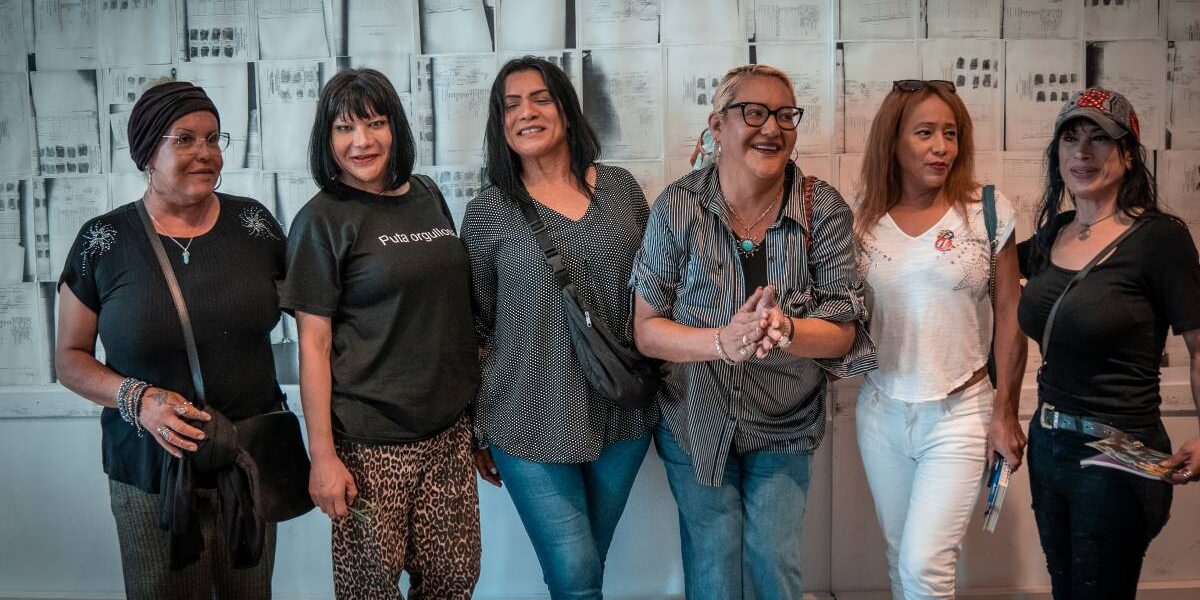
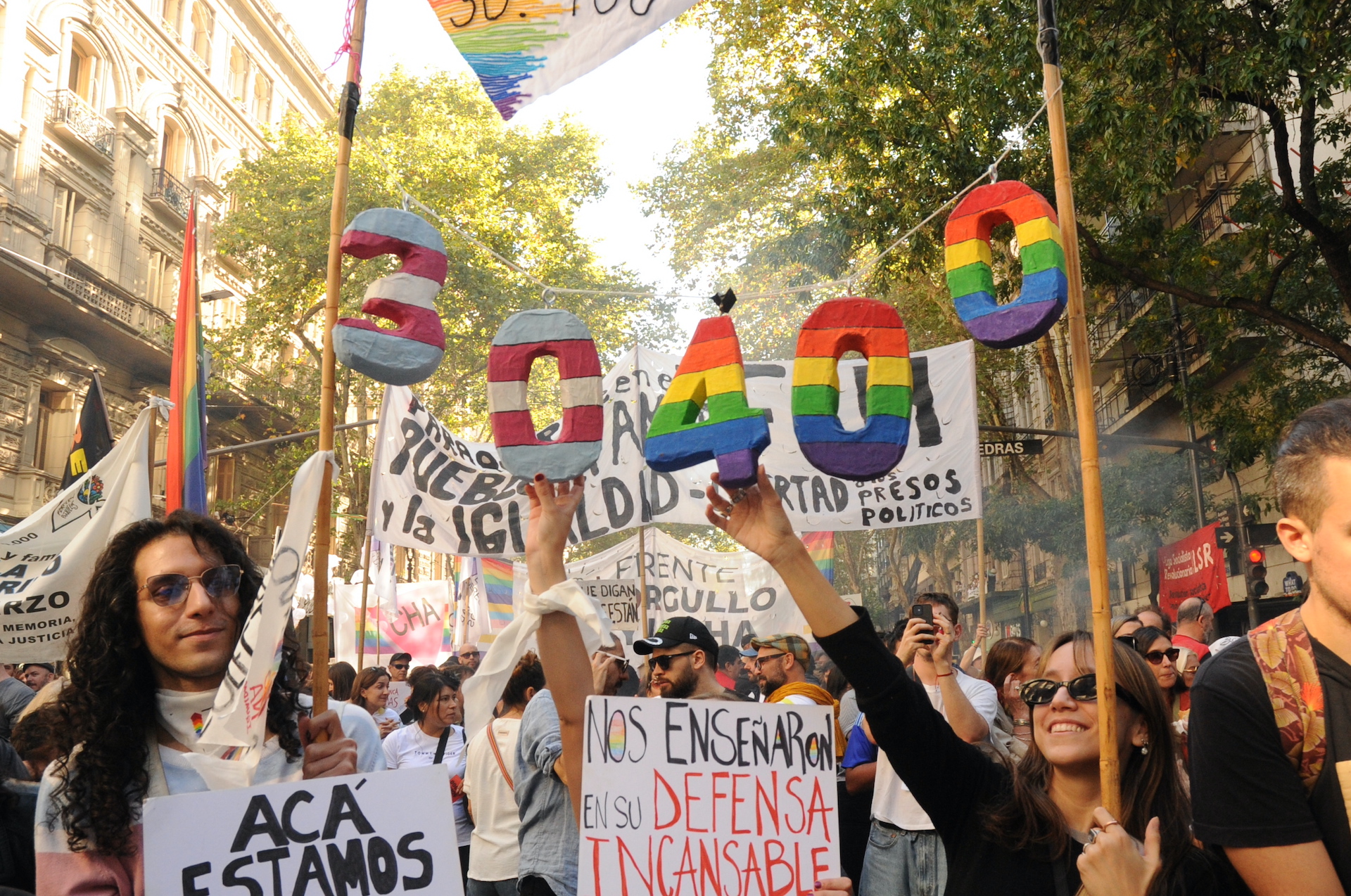
Surrounded by the police file that covered the walls of the CELS room, María Belén Correa, Lara Bertolini, Ivana Tintilay, three of the complainants, along with Lucía de la Vega and Quimey Ramos representing the organization, led the press conference on Friday, November 1, in the lead-up to the 33rd Pride March in Buenos Aires, which took place the following day.
“That file is just a part of one of our colleague’s files,” they said at the beginning of the conference, to illustrate the scale of the police harassment and persecution. In their statements, they described the institutional violence they suffered, not only at the hands of that institution. This structural violence also prevented them from accessing retirement or pensions, and from exercising their right to healthcare.
“ We are here representing what has been forgotten and has not been discussed within the LGBTIQ community in our own voices and from our own perspectives. But we cannot forget, nor can we fail to reclaim, the history of our persecution and resistance . That is the fundamental pillar of this legal action and the corresponding precautionary measure. From 1950, with the creation of police edicts applicable in the provinces and municipalities with their corresponding specific codes, the persecution of trans people was established, continuing until 2012,” Correa said.
The amparo action consists of a request for the Argentine State to recognize this structural violence and extend the scope of Law 24.241 of the Integrated System of Retirement and Pensions to provide them with a universal basic benefit .
Towards the future
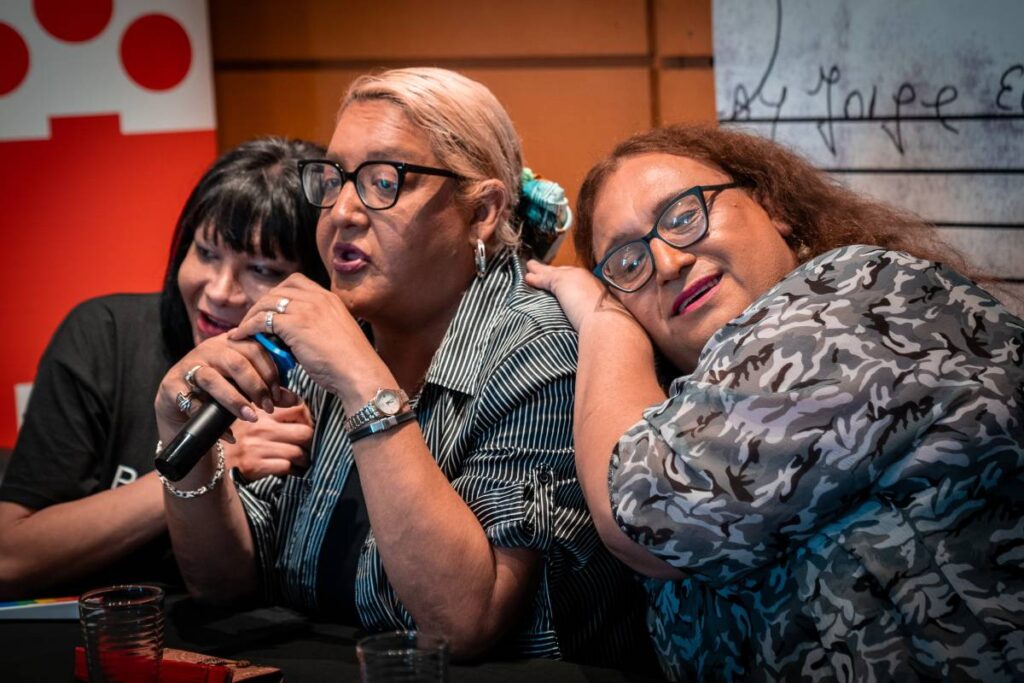
“ We want to send a message to all of society so that new generations of trans people don't have to go through police persecution, so that they don't experience all the abuses that we have experienced. It's a way of raising awareness, ” Ivana Tintilay told Presentes.
Ivana was the first of the thirteen to look for her file. And she had to walk those same corridors where she used to walk when she was arrested during her adolescence. Unlike some of her classmates, accessing her documents wasn't difficult for her.
“I arrived with my ID in 2018 and asked to start the process. When we began, we didn't know there was a law that gave us the right to retrieve our file,” she said during the press conference. “When I had the file, my lawyer told me to read it, but there was nothing new in it that I didn't already know. I remembered all the police stations where I had been detained and everything that had happened to me. She insisted I read it again and again, until I realized that the entire file referred to me as 'Jorge Eduardo'.”.
Furthermore, she recalled, “While Argentina celebrated democracy in 1983, that didn't affect our lives. Arbitrary police arrests, mistreatment in jail cells, brutal beatings, and the trans femicides and transvesticides that occurred daily never stopped. This situation never allowed us access to healthcare, dignified work, or any action related to social security, as a universal principle of human rights. Democracy for trans people arrived in 2012, just as our sisters and comrades who couldn't withstand so many decades of agony, persecution, and death were passing away,” she concluded.
One more reason to be proud
Quimey Ramos is a trans activist and works at CELS. Her task over these four years was to document the experiences of the first 13 women who came forward. “I want to tell you that they were asked repeatedly why they were the way they were. Why they were who they were. They didn't all give the same answer. Governments, doctors, teachers, and parents then tried to find a reason. They didn't know the reason, but they knew there was nothing wrong with the truth,” she said emotionally.
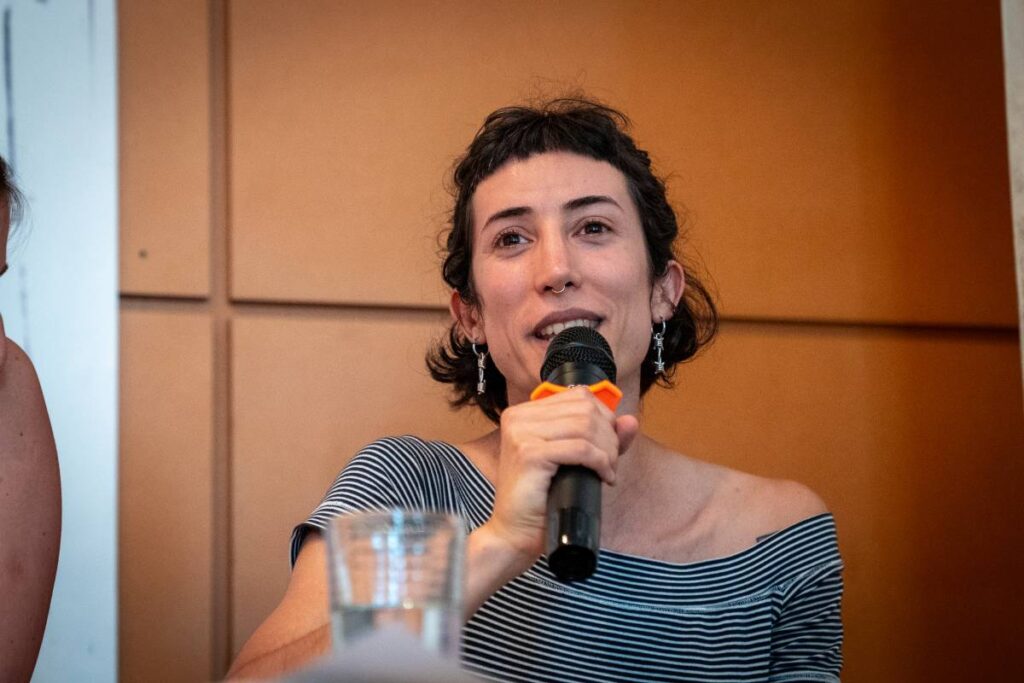
After the conference, in an interview with Presentes , Quimey stated: “The political importance at this moment, more than ever, has to do with a sense of memory and justice towards the past as a possibility for the future . And towards the effective future of the 13 transvestites and trans people who are daring to pursue this complaint for all the crimes they have had to suffer at the hands of the Argentine State.”
“There is a memory that we construct,” she emphasized. “Today, there is an abundance of narratives that suggest trans and travesti people are a passing fad. In this way (among many others), they call into question our rights, our equality in life. It is very important to explain that the social rejection that so many people feel toward us without thinking about it didn't come out of nowhere. It is a product of police persecution and all its consequences, first and foremost ,” Quimet explained.
A small group that survived
Quimey recalls that the persecution ended in the City of Buenos Aires in the mid-1990s, but that in the Province of Buenos Aires, the police edicts criminalizing trans people were only repealed in 2010. And that, in both Mendoza and Formosa, they were repealed in 2012 with the enactment of the Gender Identity Law. “It’s important to remember this in order to look ahead with clarity. And to understand why we are, therefore, an excluded and systematically marginalized minority,” she added.
Regarding the victims, she emphasized that they represent “a very small percentage of the population.” She highlighted data published by the National Registry of Persons in 2022. “It shows that half of the transgender population who changed their legal documents and died by 2022 were, on average, 44 years old. Another 25% were approximately 35 years old, and 75% died before the age of 53. So we are talking about a very small group who are alive not because of the guarantees that the Argentine State should have provided them. It is thanks to other factors directly related to their own capacity for subsistence and survival .”
“We are here so that our own archives can speak for themselves.”
Beside her, Lara Bertolini emphasized, “This presentation gives us the opportunity to proactively access social security, with extraordinary measures to prevent recurrence and avoid being forgotten by the Argentine State .”
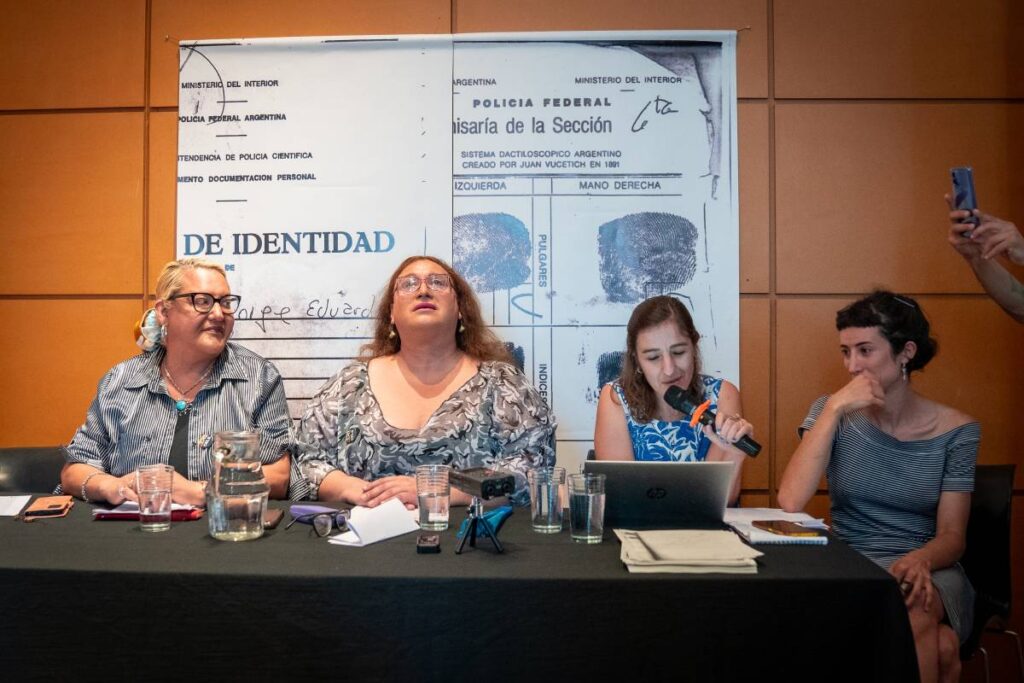
Through tears, she added: “The 13 survivors present here and those who are in exile in different parts of the world, we leave you our police files, our history and our unity, so that we can establish that trans women and femininities continue to build jurisprudence, legislation, democracy and justice despite everything.”.
“ We are here so that our own records can speak. So that our own lives can speak, and so that our revenge is that we are trying to grow old and do so with dignity.” Bertolini expressed that her generation “had it a little better because I came of age in the 90s. But this violence began in the 1950s, and we have to acknowledge that we are still living with it today.”
Also from CELS, Lucía de la Vega emphasized: “In a year in which we have had to take defensive actions, this is our first offensive legal action. Its novel aspect is the demand that the State guarantee social security for trans women over 50. This is a transformative measure, one that Argentine society and democracy owe them .”
We are present
We are committed to journalism that delves into the territories and conducts thorough investigations, combined with new technologies and narrative formats. We want the protagonists, their stories, and their struggles to be present.
SUPPORT US

FOLLOW US
Related notes


We are present
This and other stories are not usually on the media agenda. Together we can bring them to light.