

Where is Tehuel? The verdict will be announced in a trial that highlights the plight of trans people
The verdict in the Tehuel de la Torre trial will be announced on Friday the 30th. Activists are calling for a demonstration at the La Plata courthouse starting at 10 a.m.


Share

This article was published on elDiarioAr.com in Punto de Encuentro , an Amnesty International space to amplify the voices and perspectives of journalists, communicators and photographers who work on issues related to women and dissidents.
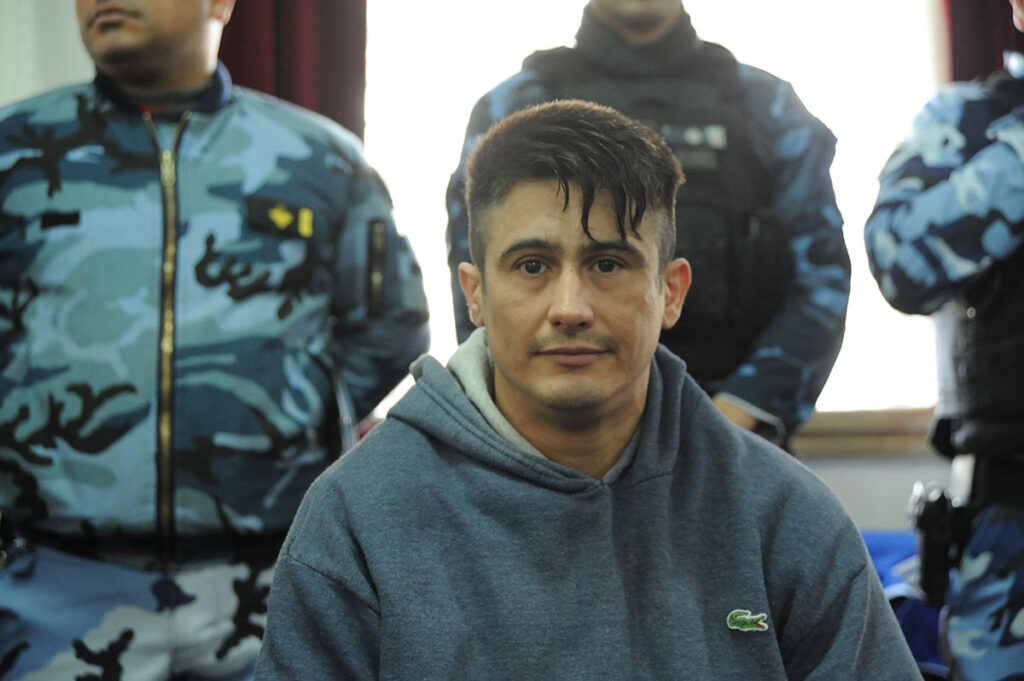
One of the people who could help answer the question “Where is Tehuel?” sat for seven long hearings before the Oral Criminal Court No. 2 of La Plata, his face expressionless and distant, lost in silence. Luis Alberto Ramos (39) is accused of the death of Tehuel de la Torre: aggravated homicide motivated by hatred of gender identity, according to the case file.
On March 11, 2021, Tehuel, a young trans man who was days away from turning 22, went to meet Ramos. He had offered him a job as a waiter at a party. This is what his girlfriend and sister recounted in the trial that began on July 15 and will have its verdict on August 30.
In its closing arguments, the prosecution, led by Juan Pablo Caniggia, argued that between 9:00 PM on March 11 and 4:33 AM on March 12, at Ramos's house in Alejandro Korn, he and Oscar Montes (who will face a jury trial) "intentionally caused the death of Tehuel De La Torre, motivated by hatred of his gender identity and sexual orientation, using methods yet to be determined." The private prosecution representing Tehuel's mother, Norma Nahuelcura, also requested the maximum sentence, life imprisonment, and community service, so that the case would have an impact beyond a criminal conviction. And so that, as his mother said, "there will be no more Tehuels."
The crucifix and the trans flag
Judges Claudio Joaquin Bernard (President of the Court) and Ramiro Fernández Lorenz, along with Judge Silvia Hoerr, listened to more than 60 witnesses from the bench, elevated on a platform. Behind them, a large crucifix stood out against a pink velvet curtain, faded with age. The elevation of the bench was also noticeable at times in the tone of some of the questions.
One of the many expectations of the oral and public process was to what extent the Justice system can respond from a gender perspective approach that does not only involve punishing, but also supporting, preventing, providing judicial responses to patriarchal violence, and applying aggravating factors to generate preventive and inclusive policies.
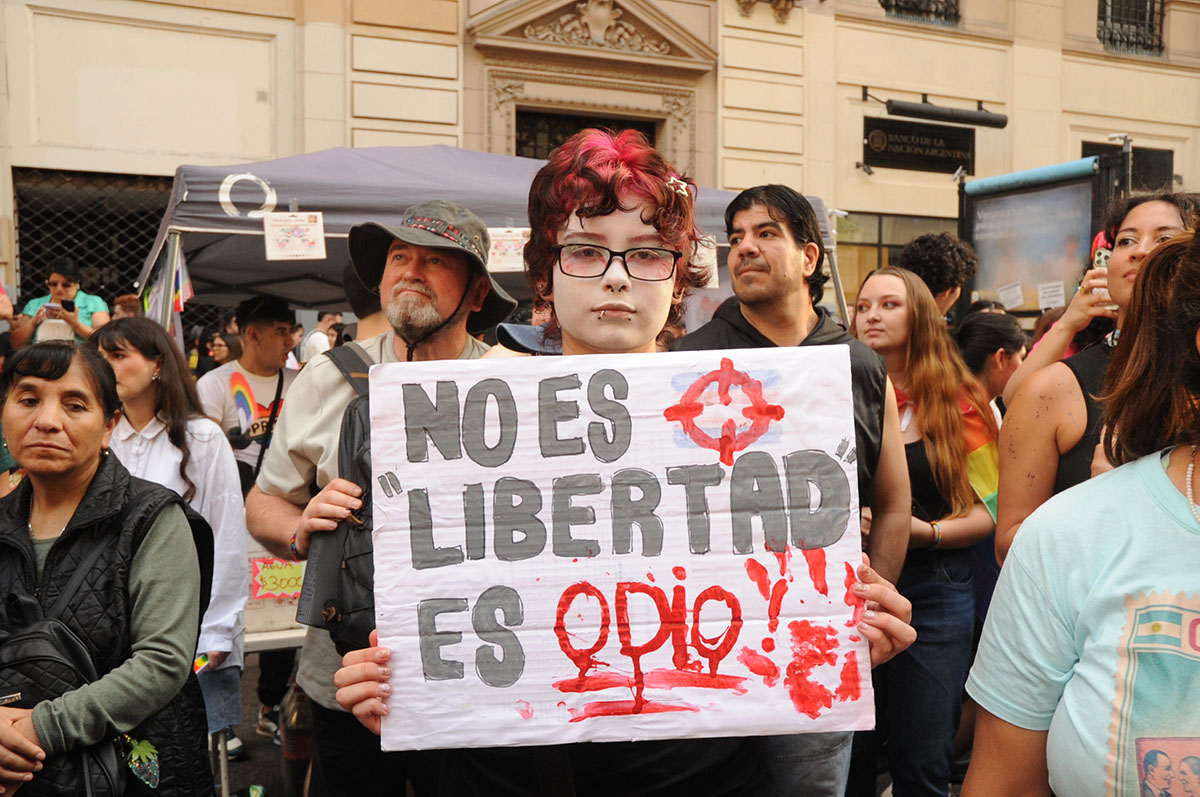
Perhaps to remind her, a trans pride flag was unfurled on a chair in the audience . It shone brightly amidst the activists, the mothers of other victims of violence, family members, officials—several from the Ministry of Women and Diversity of the province of Buenos Aires, which had supported the search from the beginning, stated that it should focus on her trans identity, and provided support—and some journalists.

Photo: Ariel Gutraich/Presentes Agency
What did the witnesses say?
Ramos didn't utter a word during the hearings. His only testimony was during the preliminary investigation, and due to his contradictions—such as claiming to have seen Tehuel in the afternoon when a photograph shows him with Tehuel and Montes that night—he was detained. His defense also failed to call any witnesses. No one testified in his favor, not even his family members, who recounted that although they hadn't seen him for years, when the police were searching for him, he came to see them in Dock Sud. There, he stole his uncle's psychiatric medication ("with how hard it was to get it!" the witness lamented), his disability card, and threatened his cousin with a knife to prevent her from telling the officers searching for him that he was there.
Four witnesses, including Tehuel's girlfriend and a former partner of Ramos, requested to testify without him being present. His presence instilled fear in them, and they feared reprisals. Ramos was then taken to a room from where he listened to them without seeing them. However, the court did not grant this request to all the witnesses who asked, and in each case, it demanded explanations.
The mother, the first to testify, recalled that when Tehuel was 12 years old, he called her and told her he liked girls. She then spoke about his gender transition during adolescence: she said she always accepted him, although she couldn't avoid referring to him with female pronouns. She emphasized that Tehuel's financial situation was dire. "Tehuel didn't have a job, he couldn't find one. He did odd jobs ," Norma said in a story that her girlfriend continued to elaborate on, portraying what it's like to be a young, poor, trans man living in the suburbs. Tehuel's financial worries were mentioned in other testimonies, as was the fact that Ramos lent him money to help him.
Tehuel's girlfriend was 17 in 2021, and they had been together for two years. She had dropped out of school when she became pregnant; Tehuel had left school in his junior year. She has a young son who was starting kindergarten at the time. They were raising him together. Money was a constant worry and an unknown. She baked doughnuts and fritters, and he went out to sell them on his bicycle. "If we didn't sell, we didn't eat." Tehuel looked for work but couldn't find any. "They told him they didn't want to hire him because he was a trans boy. He could change his mind and get pregnant."
Tehuel recounted that she met Ramos at marches, “in a group, the MST” (Socialist Workers' Movement). She disliked Ramos because of things Tehuel had told her. A former partner of Ramos described a brutal beating that caused her to miscarry and the sexual abuse of her young son by Ramos. Her harrowing account was not given the assistance of a psychologist. A former fellow activist of Ramos recalled that he harassed women, made promises he couldn't keep, was a drug dealer, and had been expelled from the organization.
A witness who had a relationship with Ramos contradicted herself and seemed to remember nothing of what she had said in 2021. She was detained for 24 hours for perjury . She was processed, released, and a case was opened against her because it was believed she knew more. She will face trial. Those who heard her testimony claim she has crucial information to answer the question, "Where is Tehuel?"
Some witnesses found the courtroom scene intimidating. Among them were people from the Ramos neighborhood who only knew Tehuel from having seen him with him that last day. Sometimes the court had to rephrase its questions, and other times the answers included tones or words that were too foreign to the judges.
Days before the verdict, Flavia Centurión, the plaintiff's lawyer for the past year, says: “We are convinced that the homicide charge, as an aggravating circumstance, has been proven.” Cristian González, Pilar Rodríguez Genin, and María Dolores Amaya joined the team. “Also, the lack of support, the absence of public policies, the lack of access to justice. Initially, Tehuel was treated as a woman; the complaint was initially refused, crucial hours were lost, and the family lacked support in the early stages. In other words, the State failed ,” explains Centurión, a feminist lawyer who became involved in the case through the Pride and Struggle movement.
“The testimonies made it clear that Tehuel’s desire was to work to support the family he had chosen. No one would hire him. He is representative, and the LGBT community knows how difficult it is to be a non-binary person with real access to rights,” says the lawyer.
“Tehuel was a victim of cisnormativity. He was fighting for recognition. He encountered barriers. Tehuel was exposed to predators, and that's where his life ended,” said an expert witness. In its closing argument, the prosecution stated that there was an asymmetrical relationship between Tehuel and Ramos—who also lived in a poor neighborhood. The victim saw Ramos as a role model who helped him. Ramos presented himself as Tehuel's friend, but when he wasn't with him, he mocked his identity and perceived him as a woman. “He didn't like men being with men and women with women; it made him angry,” said a former partner of Ramos.
Despite claiming to be a friend, the trial demonstrated that Ramos never helped in the search and attempted to evade justice. Traces of blood and DNA, cell phone tower data, the photograph, the data extracted from the seized phones, along with the testimonies of those who last saw Tehuel in Ramos's company, "constitute a solid basis for proving the homicide; the accumulation of this evidence leads us to a logical and inevitable conclusion: Tehuel was murdered by Luis Ramos."
Where is Tehuel?
Surrounded by guards from the Buenos Aires Penitentiary Service, along with his lawyer, Natalia Argenti, and in front of a disposable cup where they served him water, Ramos's lost gaze never met that of Tehuel's mother, although she often stood in front of the accused.
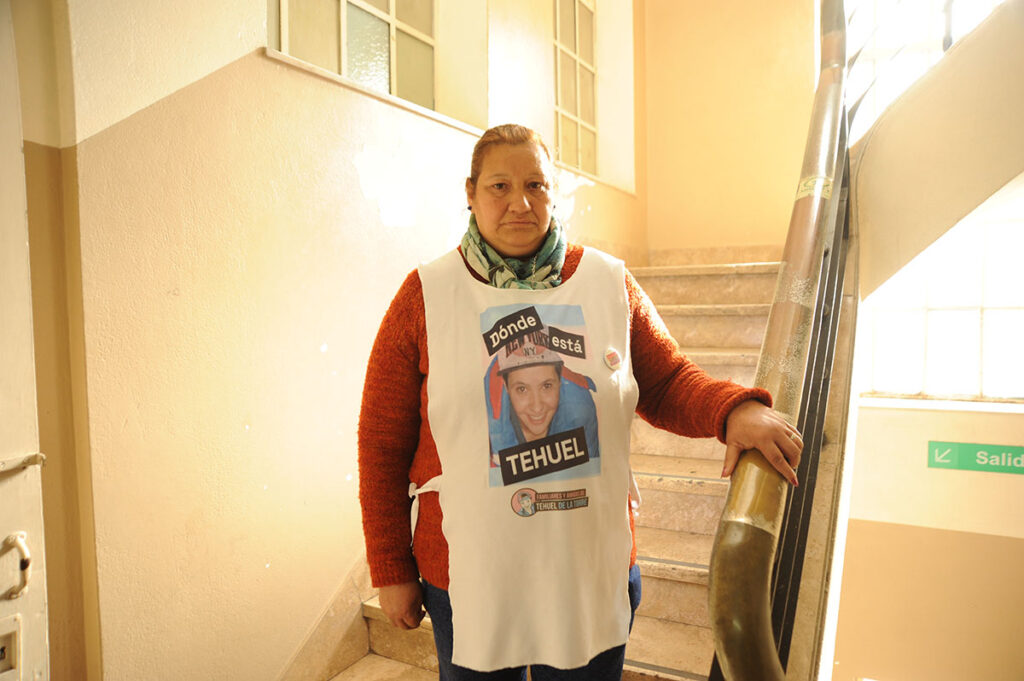
Seated behind the plaintiffs, Norma wore the vest with her son's smiling face and the inscription "Where is Tehuel?" every day. The phrase, now free of question marks, serves as an affirmation of his absence, a cry that must be repeated persistently so that what happened to him will one day be revealed. Activists and members of the Tehuel Family and Friends Commission also wore this vest with the young trans man's smiling face at every hearing. In the image, Tehuel smiles beneath his cap, and the light blue and red jacket that became evidence and was mentioned so often in the trial as the charred piece of fabric is visible.
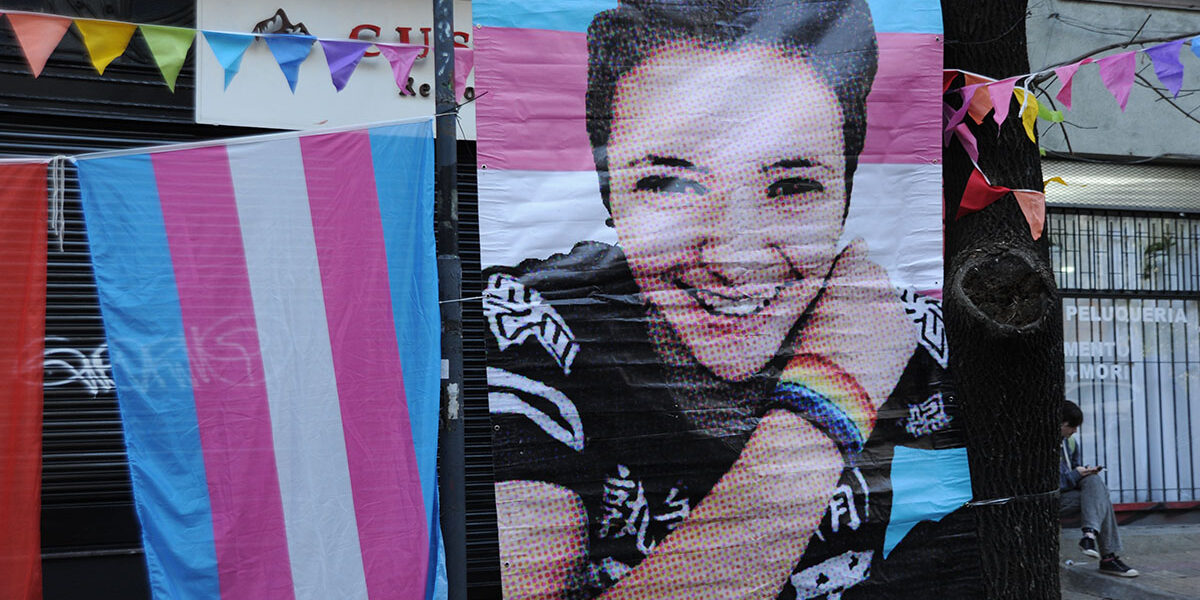
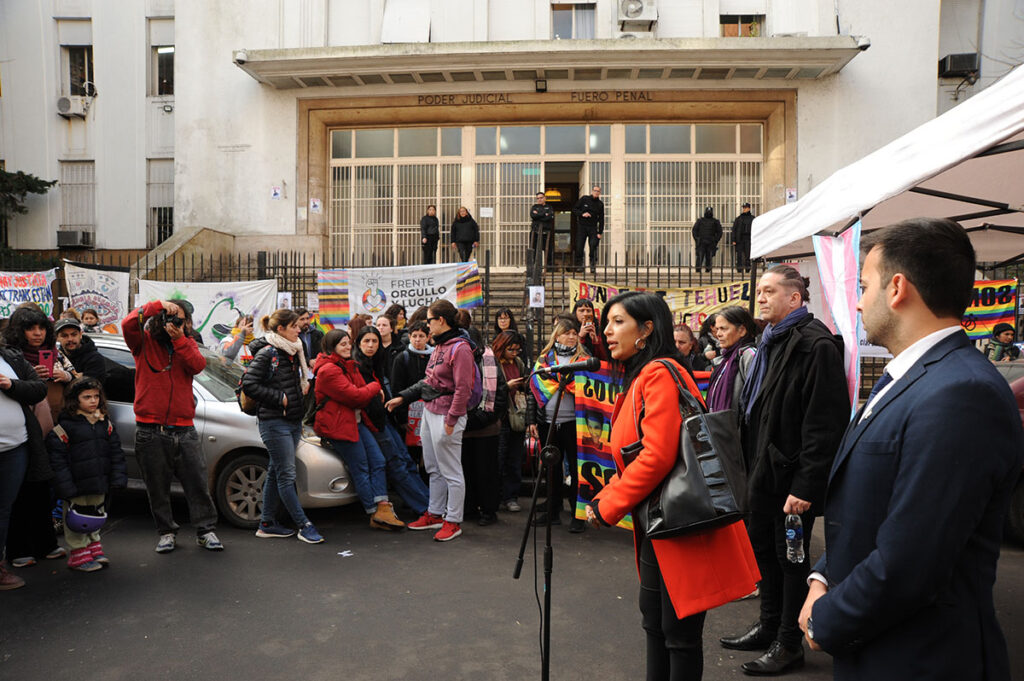
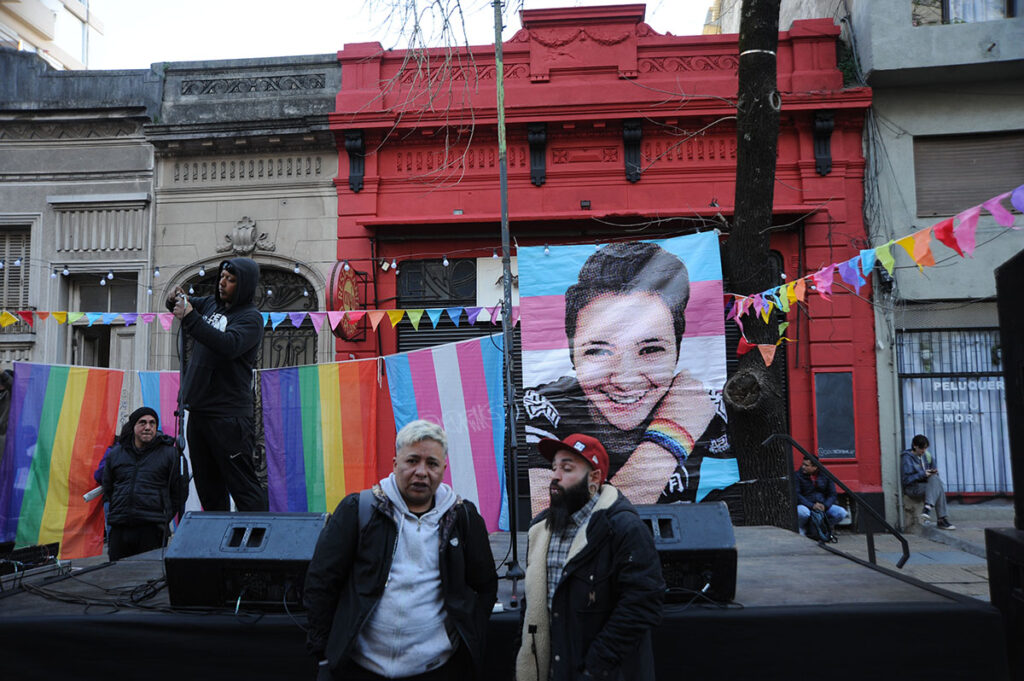
Inside the courthouse, they were searching for the killer. Outside, they were searching for Tehuel. Posters, trans and LGBT Pride flags, images, and demands for justice—"Where is he?"—covered the fence along the street. Activists and organizations accompanied each hearing until, at its conclusion, the plaintiffs' lawyers shared the day's highlights. The street awaited with an open-air radio broadcast, cultural activities, and a community kitchen. And there was a firm conviction that the trial, tentatively scheduled for August 2027 and finally taking place thanks to activist pressure, is a political victory at a time when the Argentine state's human rights agenda is regressing.
First trial for trans homicide
Florencia Guimaraes, a trans activist, is a member of the National Pride and Struggle Front, which brings together LGBT+ groups and accompanied the trial along with organizations such as the Commission of family members and friends.
“ This is the first trial where the term 'transhomicide' is used and the violence experienced by transmasculine people is brought to light .” Guimaraes recalls that for years, at Lohana Berkins' request, workshops for transvestites and trans people at the National Women's Meetings focused on naming the crimes against these communities.
“Lohana insisted that we be the ones to name these preventable acts of violence and deaths of young people. After years of struggle, the concept of transvesticide/transfemicide gained strength following the transvesticide of Diana Sacayan.” In 2018, for the first time, a conviction was handed down using this aggravating circumstance.
“With this trial we are establishing a new figure that unfortunately has to do with the disappearance and murder of Tehuel, before a justice system that continues to criminalize our existence.”
The activists believe that the attitude of the Prosecutor's team, (which did not investigate the case), was receptive to addressing the trans homicide.
Community reparation measures
“Hate crimes are characterized by a focus on the victim's individuality rather than their membership in a hated group or collective: it is more serious because it implies a threatening message to all members,” explains jurist and criminologist Eugenio Raúl Zaffaroni.
In their closing arguments, the plaintiffs and the prosecution requested joint reparations measures. They asked the provincial government for an efficient protocol, grounded in a human rights perspective, for missing members of the LGBTQ+ community and women experiencing gender-based violence. Some hope it will be named after Tehuel.
They also requested a declaration of emergency for the trans and travesti community. The lawsuit added a third item: achieving the effective implementation of the trans and travesti employment quota, approved three months after Tehuel's disappearance , urging the three branches of the provincial government to comply with the Diana Sacayán Lohana Berkins Employment Quota Law.
Why didn't Tehuel's father testify?
Tehuel had ten siblings, including a twin sister named Aylen. His mother and father, Andrés, had five children. Andrés is 70 years old and lives in José León Suárez. Norma lives in San Vicente, in the house where Tehuel lived with his girlfriend, her young son, and a brother. Norma and Andrés had separated when Tehuel was two and a half, and he had lived most of his life with his father. The year before his disappearance, he had gone to live with Norma.
Tehuel's father was summoned but chose not to attend, as did one of his brothers. “I didn't go to the trial. I wasn't going to tolerate lies and injustice. What does the trial matter to me if I don't know where Tehuel is, what they did to him? It's a failure of the judicial system. I don't care about the sentence. I care about finding Tehuel,” Andrés says angrily. He believes his son may still be alive, in the hands of a trafficking network.
For 30 years he was a taxi driver. “I quit to look for Tehuel.” He’s at home now, he says, because his car broke down on the way. “I hit a rock between Bariloche and Jacobacci, I’m getting it fixed. In January I left for San Juan.” He continued through Mendoza, San Luis, and part of Córdoba. He returned and left through the province of Buenos Aires, Río Negro, and Neuquén.
Andrés remembers that Tehuel liked mechanics. “I had him as my assistant; he’d lift the hood and stand there. He liked soccer, going out to parties. He was here until he was 18, then he got a girlfriend. An acquaintance was going to give him a piece of land to build his house, he told me. But in the end, he went back to his mother’s.”
Andrés never went to a march for Tehuel, “nor to any street blockade.” He’s not the only one in that branch of the family angry “with human rights; I tell them to go to hell.”
-Do you think Tehuel is alive?
-Yes, from the very first moment.
“Until they show me something, my sister is alive,” says her twin, Aylen. “They didn’t want to look for her alive.”
Andrés and Aylén still speak of Tehuel in the present tense, also using a feminine pronoun.
Tehuel is a lesbian and likes women, but they made a big deal out of it. How could I lie about my daughter?
"They were more concerned with a gender than with finding my sister," Aylén adds. "I'm not interested in that, I'm interested in my little sister. They came up with that nonsense, it's completely irrelevant. My other half, my skinny girl. We're going to keep looking for her until the end of our days."
Andrés knows there's evidence incriminating Ramos. There are things in the file that make him doubt. “You never know, I'm not that naive. There's a reason the prisoners don't talk; if they say they gave him to traffickers, they'll be killed in there. Are there people in prison for trafficking? No. Just like what happened with Loan, poor little boy. They've already forgotten about him, just like with Tehuel.”

Photo: Ariel Gutraich/Presentes Agency
No trans witnesses
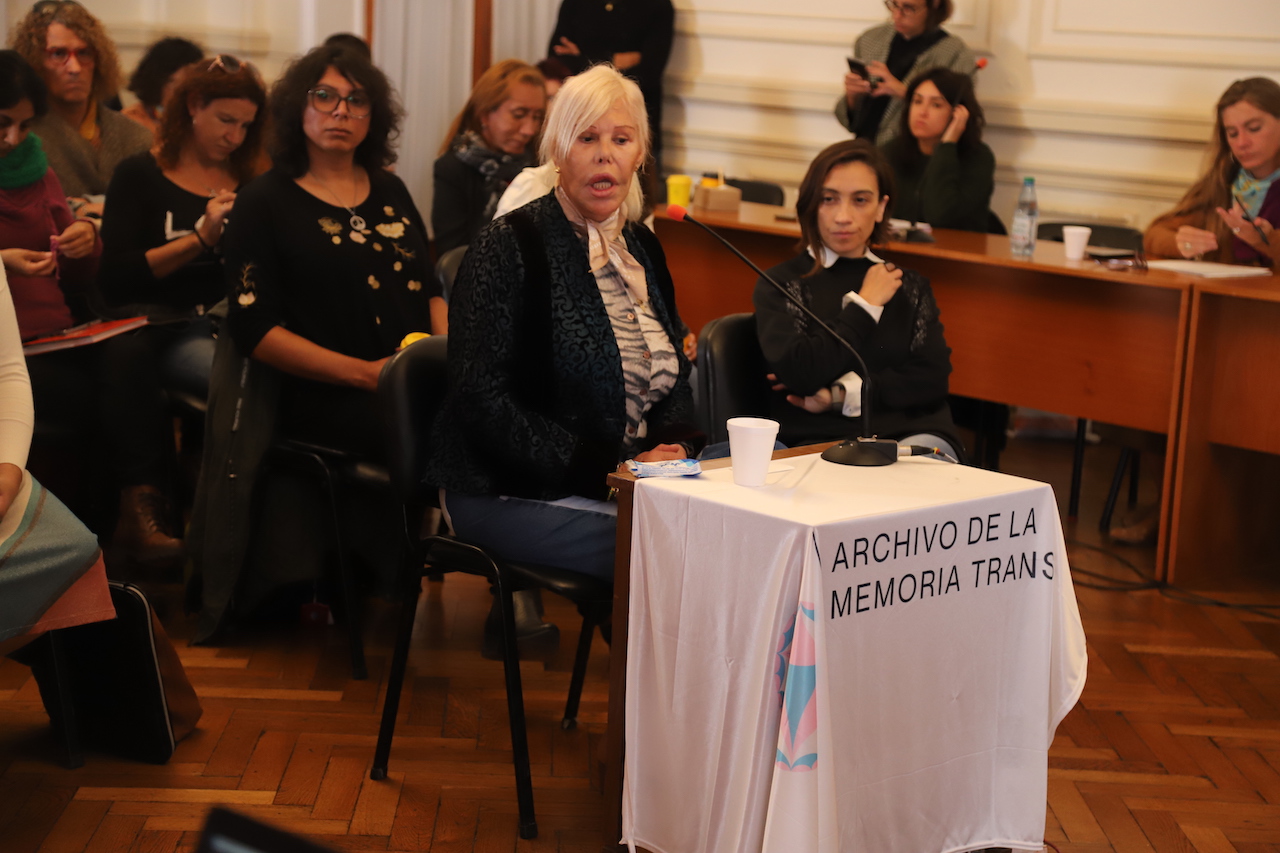
One of the complaints from activists was that this trial lacked testimony from trans witnesses who could have explained the context, unlike the muxe activist Amaranta Gómez Regalado, who testified during the trial for the transphobic murder of Diana Sacayán and gave the court a lesson on the structural violence suffered by trans people and transvestites in Latin America, where the average life expectancy is only 35 to 40 years. Similarly, Marlene Wayar testified before the Inter-American Court of Human Rights regarding the transfemicide of Vicki Hernandez in Honduras.
Judicial sources explained that the rejection could have been due to two factors: the proposal was submitted late, and the court subsequently did not admit it. One argument was that the circumstances were irrelevant because the core issue concerned the homicide motivated by that condition. This is something activists continued to demand, because in hate crimes, context is not a minor detail.
“The trial makes it clear that trans masculinities, expressions of non-cis heterohegemonic masculinity, are in a historically obscured situation of vulnerability. It has come to light that our histories are marked by significant human rights violations, including the real opportunity to live dignified lives, free from violence and transphobia,” explains Ian Rubey, a trans man and member of the Pride and Struggle Front.
Rubey explains: “It was very important to have trans men at the trial and to explain the violations they experience. That could have set a precedent in a historic trial, highlighting the need for information about trans masculinities, their experiences, and their rights situation.”
At a festival held in front of the La Plata courts during the final hearing, the closing arguments, to support the trial, transmasculine and transvestite people, including Say Sacayan, Diana's brother, also complained that they were not heard.
Where is Tehuel?
Although Argentina has contributed significantly to the conceptual and legal framework surrounding enforced disappearances, in Tehuel's case, the question remains unanswered. The search was neither efficient nor focused. The plaintiffs and the prosecution maintain that, in addition to the homicide, Ramos is responsible for concealing the body.
“The trial highlighted this lack of resources for searching for LGBT people. It revealed the obstacles and negligence in the investigation. The State is responsible for not having the tools to safeguard the life of someone who disappears,” Centurión said. He acknowledged that the search theoretically continues, but “it has been paralyzed for a year.” “With a protocol and trained personnel, perhaps we would have found Tehuel.”
“The search for the body will remain a duty of the State, but it has no bearing on the prosecution of the case and the conviction,” says Zaffaroni.
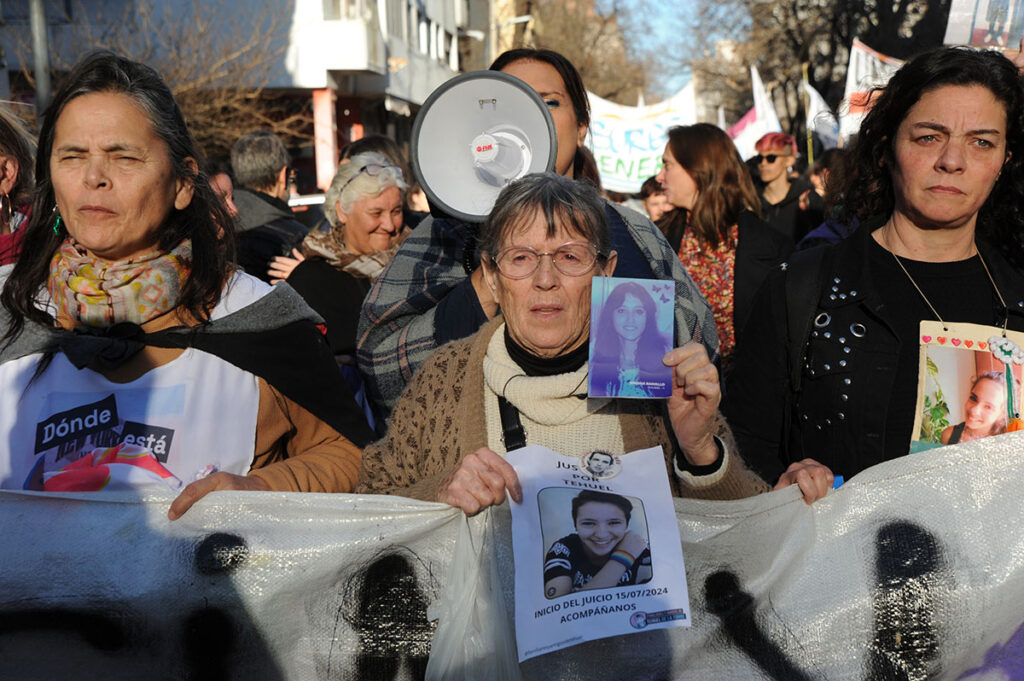
In their closing argument, Caniggia's team cited other precedents of convictions without the discovery of the body, such as the trials of victims of state terrorism, or the case of Miguel Bru, a student murdered at the 9th police station in La Plata in 1990 and still missing. Rosa, his mother, was present at the trial and accompanied Norma in a march after the final hearing. Along with other mothers of victims of violence, and on the anniversary of another disappearance, that of Johana Ramallo, they marched through La Plata to the Federal Courts to demand justice. Among them were Marta, Joanna's mother; Victoria, the mother of Melody Barrera, a young trans woman murdered in Mendoza; Mabel, sister of Sofía Hernández, murdered in a police station in Derqui; Higui de Jesús; Marta, mother of Lucía Pérez; and relatives of victims of patriarchal violence.
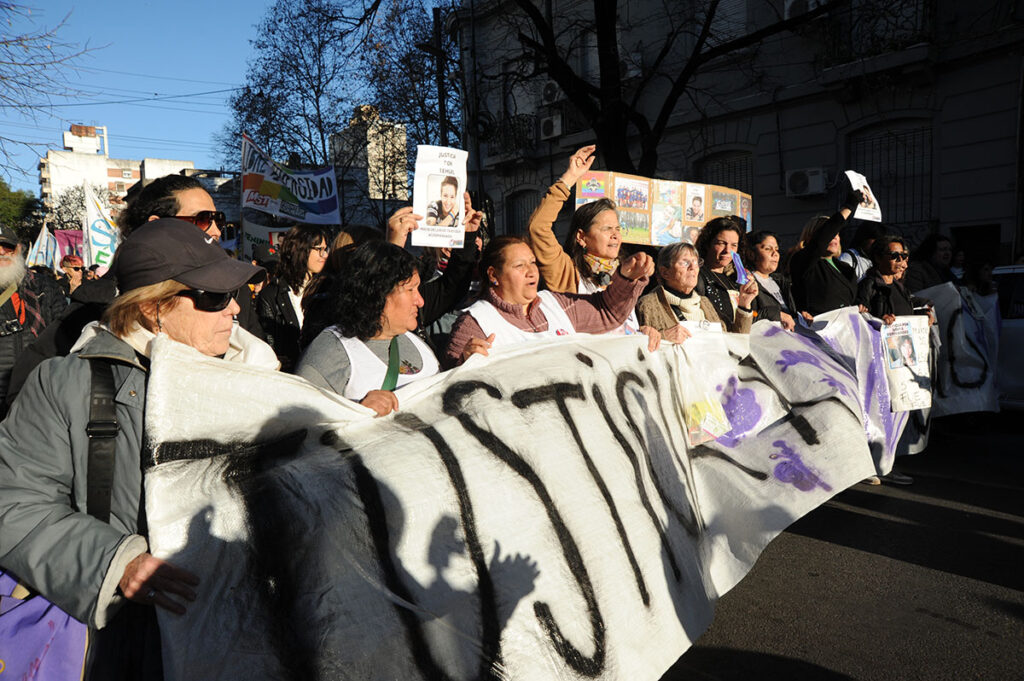
That network woven between activists, mothers and relatives, gave a distinctive character and power to the trial, especially to the final hearing and the preparations for the day of the sentence, where there will also be a collective embrace festival in front of the Court.
Norma remains grateful for “the support that gives me the strength to keep going. The two weeks of the trial were very difficult. The evidence is there. I want the sentence to be significant. I have faith.” She has repeated several times: “I don’t want any more Tehueles, never again.”
We are present
We are committed to journalism that delves into the territories and conducts thorough investigations, combined with new technologies and narrative formats. We want the protagonists, their stories, and their struggles to be present.
SUPPORT US

FOLLOW US
Related notes
We are present
This and other stories are not usually on the media agenda. Together we can bring them to light.