

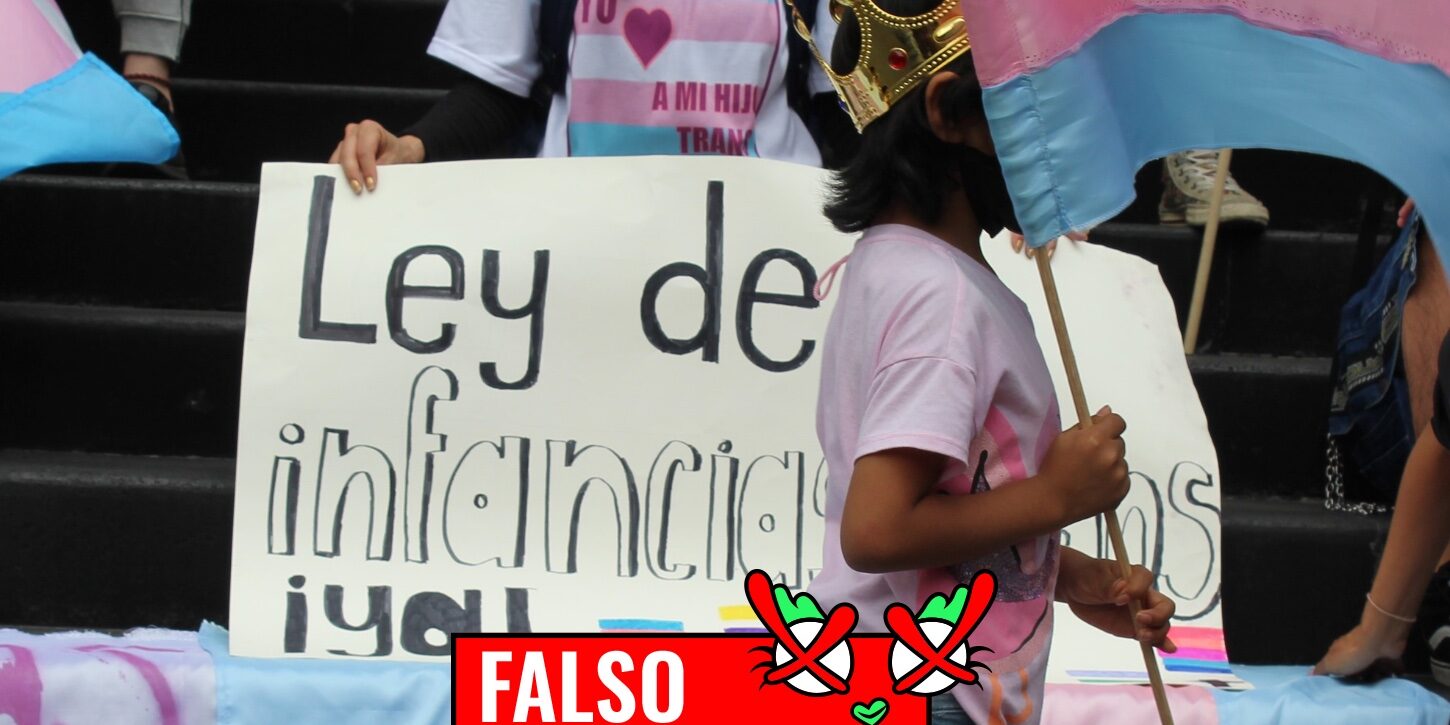
It is FALSE that trans children are "hormone-treated and mutilated"
Misinformation surrounding the identities of transgender children is having a global impact. And in countries like the United States and the United Kingdom, policies and legal reforms already exist that limit and deny their human rights.


Share

Transgender children and their caregivers face constant social scrutiny that forces them to justify their gender identities. This situation is exacerbated by misinformation and myths spread by anti-rights groups. These groups have attempted to manipulate public perception against legal reforms that support transgender rights.
Misinformation surrounding the identities of transgender children is having a global impact. And in countries like the United States and the United Kingdom , policies and legal reforms already exist that limit and deny their human rights, from access to healthcare and recognition of their identity to using restrooms and participating in sports that align with their gender identity.
In Latin America, these misleading narratives arrive and are promoted by far-right politicians and anti-rights groups who use social media and the media to spread false ideas, hoaxes, and moral panics about what it means to guarantee the human rights of trans children.
No law mutilates
Globally, no gender identity law that guarantees this right to trans children seeks to "mutilate", "hormone" or "operate" on trans girls, boys and children.
According to the ILGA World database , at the regional level, Mexico, Colombia, Ecuador, Argentina, Uruguay, and Chile have guidelines, laws, or precedents that guarantee the recognition of gender identity for minors. In some cases, this is guaranteed administratively, in others through the courts. And in no case is medical or surgical accreditation or hormonal treatment required.
Advisory Opinion 24/17 of the Inter-American Court of Human Rights ( IACHR ) maintains that the recognition of gender identity of trans people, minors and adults, must be guaranteed without them having to prove medical or surgical interventions, hormonal treatments or other procedures.
In Mexico, three states recognize the gender identity of transgender children without age restrictions, and five others recognize it starting at age 12. Whenever such reforms reach state legislatures, politicians and anti-rights groups use legislative platforms, social media, and traditional media outlets to spread misinformation about them.
A medical transition is not the same as a social transition
In Mexico, transgender children and adolescents are supported in their social transitions. This means they receive individual and family psychosocial support and tools for social transition in their various environments. This allows for social recognition of the name, gender expression, and identity with which they identify.
These support services are provided by organizations such as the Association for Trans Children, the Trans Families Network and also at the Comprehensive Health Unit for Trans People (USIPT) through services such as peer groups for trans adolescents, individual and family therapies with psychosocial and child psychiatry services for trans children and adolescents.
The USIPT is the first specialized public health space in Mexico City dedicated to serving transgender and non-binary people. Its goal is to guarantee access to comprehensive healthcare and a life free from discrimination.
Protocols
The Protocol for Non-Discriminatory Access to Healthcare Services for Lesbian, Gay, Bisexual, Transgender, Transvestite, and Intersex People and Specific Care Guidelines of the Ministry of Health (applied at the USIPT) indicates that a multidisciplinary team may be considered, together with transgender minors and their mother, father, or guardians, for the evaluation of the use of puberty blockers to postpone the development of secondary sexual characteristics. This is stated as follows:
“Depending on the facilities’ capacity to resolve the issue, in the case of transgender minors, a multidisciplinary team, the parents or guardians, and the minors themselves may jointly consider the use of puberty blockers to postpone the development of secondary sexual characteristics, and, if necessary, to allow more time and confirm the minor’s decision to begin hormone therapy. The medical staff’s perspective will determine the window of opportunity for the treatment, which is generally recommended before Tanner stage II of puberty,” the Protocol states.
Despite the existence of a protocol for accessing medical care, transgender people in Mexico still face discrimination and institutional violence in accessing physical and mental health services. Likewise, gender affirmation procedures are not fully guaranteed for adult transgender people.
Furthermore, Mexico City is the only entity in the entire country where there are only three specialized and public clinics that provide medical support for hormone replacement to adult trans people.
It is FALSE that surgeries are performed on transgender minors at the Social Security system.
In Mexico, on February 9, 2023, Congresswoman América Rangel of the National Action Party (PAN), a far-right party, presented a bill to the Mexico City Congress to reform the Law on the Rights of Children and Adolescents and the Mexico City Penal Code. Her proposal seeks to criminalize “any attempt by an adult to condition, pressure, or coerce the determination of the sexual identity of children and adolescents contrary to their biological identity.”
When presenting her initiative to the Mexico City Congress and in the media, she claimed to have data indicating that the Mexican Social Security Institute (IMSS) performs surgical procedures on transgender minors. This is false.
-Public health institutions in Mexico do not perform surgeries on transgender children and adolescents. To date, neither the IMSS nor the ISSSTE have reported that these medical procedures are performed at their facilities, not even on transgender adults.
To date, América Rangel has not presented to the public the data she claims to have to support her anti-rights initiative.
Mutilations of intersex children
However, in Mexico's public health system, invasive and unnecessary medical procedures are performed on the bodies of intersex children.
According to the First Intersex Survey of Mexico , prepared by the organization Intersex Compass and the National Council to Prevent Discrimination (Conapred), one of the main human rights violations experienced by intersex people is the performance of genital surgeries and other invasive and unnecessary medical procedures in childhood, without their own consent or adequate information.
- Among intersex individuals who reported having undergone surgery, nearly half of the procedures occurred in childhood. A significant percentage occurred in early childhood (22.4%) and childhood (24.5%). 30.6% had the surgery in adolescence and 22.4% between the ages of 18 and 30.
Intersexuality refers to “ congenital variations in sex characteristics that do not conform to medical definitions and social conceptions of male and female. These variations are chromosomal, hormonal, and anatomical, may be more or less evident, and can be detected at birth or in later stages of life, particularly during puberty .”
Intersexuality is not a pathology, it is not a sexual orientation, it is not a gender identity, and it is not a "third gender".
Congresswoman América Rangel has stated that her initiative is to “protect children.” However, to date, she has not spoken out against the human rights violations committed against intersex children in this country.
We are present
We are committed to journalism that delves into the territories and conducts thorough investigations, combined with new technologies and narrative formats. We want the protagonists, their stories, and their struggles to be present.
SUPPORT US

FOLLOW US
Related notes

We are present
This and other stories are not usually on the media agenda. Together we can bring them to light.