

A report on LGBTI+ public policies in Greater Buenos Aires
The report "Municipality by Municipality" surveying public policies for sexual diversity in Greater Buenos Aires between 2019-2023 was published.


Share

The organization Conurbanes por la Diversidad (Suburbanites for Diversity) presented the second edition of its report, “Municipality by Municipality,” on the state of local public policies on sexual diversity in the 31 districts of Greater Buenos Aires. In a context where the national government is delegitimizing the State and public policies, especially those related to gender, the report highlights “the organization and territorial strength of these groups.”
“In times of conservative advances, the role of municipalities is more important than ever. We will defeat neo-fascism with organization and territorial power,” said Darío Arias , a leader of Conurbanes por la Diversidad (Suburbanites for Diversity ).
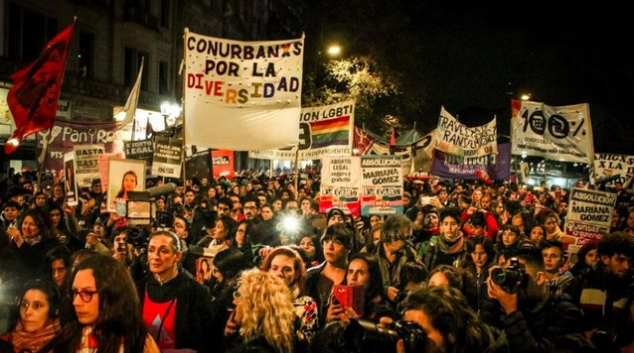
The report was self-managed with the collaboration of volunteers. It analyzes 18 categories of public policy, such as health, labor inclusion, and addressing hate crimes. It covers the period from December 10, 2019, to December 9, 2023, that is, the entire first term of Axel Kicillof's government in the province of Buenos Aires. It can be viewed in full at this link . A third report will analyze the period following the current one.
“At Conurbanes, we have been working for many years at the local and territorial level because we believe that municipalities have a fundamental role in the recognition, protection, and social inclusion of the LGBTI+ population. This report aims to continue placing at the center of the agenda the enormous responsibility that local governments have to improve the quality of life of our community,” Arias stated in an interview with Presentes.
Argentina has more than 2,000 municipalities, with a population of 45,892,285, according to the 2022 census. Greater Buenos Aires comprises 31 municipalities, home to 11,951,046 people. This represents 68.19% of the inhabitants of the province of Buenos Aires and 26% of the country's total population.
“This report reflects the progress and challenges in Greater Buenos Aires, one of the most unequal territories in our country, with the highest levels of prejudice-based violence and structural discrimination. It demonstrates that while we have made significant progress in terms of institutional frameworks for sexual diversity and inclusive legislation, most municipalities face the challenge of ensuring that the policies they have created are fully implemented, specific, and have their own budgets,” Arias noted.
For trans activist Florencia Guimaraes García , president of La Casa de Lohana y Diana and invited to participate in the report, thinking “about public policies in our municipalities has been a fundamental part of our activist agendas: the planning, articulation, monitoring and evaluation of public policies between civil society organizations and the State is necessary and fundamental to guarantee the full access to rights of lesbian, gay, bisexual, transvestite, trans, intersex and non-binary people.
Among the report's main observations was that of the 31 districts, only 35.5% have a specific area dedicated to sexual diversity at the departmental, sub-directorate, or directorate level. In this regard, Arias, Florencia Paltrinieri, and Ivana Gutierrez analyzed in a note within the report that "the integration of LGBTI issues with 'women's' and 'gender' areas has, in many cases, neutralized effective responses to this population."
A “map of available resources”
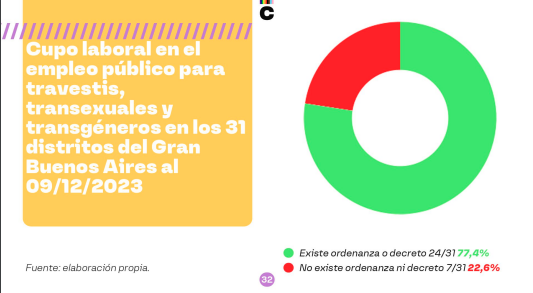
On the other hand , 77.4% approved ordinances or decrees establishing job quotas for transgender and transvestite people in public employment. Among the municipalities that adopted these quota-related measures, only 12.5% are in advanced stages of compliance, while 16.7% are not.
71% of districts have an inclusive clinic or health service with a sexual diversity perspective. In turn, 93.5% have a policy mechanism for preventing and addressing violence based on sexual orientation and gender identity, integrated with cisgender heterosexual women.
“It is important to emphasize that when certain state mechanisms function effectively in an inclusive and supportive way, addressing the challenges faced by this population, the positive impact on their lives is extraordinary, and the resulting significance is not merely inclusive. At the same time, it demonstrates that it is possible to build an institutional framework rooted in the identities of its own territory,” Guimaraes García stressed.
Among other findings, the report indicated that 54.8% of municipalities approved an ordinance establishing May 17 as the Municipal Day of Respect for Sexual Diversity and Gender Identities. Additionally, 32.3% established March 7 as the Municipal Day of Lesbian Visibility.
Lucía Portos Undersecretary of Gender and Diversity Policies at the Ministry of Women and Diversity of Buenos Aires , this report “takes on special relevance because it is a map of resources available to the population, because it celebrates what exists and denounces what is lacking.”
“Having this work will allow us to further develop provincial policies that move in this direction and that rely on community organizing as the creative engine for solving our people's historical problems,” said Portos. He added: “Our role must be to ensure that these policies are implemented in each of the 135 municipalities in our province, because there are no 'good Argentinians' and 'bad Argentinians.' There are citizens who deserve a dignified and happy life, and a State that must commit to Social Justice, which is the only way in which the community can thrive.”
We are present
We are committed to journalism that delves into the territories and conducts thorough investigations, combined with new technologies and narrative formats. We want the protagonists, their stories, and their struggles to be present.
SUPPORT US

FOLLOW US
Related notes


We are present
This and other stories are not usually on the media agenda. Together we can bring them to light.