

Alicia Caf, an intense and compassionate life marked by community dreams
A lesbian activist and advocate for the rights of all marginalized people, Alicia Caf died in poverty and lives on in the memory of her comrades.


Share

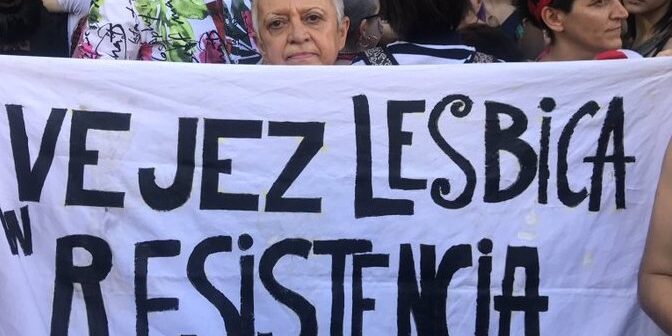
Lesbian activist Alicia Caf was a regular presence at all the marches in Buenos Aires, supporting various struggles. Her existence was collective, and her perspective intersectional. She was one of the founders of the "Sueño de Mariposas" (Butterfly Dream) project, an intergenerational space for mutual care between older lesbians and young lesbians. She died in poverty on August 1, 2020, leaving behind a collective project and a poignant story of survival.
Alicia was born on October 16, 1951, in Buenos Aires. She grew up in a middle-class family home in Ramos Mejía, Buenos Aires. The daughter of an unknown father, she bore the surname of her mother, Angela Rosa Caffarella, who died at the age of 49. She had an older sister and a niece with whom she had no contact.
A survivor of a very difficult childhood, marked by domestic abuse, she used to say she was born a lesbian . At 14, she underwent psychiatric treatment with electroshock therapy as a "cure for her lesbianism ." This experience made her rethink her entire concept of family. At 17, she had recurring dreams of living in a village of only women , a desire that, during her migration to Europe in 1986, she was able to fulfill in a way when she met Gavina Heiz, a Swiss woman, in a Barcelona bar. Heiz invited her to a similar community in the Pyrenees.
Lesbian exile
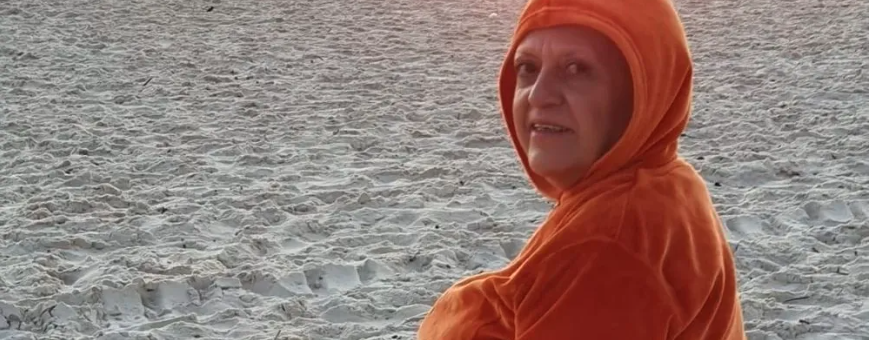
During the nearly three decades she lived in Europe, she became involved in activism that intersected with her own migration and her lesbianism. From 1998, she collaborated with the Dutch activist Gabbi Wierenga and later—until her return to Argentina in 2014—participated in the organizations SPAZ and Frauen Zentrum in Zurich. In 2001, she made the documentary video Seven Times Seven, recreating situations experienced by undocumented migrants, conversations about the precariousness of undocumented work, and reflecting an intersectional axis of class, migration origin, racialization, gender identity, and sexual orientation. At the beginning, she is seen reading excerpts from texts by the edge of a lake, sharing time with her close friend Gavina, and Ali says:
"When time and space cease to exist, and memory exists, then there is always. This is intended as a tribute to Gretel Ammann Martínez (1947 – 2000), philosopher, essayist, activist, radical, and lesbian separatist – a pioneer of feminism in Barcelona."
Alicia lived in communal houses, participated in marches, talks, and activist gatherings, and immersed herself in the daily realities of undocumented migration. She left Argentina in the early 1980s seeking to live her lesbianism more freely and encountered the other difficulties of migration. She practiced activism based on solidarity and with a gender and class perspective.
Those years in Switzerland were a kind of "lesbian exile." In Argentina, it was not possible to live an openly lesbian life.
A difficult return and a dream
In 2014, she returned to Argentina with the help of the Red Cross for her passage. In an interview with Presentes, Alicia said: " It was very strange to come back, because I had to learn to live somehow. I was away for a long time and I was alone. I left alone and I came back alone."
For the first few years, she lived on the streets until October 2015. She then spent two years at the Frida Integration Center in Buenos Aires. During that time, she became eligible for the minimum pension and has relied on that income since 2016. In 2017, she rented a room in a hotel. Her work life has always been very precarious, and that has been exhausting.
In Argentina, she resumed her activism, supporting actions for people in prison, migrants, and those in psychiatric care. "Alicia promoted accompaniment and activism, being there for others, her body present in the struggles, which somehow intersect with the precariousness of life," Ju, a lesbian activist and friend, tells Presentes.
In a March 2017 post on the closed Facebook group Transfeministas Cooperando (Transfeminists Cooperating), Alicia made a personal request and a call to join and work "for the housing needs of older lesbians." She challenged her readers about the possibility of creating something together to support and give visibility to older lesbians, but in an intergenerational way, with others, thus developing alternatives for future generations.
This is how Sueños de Mariposas (Butterfly Dreams) —their territory, their island, their space for women. Butterflies as a tribute and recognition to the Mirabal sisters: María Teresa, Patria, and Minerva, as well as Diana Sacayán and Lohana Berkins. In June 2017, the first meeting took place at the La Tribu radio station bar in the Almagro neighborhood of Buenos Aires. At the Permanent Lesbian Assembly, Alicia met Ju, a lesbian activist. Some time later, she joined Sueños de Mariposas.
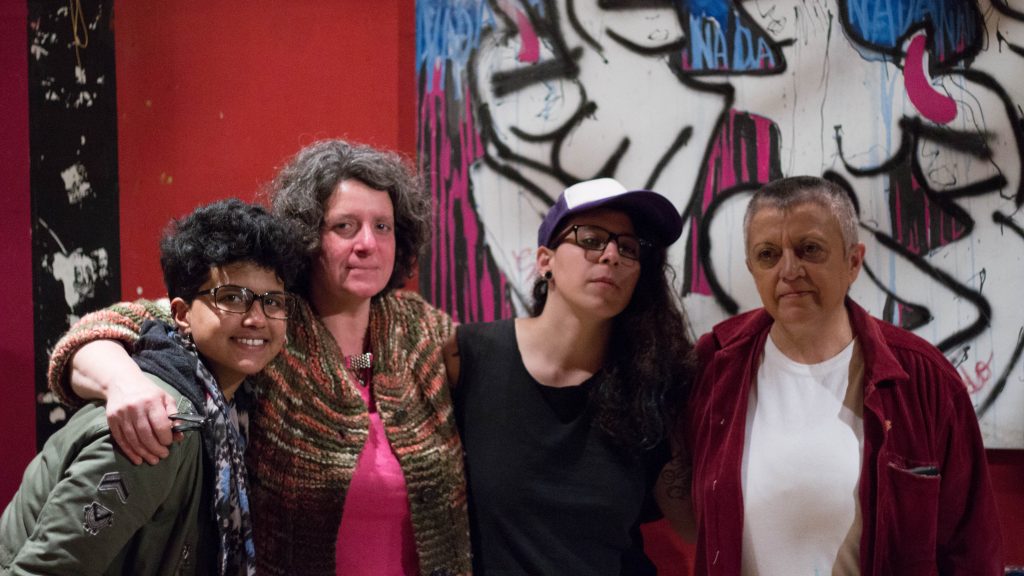
"That Facebook post made them realize that I wasn't alone, that there were many people there rethinking old age. Alicia had a strong character, her face, the roughness in her face as a sign of having lived so long, and that's also why it resonated with me so much to bring it up," Ju told Presentes.
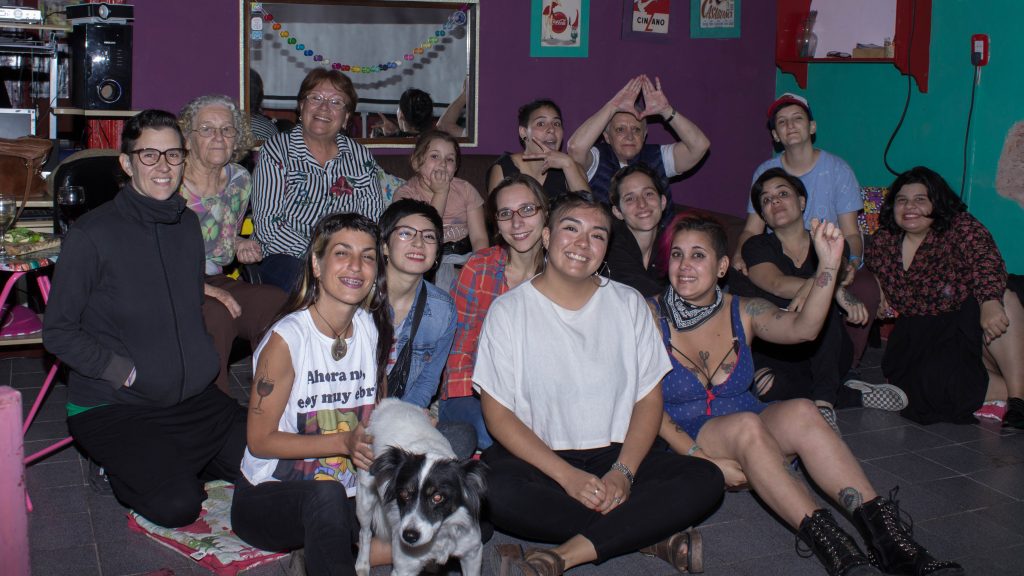
They became friends, brainstorming events, meetings, talks, variety shows, weekly film series, all self-organized. They held meetings at the Tierra Violeta Cultural Center in San Telmo, until the opportunity arose to meet at the Ambigú bar, which was a few blocks from Congress.
"Ali liked beer, the songs of Sandra, Celeste Carballo, Chavela Vargas; she made a playlist on Facebook to share her favorite songs. But she was a person who was sometimes sad, longing for the years she lived in community with other lesbians during her time in Europe."
While the main objective was to create the " lesbian ward ," there was sensitivity and empathy towards other issues.

Persistence, determination, and tireless work.
Alicia liked to write in notebooks, on loose sheets of paper—we could call them diaries—in which she described a day in her life, lists of tasks to be done and/or completed, but above all, her feelings. You can also read her constant records of managing available resources, additions and subtractions, emails to send, calls to make, phone numbers, and people to schedule.
This meticulous work of documenting Alicia's legacy and creating the Sueños de Mariposas Instagram account was done by Mad (35 years old), a lesbian, trans, and feminist activist, and mother. Thanks to this nascent archive, we can now reconstruct part of Alicia's final years in her own words. Mad recalls:
"She liked fresh, hand-cut cilantro, she was determined, I'm a big fan of her sayings, and since I manage social media, whenever something happens I go to her Facebook profile. She said she needed the younger ones because they have more strength, and at the same time she gave us strength."
Lesbian old age in resistance
Alicia died at 68. She collapsed on the street on August 1, 2020, during the pandemic, on Avenida Córdoba in Buenos Aires. Her body was found there. She lived in precarious conditions in a room at a family-owned hotel.
Her friends claimed her body and, after tracking down her sister and niece, managed to get their permission to enter the room and collect her belongings. They recovered some notebooks and other items that were being thrown away. They took up a collection for the funeral and are awaiting an autopsy to determine the true cause of death. Alicia had long ago decided not to go to the healthcare system. She didn't want to have contact with doctors, even though she had a wound on her chest that wouldn't heal. Her friends attributed this decision to her experiences of various forms of violence in childhood.
Farewell, butterfly
Her friend of almost three decades in Switzerland, Gavina, wrote on her Instagram account:
Ali has been more than a sister to me, more than a friend. We've known each other for over 33 years. Loving each other as friends, fighting a lot too. We had different cultures, different family histories… We lived together in Barcelona, a lot of lesbian political activism!
Ju remarks: "She was a stubborn lesbian, but very tender, who showed her tenderness at times and you had to know how to handle her when she got angry."
In a Facebook post on November 8, 2019, at 4 a.m., Alicia wrote:
Even in the darkest of times, there are ALWAYS small actions that, interconnected, spark a new awakening full of hope. New relationships that nourish us constantly. Finding your own path is my greatest wish! Sweet dreams!
We are present
We are committed to journalism that delves into the territories and conducts thorough investigations, combined with new technologies and narrative formats. We want the protagonists, their stories, and their struggles to be present.
SUPPORT US

FOLLOW US
Related notes


We are present
This and other stories are not usually on the media agenda. Together we can bring them to light.