

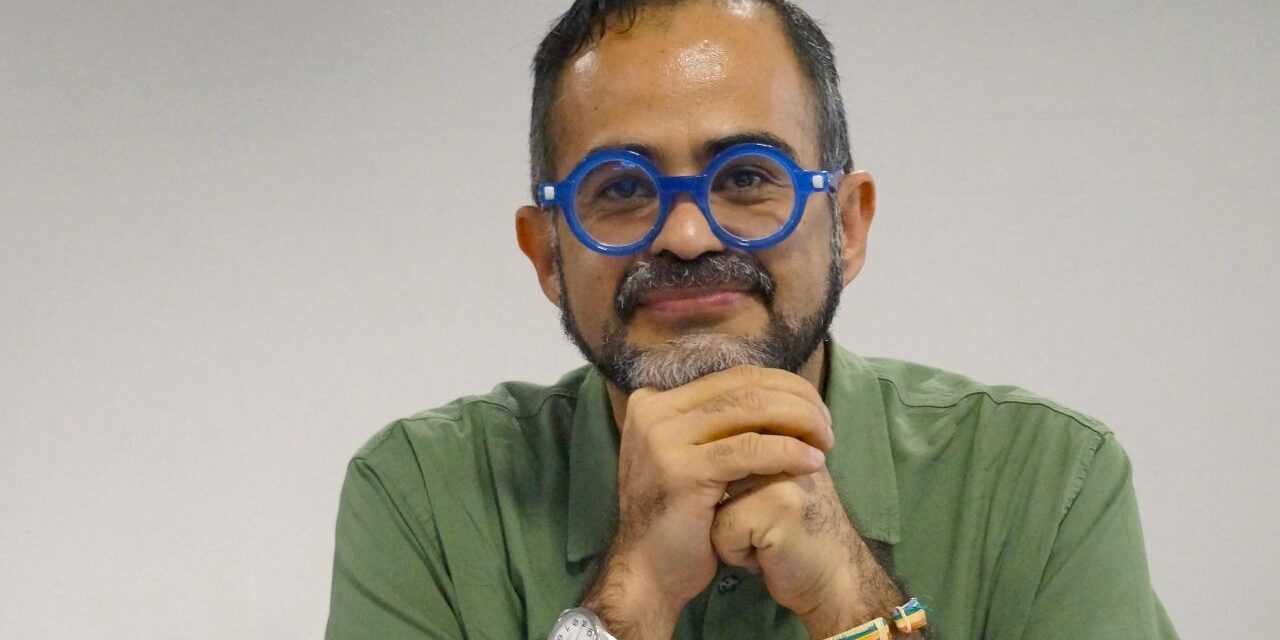
Wilson Castañeda: "Anti-rights groups use Latin America as a laboratory"
Interview with Colombian human rights activist Wilson Castañeda, expert in peace processes and sexual diversity, and director of the organization Caribe Afirmativo.


Share

an expert on the subcommittee overseeing peace talks between the Colombian government and the FARC-EP , drew a parallel between state terrorism and the Colombian armed conflict during his visit to Argentina. According to the political scientist and activist, both processes "share the common characteristic of making life more difficult for historically marginalized groups, such as LGBTQ+ people."
In the peace process that Colombia has been facing since 2016, for Castañeda “it is very important to understand ourselves in the face of a dictatorship: what does it mean to build a comprehensive reparation process, guaranteeing a dignified life for LGBT people.”
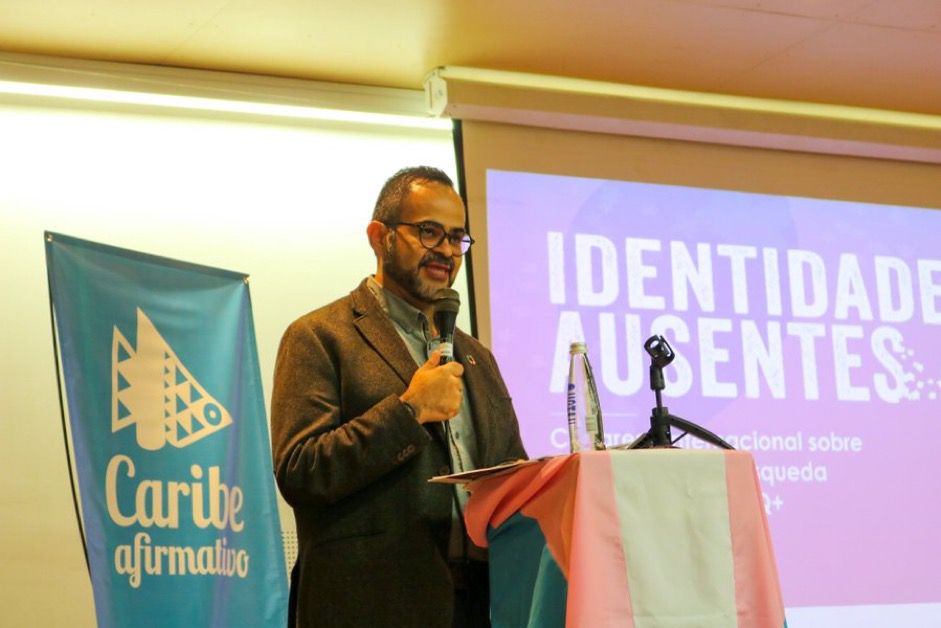
Castañeda is a political scientist from the National University of Colombia , holds a master's degree in Philosophy from the Pontifical Bolivarian University , and is a doctoral candidate at the same university. He is also the director of the Caribe Afirmativo Corporation , an LGBTI rights organization, and was a consultant for the United Nations Development Programme (UNDP) .
“We share two realities that, while different, have the same structure. The Argentine dictatorship and the Colombian armed conflict have in common that they made life more difficult for historically marginalized groups . In both Argentina and Colombia, LGBTIQ+ people were victimized by the dictatorship and the armed conflict. Their projects were made more difficult. The moral sanctions imposed by both the dictatorship and the armed conflict ended up generating social sanctions against sexual and gender diversity,” Castañeda analyzed.
In this vein, the Federal Oral Court No. 1 of La Plata recognized in March of this year, for the first time in history, that eight trans women and transvestites were victims of crimes against humanity during the last Argentine military dictatorship (1976-1983). In the grounds for this landmark ruling , the Judiciary considered that “State Terrorism guaranteed a hegemonic gender model (…) within a distinctly patriarchal-Western culture.” Trans and transvestite identities were considered “subversive” to the “Western and Christian” model and were therefore persecuted and subjected to particular violence.
During his visit to Argentina, Presentes spoke with him about the bridges that can be built between both historical moments, the types of reparations needed to guarantee non-repetition, and the advance of the far right globally.
– How did both the Argentine dictatorship and the Colombian armed conflict worsen the lives of LGBTIQ+ people?
Democracies are designed to guarantee rights. Dictatorships and armed conflicts break down democracy, meaning they jeopardize rights, and they also have a moral component. This ultimately affects the most marginalized population groups. In the case of LGBTQ+ people, this decline in quality of life, in a comparison between Argentina and Colombia, can be seen in three factors. First, the increase in violence: murders, femicides, transphobic murders, threats, forced displacement, torture, and sexual violence. These are used to make LGBTQ+ people disappear, control them, or eliminate their lives.
The second issue is that it creates hierarchical chains of access to resources, and there is no place for LGBTIQ+ people in these systems. As a result, poverty, homelessness, and exclusion from policies governing the distribution of goods and services begin to place these groups within the ranks of poverty and marginalization. Thirdly, both dictatorships and armed conflicts jeopardize the right to a dignified life for LGBTIQ+ people because they close off spaces for participation. Dictatorships in their final stages and conflicts in their decline—when social sanctions have already been imposed—reduce the issue of eliminating people but instead resort to making them invisible. Thus, spaces for participation are closed, and social and political control over bodies begins. Therefore, rebuilding democracy after an armed conflict or dictatorship hinges primarily on giving visibility to population groups that have historically been rendered invisible.
– How is the process of reparations for victims of the armed conflict viewed in Colombia?
Our peace project and our Victims' Law consider truth, justice, reparation, and guarantees of non-repetition as the four fundamental values of transitional justice, understanding that there is a link between them. Regarding reparations, we call for both individual and collective reparations, both monetary and symbolic. Individual reparations because each life must be repaired in its very essence. Collective reparations because the armed conflict disrupted organizational processes that must be rebuilt. Monetary reparations because it impoverished people, and they must be given resources to access services that improve their quality of life. And symbolic reparations because the armed conflict imposed a homophobic, transphobic, misogynistic, patriarchal, and sexist moral and political project.
But the biggest challenge for reparations in Colombia lies in proposing transformative reparations. The Truth Commission report indicates that the armed conflict made life more difficult for LGBTIQ+ people. Therefore, the great challenge of reparations is to make structural changes. To get to the root of those social practices that predate the armed conflict. And to eradicate those practices completely so that they never happen again. Otherwise, we can sign a peace agreement, overcome the conflict, and guarantee that armed actors return to civilian life, but LGBT people will continue to be victimized.
– How do you see the rise of far-right political projects globally and their impact on Latin America?
– In recent years, the right wing and neoliberalism have made it clear that they want to dismantle rights and reduce the state to its bare minimum. It is now evident worldwide that corporations and capital are controlling democracy. The social agenda is jeopardizing their expansionist projects. One thing is clear: Latin America is currently a testing ground for anti-rights groups. Their aim is to reduce the welfare state to its bare minimum and allow private enterprise to advance.
– How do you analyze the relationship between this reactionary advance and the promotion of an anti-rights agenda?
There are those who are seeking to gain popular support for this dismantling of rights. They create hate speech to make people believe that the advancement of our rights is causing the economic and material crisis. Today, the anti-rights agenda is the political agenda. Anti-rights rhetoric has become a way of governing, something that didn't happen before. There were very conservative governments, but they never used anti-rights rhetoric to govern.
This is a multinational strategy that transcends national borders. Anti-rights groups operate with a regional strategy . They have members in Argentina, Brazil, Colombia, and Mexico, they act as a bloc, and they receive substantial funding from the Global North. What is happening today in Argentina has the support and networks of anti-rights groups from other countries, which ultimately influence events, even in the media. Latin America is the easiest region for anti-rights groups to dismantle the social welfare state because we share cultural and religious practices that unite us. Anti-rights groups argue that LGBT rights cannot be advanced because it will destroy the family, and the family is a value that unites us.
– What strategies can LGBT activism and citizens adopt in the face of this situation?
I believe that the strategies of citizens should be, first, to build political projects that transcend governments. The LGBT movement in Argentina operates on a day-to-day basis. I think it's up to us to build long-term political projects that allow us to consolidate our gains. It's also necessary to bring in more and more allies. It does us a lot of harm when we act in isolation.
According to the UNDP, Colombia is one of the countries that best guarantees the rights of LGBTIQ+ people due to its legislation. However, it is also one of the most violent countries. This is very frustrating. In this sense, I believe that laws need civic culture to be implemented. In Colombia, we have focused on influencing those who create the laws. But we haven't focused on those who ultimately enforce them, such as the shopkeeper, the school teacher, the security guard, the inspector, or the police officer on the street.
On the other hand, I think we need to be more creative with our language. Sometimes we're very boring, very rational; we need to create mechanisms that bring us closer to people. Anti-rights groups have had an advantage in this because they're very creative: they appeal to emotions. Furthermore, we have to demand that society stop seeing what we have as privileges. What we have are rights, and rights are not to be jeopardized. Finally, we mustn't lose our optimism, our joy. Let's not forget that we resisted horrible governments.
We are present
We are committed to journalism that delves into the territories and conducts thorough investigations, combined with new technologies and narrative formats. We want the protagonists, their stories, and their struggles to be present.
SUPPORT US

FOLLOW US
Related notes
We are present
This and other stories are not usually on the media agenda. Together we can bring them to light.