

A law criminalizing transfemicide has been approved in Mexico City
The Mexico City Congress approved the Paola Buenrostro law that defines the crime of transfeminicide in the Penal Code.



Share

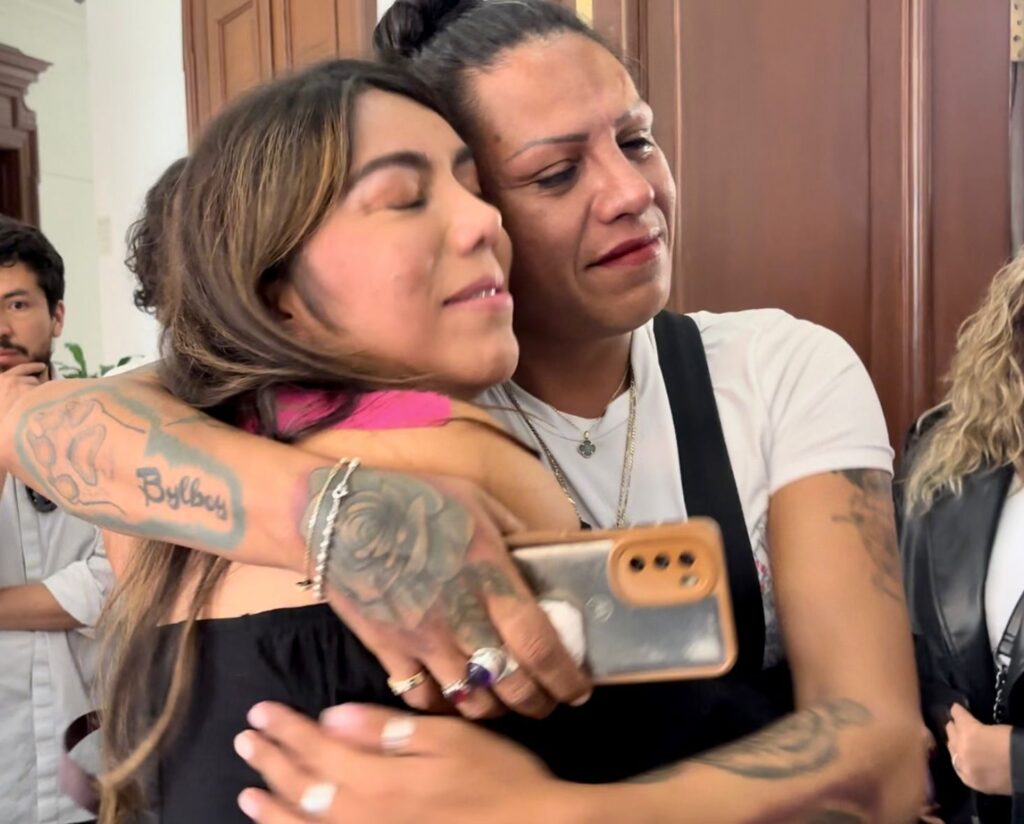
On Thursday, July 18, the Mexico City Congress approved the Paola Buenrostro Law with 42 votes in favor, 3 against, and no abstentions. This bill criminalizes transfemicide in the Penal Code, establishing a maximum sentence of seventy years in prison. The project was introduced by Representative Temístocles Villanueva and co-authored by Natalia Lane and Kenya Cuevas, human rights defenders and survivors of transfemicide and institutional violence.
In addition, it considered the work of the organizations Center for Support of Trans Identities (CAIT), Casa de las Muñecas Tiresias and Letra S.
🇲🇽🏳️⚧️ The session to vote on the “Paola Buenrostro Law” to criminalize transfemicide in the Mexico City penal code has begun.
— Presentes Agency (@PresentesLatam) July 18, 2024
Natalia Lane and Kenya Cuevas are present in the chamber. @kenyacuevas101 @natalia_lane pic.twitter.com/EepaJ3C5FG
The law emphasizes that there is an urgency to recognize transfeminicide “as an autonomous criminal figure and as a crime with its own characteristics, because it presents itself as a hate crime against trans women and its investigation still faces diverse and profound challenges.”
“The approval of this law sends a very clear message: trans women are women, and our deaths must be investigated from that perspective, considering the particularities of our contexts, jobs such as sex work, and conditions of vulnerability. It also includes the recognition of our chosen families,” Natalia Lane, a human rights defender, survivor of attempted femicide, and sex worker, told Presentes.
“But we know that a criminal offense is not enough; reparations, public policies, and structural changes are needed to prevent transfemicides,” she added.
This law is named in memory of Paola Buenrostro , a trans woman and sex worker murdered on September 30, 2016. Following her murder, the call for justice from her friend and human rights defender, Kenya Cuevas, broke social and media paradigms regarding lethal violence against trans women in Mexico.
To date, only the state of Nayarit and Mexico City consider transfemicide a crime in their penal codes. However, the Supreme Court of Justice of the Nation (SCJN) and the National Human Rights Commission (Conapred) have determined that every violent death of a trans woman must be investigated under the femicide protocol and demand that local legislatures establish measures to guarantee access to justice for this population.
What does the Paola Buenrostro Law include?
In June, the head of government of Mexico City published a decree to reform the penal code and determine that the crime of femicide "includes all women, as well as all persons of the female gender"; in addition, prejudice to the gender identity and sexual orientation that exists about the victim is added as a reason of gender.
However, the Paola Buenrostro Law is broader because it not only reforms the penal code but also proposes an approach to the context analysis of victims of transfeminicide and attempted transfeminicide.
It considers sex work as the working condition of the majority of victims and recognizes the families chosen during the process of access to justice.
Lane explains that the importance of context analysis during the investigation of these crimes involves considering the conditions of vulnerability of the victims, such as sex work, conditions of migration or displacement, being dedicated to the defense of human rights; as well as the type of violence exercised against the victims before, during and after being murdered.
Furthermore, the law requires the mandatory application of the National Protocol of Action for Personnel of the Justice Administration Agencies of the Country, in cases involving Sexual Orientation or Gender Identity to guarantee an investigation with a differentiated approach, gender perspective and human rights by all actors involved in the investigation process and access to justice in order to guarantee non-revictimization.
Consider the selected families and propose collecting data
This initiative is based on recommendation 02/2019 issued by the Human Rights Commission of Mexico City, which declared Kenya Cuevas a direct victim of transmisogyny and discrimination, as she was then engaged in sex work, perpetrated by public officials during her friend Paola's search for justice.
Following that recommendation, this law also reformed the Civil Code, the Organic Law of the Prosecutor's Office and the Victims' Law of Mexico City in order to consider the chosen family as part of the request for justice when accompanying cases, being witnesses or processing a death certificate that does not violate the gender identity of the victims.
This is an action that activists Kenya Cuevas and Rocío Suárez, director of CAIT, have been carrying out for years in order to dignify the deaths of trans women , and not bury them as unknown persons in mass graves.
Finally, this law also proposes the statistical collection of this violence in order to develop public policies for the prevention and combat of transfeminicidal violence.
More than 50% of hate crime victims are trans women
In Mexico, trans femicides represent more than 50% of hate crimes against the LGBT+ population, according to Letra S . Most of the victims were sex workers, and few cases are investigated under the femicide protocol, go to trial, or result in a sentence.
So far in 2024, at least 30 transgender women have been murdered in Mexico. The majority of these crimes, ten, have occurred in Mexico City, and almost all of the victims were sex workers living in precarious employment and housing conditions.
We are present
We are committed to journalism that delves into the territories and conducts thorough investigations, combined with new technologies and narrative formats. We want the protagonists, their stories, and their struggles to be present.
SUPPORT US

FOLLOW US
Related notes


We are present
This and other stories are not usually on the media agenda. Together we can bring them to light.