

Argentina: Court orders reinstatement of two transgender state workers
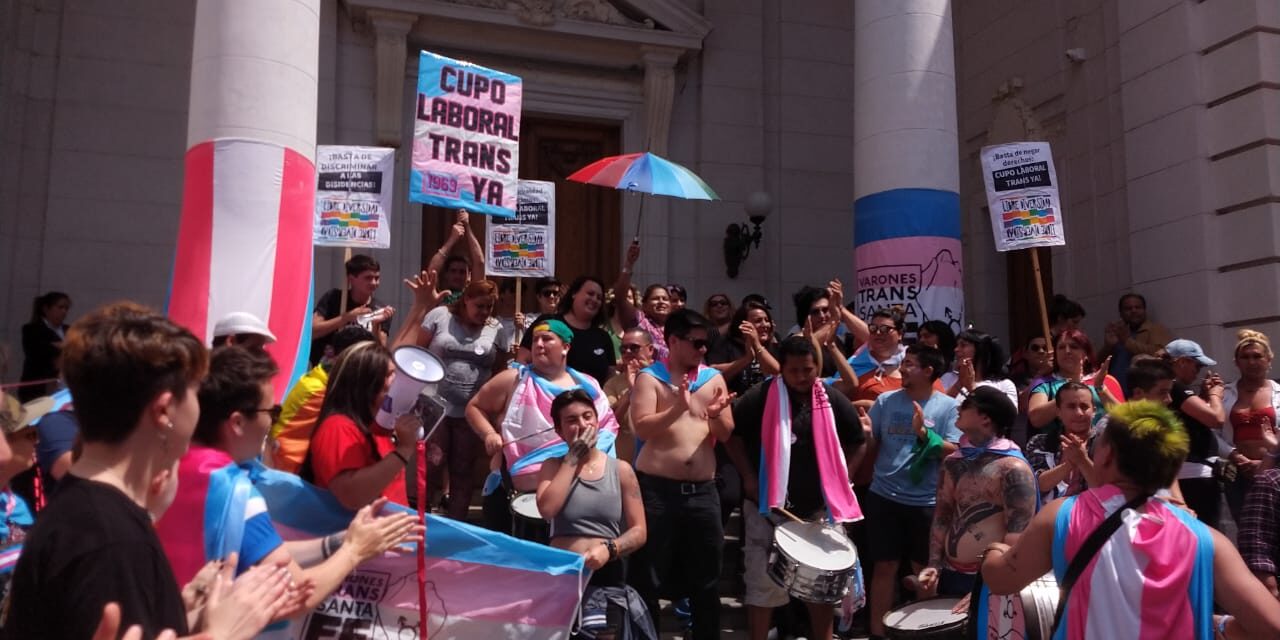
The court ruled in favor of precautionary measures promoted by the State Workers Association (ATE) for the reinstatement of trans workers protected under the transvestite trans labor quota law.


Share

The court ruled in favor of precautionary measures promoted by the State Workers Association (ATE) for the reinstatement of trans workers protected under the transvestite trans labor quota law.
The National Labor Appeals Court and the Federal Administrative Court No. 11 ordered -in separate rulings- the reinstatement of two trans workers who had been dismissed.
The ruling issued by Judges Enrique Catani and María Cecilia Hockl ordered the immediate reinstatement of a worker to his position at the National Social Security Administration (ANSES) . He had started working on March 1, 2021, and on March 21 of this year, the agency did not renew his contract.
This is a response to an innovative injunction filed by five transgender workers whose contracts were not renewed by ANSES this year. So far, the court has ruled in favor of continued employment for one of them, and rulings are pending for the other cases.
“This ruling is very important because, in addition to the stability of public employment as a fundamental constitutional right whose violation we have been denouncing for all these months, it now clearly specifies the damage to physical and mental health, and also the social damage that these mass layoffs generate in workers,” stressed the general secretary of ATE Nacional , Rodolfo Aguiar .
Meanwhile, Federal Administrative Court No. 11 ordered the reinstatement of another worker dismissed from the Education Secretariat of the Ministry of Human Capital. This ruling came in response to legal action brought by the Buenos Aires City Board of Directors of the State Workers' Association. The action emphasized the state's obligation to guarantee Law 27,636, the Diana Sacayán-Lohana Berkins Law Promoting Access to Formal Employment for Transvestite, Transsexual, and Transgender People .
“The damage caused by the untimely manner in which the contractual termination was carried out exceeds the economic aspect that the loss of salary may cause to the plaintiff and transcends to his spiritual and emotional aspect, especially since his access to the contract was linked to the application of Law 27,636, which protects his rights by virtue of the situation of vulnerability in which his condition places him within society and which the State, through the aforementioned law, seeks to protect,” the ruling details.
“We are witnessing a significant advance in the fight that public sector workers are waging against the austerity measures being implemented by the National Government in the public sector,” Aguiar stated. He added, “The courts are beginning to rule in our favor and are demonstrating the absolute illegality of the mass layoffs that the Executive Branch decided to carry out throughout the administration.”
Optimism
In this vein, the leader concluded: “This court ruling gives us optimism in reversing a scenario of mass layoffs that are affecting all state services and resulting in a huge loss of rights for the population.”
Clarisa Gambera Secretary of Gender and Diversity , the national government's layoff policy is rooted in discrimination. "The focus is on areas related to gender, diversity, and human rights. We believe there is a selective and ideologically driven approach to these cuts, which reflects a discriminatory perspective on the part of this government," she stated.
These judicial responses set "an important precedent in the fight for respect for quotas and against the continuation of such a status quo of the heteronormative binary paradigm," ATE emphasized.
In this sense, the judges' ruling recognizes "the integral condition of a disadvantaged collective, historically oppressed in reference to social stratification, located in a place of regrettable structural inequality" in relation to the transvestite trans collective .
Furthermore, it highlights that work is one of the essential socializing agents for individuals and that cultural biases hinder access to it for diverse groups. It illustrates this by stating that “80% of the trans population is employed informally,” while “6 out of 10 trans women and 7 out of 10 trans men drop out of formal education at the secondary level (…) as a consequence of the discrimination they experienced during their studies.” It also acknowledges that “7 out of 10 trans people suffered segregation when accessing the public health system” and that “50% of the trans community did not participate in any training or job skills development courses.”
“Within the described framework, ideal for structuring a cycle of institutional violence, structural inequality and absolute vulnerability of the group under study, the need to address its shortcomings through public policies with a holistic impact becomes evident,” he emphasizes.
We are present
We are committed to journalism that delves into the territories and conducts thorough investigations, combined with new technologies and narrative formats. We want the protagonists, their stories, and their struggles to be present.
SUPPORT US

FOLLOW US
Related notes


We are present
This and other stories are not usually on the media agenda. Together we can bring them to light.