

Triple Lesbicide: Farewell to Pamela, Roxana and Andrea amidst grief and collective struggle
On Wednesday the 26th in the afternoon, Pamela Cobbas, Roxana Mercedes Figueroa, and Andrea Amarante were mourned and buried in a ceremony filled with sadness and collective struggle.


Share

BUENOS AIRES, Argentina . Pamela Cobbas, Roxana Mercedes Figueroa, Andrea Amarante, and Sofía Castro Riglos were attacked with an explosive device near midnight on May 5. With 90 percent of her body burned, Pamela died the following day. Roxana died three days later. Andrea died on May 12. They were laid to rest yesterday in the Chacarita Cemetery, in graves so close together it seemed as if they were still in the room they shared, the last place they were together before the flames engulfed their skin and the ambulances arrived.
"You are part of my soul"
Sofia spent a month in the Burn Unit. Her left hand is still bandaged, and her right hand is reddened from contact with the fire, from which her partner, Andrea, tried to save her by shielding her with his own body. Her face also bears some scars and a sad yet tender expression. The sole survivor of the hate crime attack left the apartment where she has been living since her discharge—and where she receives treatment and support—to attend the wake for her partner and her two lesbian friends.
In the funeral home in Paternal, the three caskets bore the names of each of the victims, alongside floral arrangements of white and yellow chrysanthemums shaped like hearts. Sofía said goodbye to Andrea, gently caressing the flowers while whispering words only Andrea could hear. She left her a written message on a card placed beside the flowers: “You are part of my soul.”
“Roxana, Pamela, and Andrea, may the angels accompany you, may the saints receive you in heaven, may Mary present you before her son Jesus. May you live forever and be happy forever. May God receive you, may there be no discrimination, and may you be happy forever,” a priest said during the prayer service before leaving for the cemetery. It's difficult to process these prayers when the Catholic Church's stance, with few exceptions, is not open toward LGBT people.

Beside Roxana's coffin, her teenage son wept in despair. Pamela's daughter sat silently to one side, her gaze lost in thought. Everything in that tiled room, with its enormous purple cross and candelabras, served as a stark reminder of the raw reality of hatred and death. Hatred had torn these three women from everything they loved and from those who loved them, and locked them in those coffins where they were buried yesterday in Chacarita Cemetery.
The procession left the funeral home with a dozen cars and flags - lesbian, sexual diversity, ATE, FALGBT (Argentine Federation of Lesbians, Gays, Bisexuals, Transvestites and Trans).
"It's not freedom, it's hate."
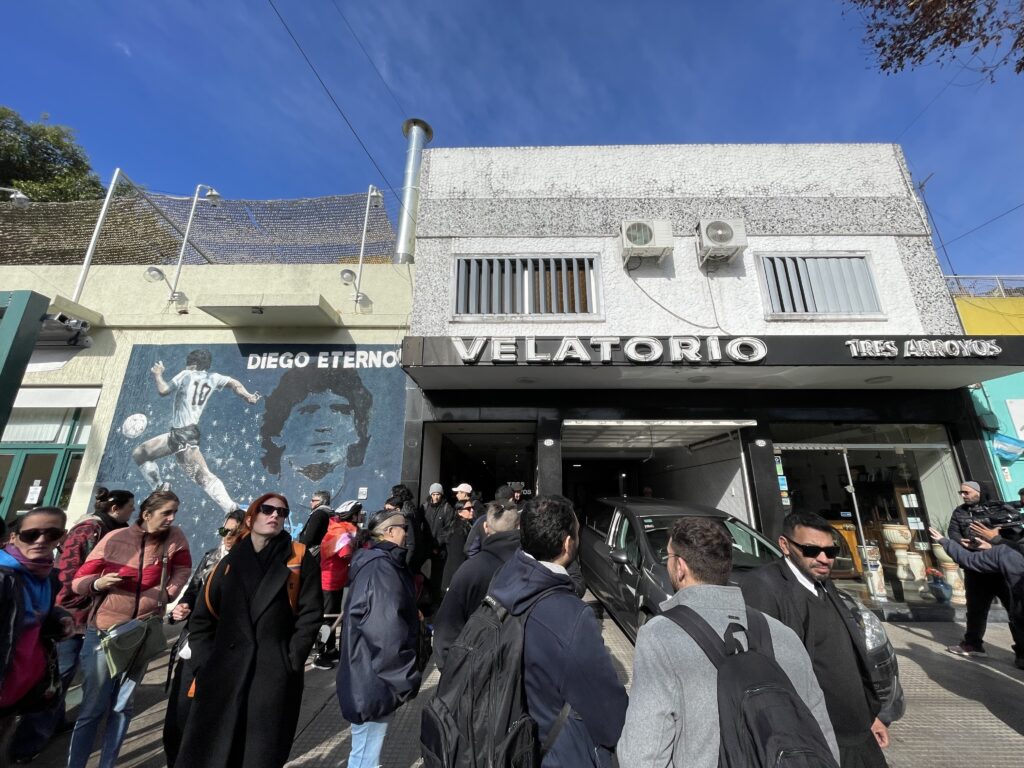
On the facade of the funeral home, the women from La Fulana displayed a lesbian flag and a sign that read, “This is not freedom, this is HATE. They killed three lesbians,” on a wall where there was a mural of Diego Maradona. Some joined the procession on bicycles, carrying banners: it was lesbicide. Cars also carried messages. “Andrea Amarante fought for humanity.”
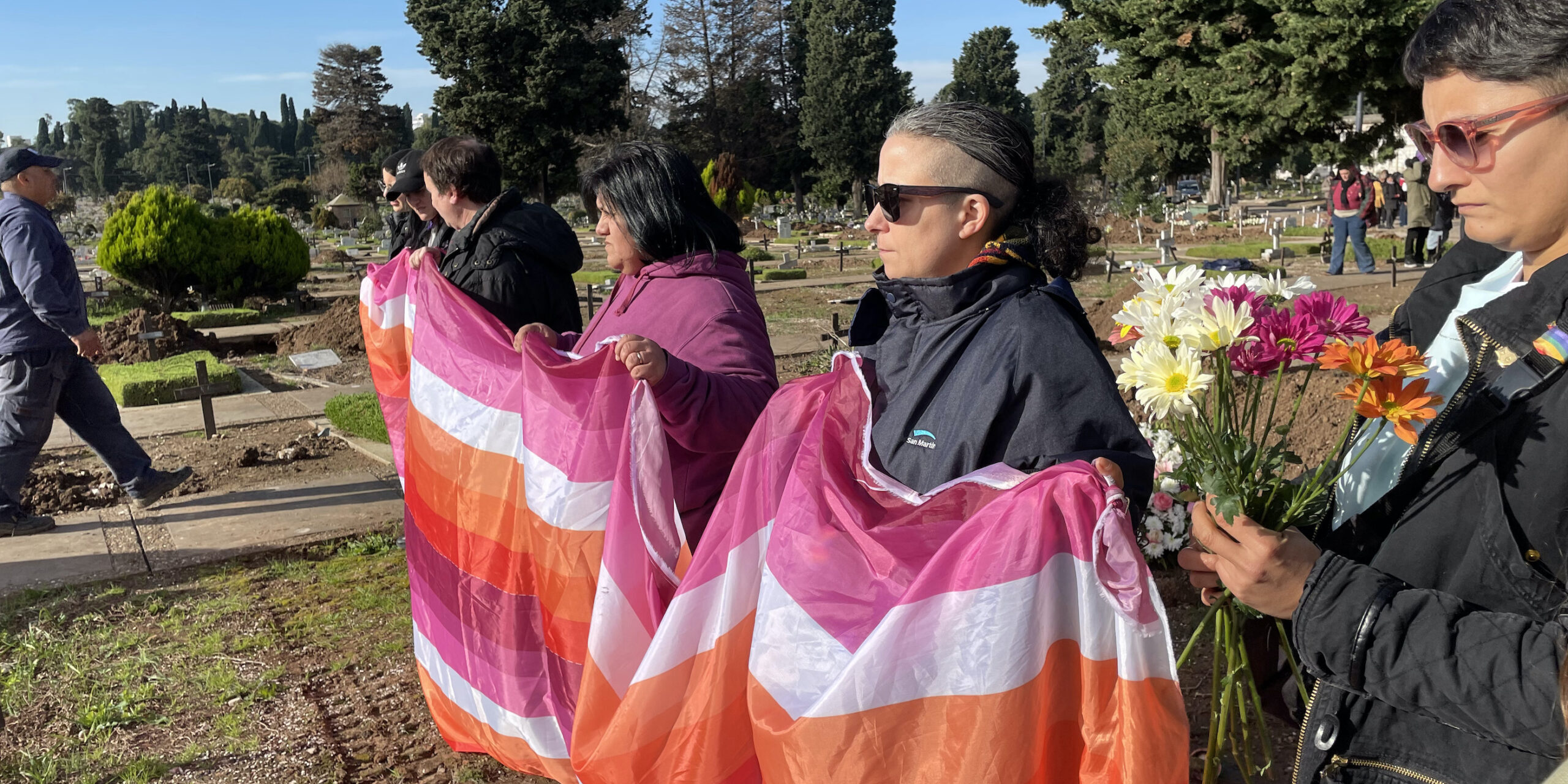
Family members of each of the victims, friends, lesbian and human rights activists—dozens of people came to Chacarita Cemetery to say goodbye to Pamela, Mercedes, and Andrea. They repeatedly chanted the word "lesbian." They unfurled rainbow and lesbian flags: a huge one, pink, white, orange, and red, held by several people, shone brightly in the sun in the middle of the cemetery. Another priest, standing behind the lesbian flag, recited the customary words, with a slight variation: "May they live happily ever after. May God receive them and may there be no discrimination."

Activism, present
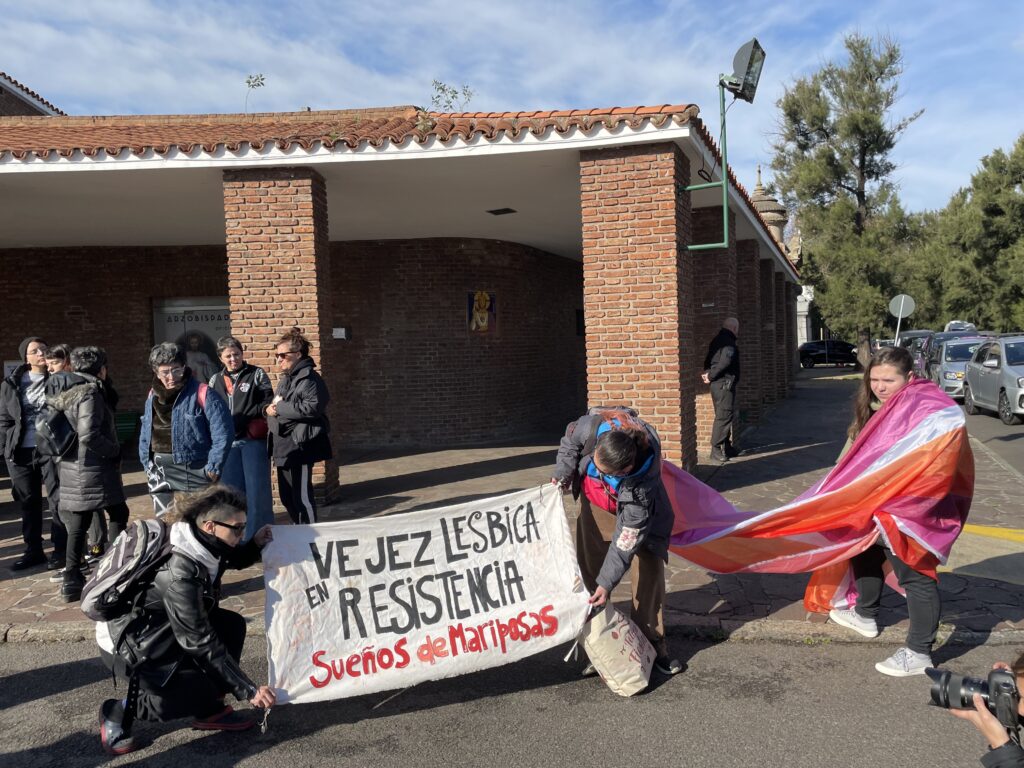
The LGBT Ombudsman's Office and FALGBT+ team, who have been supporting the victims since that Sunday night, were attentive to the logistical details. Also present were members of the organizations that are developing strategies to ensure Sofía is supported and provided with what she needs. Among them were the lesbians from the Barracas Assembly, the members of the collectives Yo no fui (It Wasn't Me), No tan distintes (Not So Different), and Lesbianas Autoconvocadas (Self-Organized Lesbians). And those from Sueños de Mariposas (Butterfly Dreams).
“It was a very emotional day where we saw a community organized to respond to the pain and violence with camaraderie, love, and organization. That's why our organizations filed the lawsuit so that the justice system recognizes that it was a lesbicide, that these were hate crimes,” María Rachid, representative of the LGBT Federation, told Presentes.
The legal case
- On Monday, the FALGBT (Argentine Federation of Lesbians, Gays, Bisexuals, and Transgender People) filed a lawsuit with the courts on behalf of the four victims. In it, they requested that these crimes be classified as hate crimes against four lesbians and asked for the intervention of the Specialized Prosecutor's Unit for Violence against Women (UFEM), which has worked with prosecutors in other cases of lethal violence linked to hate crimes. However, in the case of the triple lesbian murder, the prosecutor's office had not accepted the intervention now requested by the FALGBT+.
- The case is being processed in Criminal and Correctional Court No. 14, under the jurisdiction of Judge Edmundo Rabionne.
- Justo Fernando Barrientos (67), a neighbor of the boarding house where the four women shared a room, is in custody. He has been charged with “double aggravated homicide” against the three victims: Andrea Amarante, Pamela Cobbas, and Roxana Figueroa. He is also charged with “assault” against Sofía. The aggravating circumstances applied were treachery and common danger, but the specific aggravating circumstance of hate crime based on sexual orientation was not considered . Gender-based violence was also not considered.
Collective hug
On the way to the burial site for those disobedient and punished bodies, those present marched for about five hundred meters, carrying a long lesbian banner, some holding hands. The silence of the walk was broken by timid voices singing “Puerto Pollensa,” amidst smiles and tears. A few more joined in with “Honrar la vida” (Honor Life), and when it came to “Soy lo que soy” (I Am What I Am), the singing became a collective effort.
“Here we are, saying goodbye to our comrades with struggle, with our flags. It’s a very sad day, we are deeply moved, but it also marks the end of a cycle,” Perla Aguirre, a member of the Self-Convened Lesbian Assembly for the Barracas Massacre, shared with Presentes. This group emphasized the organization and unity that emerged in the wake of the triple lesbicide. “We must greatly value the networks that are being woven, that we are able to build. We all understood that this was about unity and that we had to move forward,” said Estefanía Cámera Da Boa Morte, also from the Assembly.
Multiple human rights violations
Those who couldn't attend sent greetings. María Elena Naddeo, from the Permanent Assembly for Human Rights (APDH), conveyed the message of Taty Almeida, a Founding Mother of Plaza de Mayo, and of the Roundtable of Human Rights Organizations. Estela Díaz, Minister of Women and Diversity of the Province of Buenos Aires, sent greetings to the families and friends. “In our commitment to eradicating gender-based violence and defending the rights of women and LGBTQ+ people, we join in the call for justice.”
Naddeo emphasized that “the murdered women and the survivor suffered not only discrimination and gender-based violence in their lives, but also state abandonment that prevented them from accessing decent housing and employment. That is why they were crammed into a hotel filled with tension and misery.” Regarding the triple lesbian murder, she demanded, on behalf of the APDH (Permanent Assembly for Human Rights), “an end to hate speech.” She also demanded “that both the city and national governments comply with current legislation protecting our rights.”
From now on, “what lies ahead is a legal battle,” the Assembly stated. “ We demand that the justice system understand that this is not an isolated case, that it was a hate crime, that they were killed and set on fire for being lesbians, that it is a massacre. We deserve justice that rises to the occasion,” said Jesi Hernández, a member of the self-organized collective.
We are present
We are committed to journalism that delves into the territories and conducts thorough investigations, combined with new technologies and narrative formats. We want the protagonists, their stories, and their struggles to be present.
SUPPORT US

FOLLOW US
Related notes

We are present
This and other stories are not usually on the media agenda. Together we can bring them to light.