

Reas: the power of fantasy
Lola Arias's new film focuses on prison life and narrates it through documentary fiction, melodrama, and musical theater.



Share

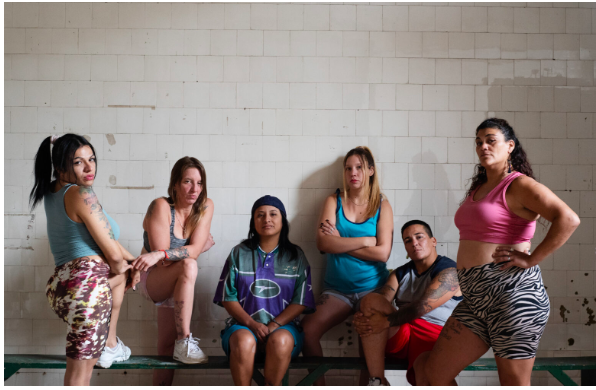
The docudrama-turned-prison musical directed by Lola Arias and starring cisgender and transgender ex-convicts from Ezeiza prison dismantles a crystallized narrative about incarcerated individuals. Accentuated by songs, vogue , and communal affection, Reas is a film but also a broader project that moves beyond stereotypical assertions. It raises powerful questions about the power of imagination and the role of artistic experimentation in contexts of confinement.
The film tells the story of six ex-convicts who served their sentences in prison. Yoseli is 26 years old and has a blonde ombré hairstyle. She dreams of traveling and has the Eiffel Tower tattooed on her right shoulder. Upon arriving at the prison, she meets the rest of her fellow inmates and assumes a leading role in the film's plot.
A group of women are playing soccer in the prison yard. Noelia, a trans woman who was forced into a sex trafficking ring, is wearing a Riquelme jersey. What initially seems to be the start of a fight between Noelia and another inmate transforms with the appearance of a catchy rhythm that grows louder and louder. The confrontation evolves into a choreographed routine with kickboxing moves and catwalking characteristic of ballroom culture.
The origin
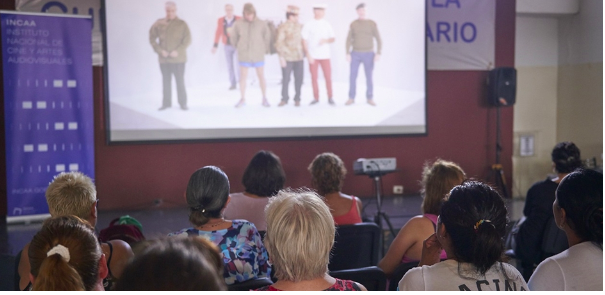
In 2018, the Penitentiary Ombudsman's Office, together with the National Institute of Cinema and Audiovisual Arts (INCAA) and the Argentine Academy of Cinematographic Arts and Sciences, and with the collaboration of the Federal Penitentiary Service, held a film series at the Ezeiza Women's Prison. One of the films screened was * Teatro de guerra * (2018), Arias's debut feature. It tells the story of six Falklands War veterans who reunited to make a film thirty-five years after the conflict.
The women in attendance surprised everyone with their level of curiosity. They were impressed by the possibility of seeing non-actors starring in a film; the unexpected act of translating complex experiences through art. Questions and comments swirled in the screening room. From that moment on, Lola Arias knew she would return to the prison to turn those questions into exclamation points.
On February 18, 2019, artists and teachers began offering film and theater workshops at the Ezeiza Women's Prison. From the outset, Lola Arias's vision was clear and ambitious: she wanted to film a movie with incarcerated individuals . Months after the workshops began, the Covid pandemic brought any possibility of continuing the artistic training to a halt. The project was temporarily suspended, and the prison once again became, more than ever, an implosive, inaccessible capsule.
The obstacles
Proposing, designing, and maintaining spaces that foster autonomy in an environment where life is completely regulated—everything requires authorization from the prison service, supervisors, guards, or judges who administer sentences—is a nearly impossible task. Punitive confinement, where there is neither privacy nor silence, where personal decisions, life plans, and daily desires are disregarded, directly impacts each person's inner world and sensitivity. That is why Arias's team does not give in to these obstacles.
With the Covid pandemic over in 2022, Lola's team joined forces with social workers to reach out to people who had already served their sentences and were now free. Yoseli, arrested for drug trafficking at an airport, and Nacho, a trans man arrested for fraud who founded the rock band "Sin Control" while incarcerated, were part of this group. They met at the former Caseros prison, located in the Parque Patricios neighborhood of Buenos Aires.
Off-axis narratives
Reas intelligently avoids romanticizing prison life without suppressing the sadness and pain experienced by its characters. The project emphasizes and amplifies moments of joy and the strengthening of bonds of solidarity within the prison. There are impromptu dances, friendships, and romances that emerge amidst the unexpected.
Unlike recent major audiovisual productions in Argentina, Arias's film moves beyond the clichés that reinforce class and gender stereotypes, focusing instead on communal affection and the creation of scenarios that blur the lines between fiction and reality. Although the film's participants never shared the same prison simultaneously, their stories and fictional narratives reconstruct the authentic experiences lived by each individual. Is this—really—prison? This doesn't seem to be a question Arias is interested in answering, but rather in questioning the assertion that—this, too, can be —prison.
In the film, people are not defined by the violence that surrounds them; rather, the violence serves to precisely contextualize their environment. A shocking scene—though unique within the film's overall universe—illustrates this point: three police officers brutally beat Nacho without any justification. However, this violence is not explicitly shown to us; it is subtly revealed through a barred mirror, evoking the atmosphere of a prison cell. We only catch glimpses of the aggressors' upper bodies as we hear their shouts and blows mixed with the victim's faint whispers.
Challenges of the collective
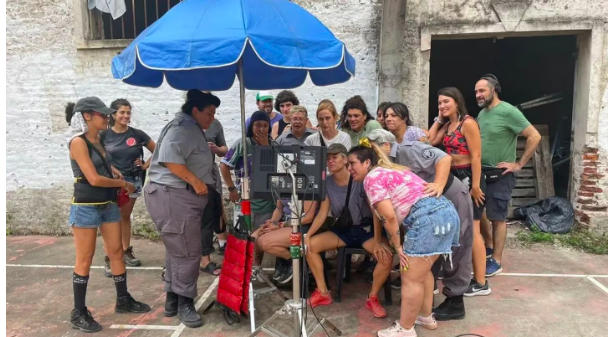
Since the project is the result of a collective effort, the performers played an active role in creating and narrating their past memories. They integrated their own experiences and perspectives. In this process, Arias ingeniously utilizes pop culture tropes and elevates music as one of the key resources he discovers as a means of expression in contexts of confinement. The musical moments are enriched with striking effects of blowing hair, expressive glances directed at the camera, and phone calls that oscillate between flirtatious, desperate, corny, and anguished.
Lola Arias hates musicals, which is why her reappropriation of the genre serves as a platform to subvert its characteristic virtuosity and transform Reas into a friendly and relaxed space for the therapeutic potential of recreation. The director of * My Life After* champions the ability to dismantle stigmas and generate tools that broaden horizons and allow us to imagine other possible worlds. It also explores new ways of conceiving communal life and community building.
A three-week shoot cut to two due to budget constraints; postponed rehearsals and people dropping out of the project led Arias to doubt, at times, that the film would ever be made. “I need us to get on the same page, otherwise I’m going to die,” he confessed to telling his cast in an interview. Even so, exactly five years after the workshops began in the prison, on February 18, 2024, Arias’s second film premiered in the Forum section of the 74th Berlin International Film Festival (Berlinale). It also won the Best Documentary award at the Luxembourg Film Festival (Lux Film Festival).
The execution of any sociocultural project involves making key decisions: what to do, for what purpose, how to carry it out, and with whom to collaborate. When the filming process directly or indirectly involves groups of people, the consequences can have a significant impact on those groups. Currently, the cast of Reas is in the second stage of the project, Los días afuera (The Days Outside ), in a theatrical format. They will also begin a year-long world tour directed by Arias. This pair of projects marks the first recorded work of its performers since their release from prison.
People living in conditions of punitive confinement and those who have served prison sentences constitute groups that have historically been subjected to discrimination, criminalization, pathologization, and exclusion by various institutions. With recognizable subtlety, Arias leverages spaces of legitimate knowledge production to create a work that challenges stereotypes and simplistic perceptions. Her approach amplifies alternative perspectives on desire, enjoyment, punishment, and imagination in contexts of confinement. It enables a more humane and complex understanding of these experiences.
The language of fantasy
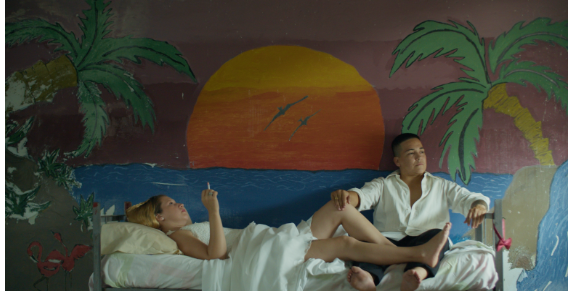
Artistic training and experimentation programs in prisons and other socially vulnerable settings often create opportunities for reclaiming one's voice, enabling alternative identities or versions of one's own story, contrary to those prevalent in mainstream media, court rulings, and criminological reports. This shift does not seek to evade or deny responsibility, but rather offers a space to retell one's (auto)biography in a way that differs from the supposed destiny imposed by the sentence, making possible the (re)writing of individual and collective history. It is, therefore, a moment of transition, a movement of meaning, with both individual and collective implications, as it allows for the revitalization of the bonds built and sustained within contexts of confinement, while simultaneously blurring the dynamics and roles inherent to that context.
Yoseli is found by her classmate in the courtyard:
“I was looking for you. What are you doing?”
“Nothing. Just staring at the wall,” Yoseli replies.
“What’s wrong with the wall?”
"What? Can't you see?"
“It’s all broken.”
“Yes, but I see beyond the wall: I see the grass, the trees, the campsite where I used to go with my dad and my sisters. When I was in Ezeiza, my cellmates would get mad because I didn't hang out with them. But oh well, I like being alone. You see me here, but my mind is elsewhere.”
With little drama and a lot of irreverent fun, Yoseli, Nacho and their companions propose to revisit their past in a disturbing language that plays with the present.
And that language, vibrant and luminous, is the language of fantasy.
We are present
We are committed to journalism that delves into the territories and conducts thorough investigations, combined with new technologies and narrative formats. We want the protagonists, their stories, and their struggles to be present.
SUPPORT US

FOLLOW US
Related notes
We are present
This and other stories are not usually on the media agenda. Together we can bring them to light.