

What does the Framework Law have to do with the rights of women and diverse groups?
The law raises a number of violations, particularly for women and diverse groups who are among the most unprotected.


Share

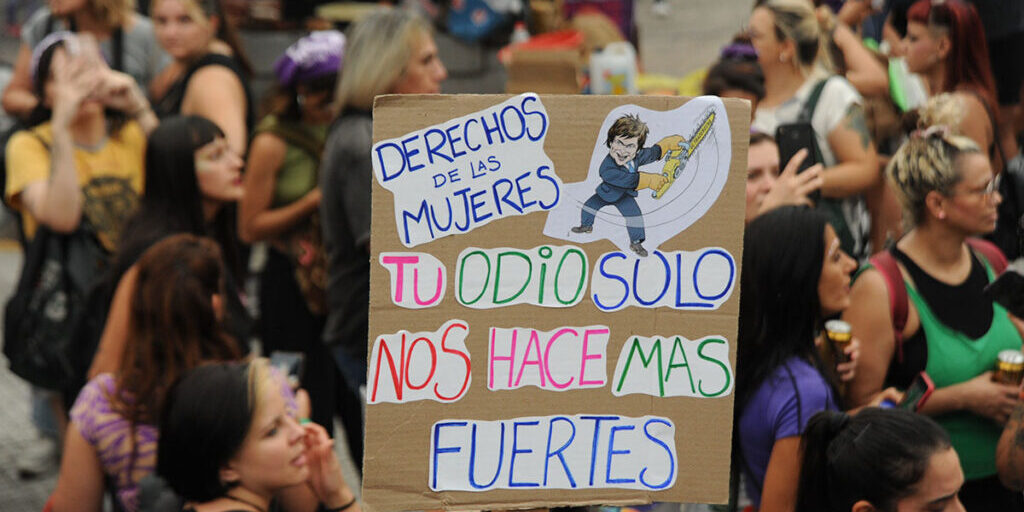
In the six months since Javier Milei took office in Argentina, the economic situation of the most vulnerable sectors has worsened. Layoffs, inflation, and stagnant wages are part of a political project that, using economic arguments, is advancing its attempts to erode rights. This disproportionately affects women and LGBTQ+ people. In recent days, the closure of the Undersecretariat against Gender Violence was announced, which had previously replaced the Ministry of Women and Diversity.
This Wednesday, the Senate is scheduled to debate the "Law of Bases and Starting Points for the Freedom of Argentinians ." It has already passed the lower house. This law is generating particular concern due to the elimination of the pension moratorium, as well as labor deregulation that leaves workers unprotected in cases of discriminatory dismissals.
Precarious employment and limited access to pensions reinforce a structurally patriarchal society, where both women and sexual minorities are excluded.
Framework Law approved in Deputies: women and diverse groups, out
On Tuesday, April 30, the Argentine Chamber of Deputies voted in favor of the "Law of Bases and Starting Points for the Freedom of Argentinians ." The bill passed with 142 votes in favor, 106 against, and five abstentions.
The law reached Congress in this second instance with 232 articles. It was a revised version of the first one, which had been rejected by the Lower House. This time, it was divided into ten sections. Most of these articles constitute an attack on labor rights, gender equality, sovereignty, and state interference.
As activists, experts, and feminist militants had been anticipating, the law poses a series of violations, particularly for women and diverse groups who are among the most unprotected.
From a labor reform that does not protect against dismissals due to discrimination, allows probationary periods of up to one year and shortens maternity leave, to a pension reform that restricts the possibility that women have had until now to access a moratorium to obtain their retirement at age 60.
Against human rights
The law reforms crucial chapters that protect fundamental human rights, such as the right to work. “These rights affect women and LGBTQ+ individuals,” Adriana Micale, a lawyer specializing in social security, tells Presentes, “because they are among the most vulnerable groups. Statistically, it’s a very significant number.”
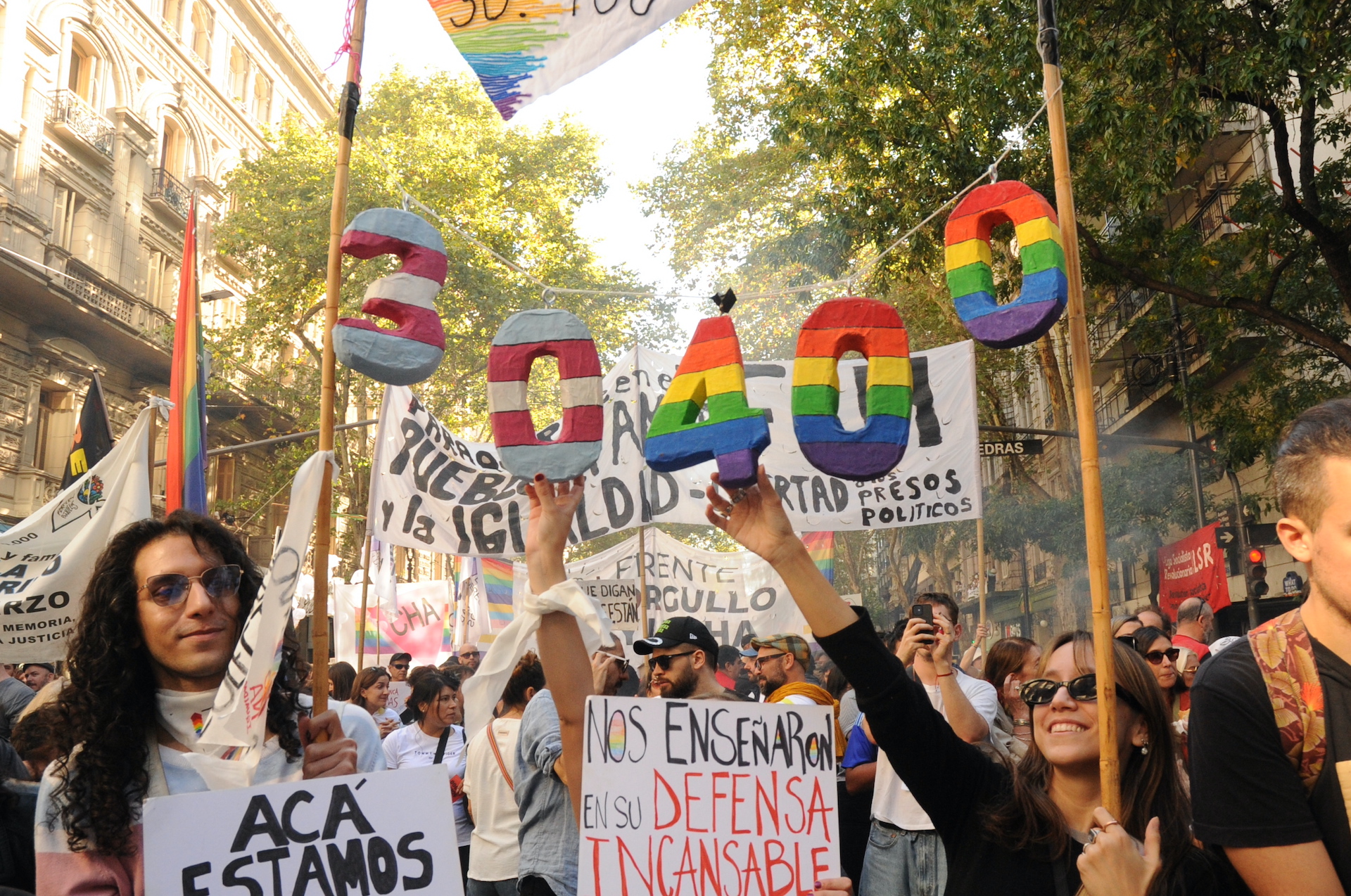
Manu Mirelles, academic secretary of the Mocha Celis Popular High School , analyzed the implications of the law for Agencia Presentes , particularly for the trans population. “LGBTIQ+ organizations reject the law because it poses enormous risks and setbacks not only for democracy, but also for guaranteeing the lives of the people and the necessary conditions for living.”
“ It is necessary to recognize the fundamental role that LGBTIQ+ people play in democracy and politics. The trans, travesti, and non-binary movement embraces and advocates for alternative models to the current economic system. And we want to move towards a society that allows, guarantees, and promotes the sustainability of life ,” she added.
The elimination of organizations fundamental to sexual and cultural diversity creates a context of violence and inequality. Furthermore, the Framework Law represents a setback in terms of labor and social security guarantees. Thus, the State itself is jeopardizing the rights acquired by LGBT people after long struggles.
Mirelles further clarified that she emphasizes the need to continue promoting the effective participation of LGBTQ+ people in decision-making spaces. “Our movement was born out of various emancipatory, workers', and feminist struggles. So, for us, guaranteeing democracy is the starting point from which we must consider regulatory frameworks.”
Increased inequality and violence
Ni Una Menos focuses its demands on an economy that exacerbates inequality and violence against women and gender-diverse people. “ The preliminary approval of the Framework Law is very bad news for lesbian, transvestite, and trans women . It affects us across the board as public employees, workers in state-owned companies, self-employed workers, and all workers,” says Luci Cavallero, one of its leading figures. “It’s a regressive law that aims to lower the tax burden for large corporations, the so-called heroic businessmen , and especially foreign business owners,” adds the sociologist.
The Lower House also approved the sale of public companies that have been fundamental to the development of equality in Argentina, such as public media outlets. This also undermines gender inequality, since these media outlets, for example, the Télam news agency and public television, sought to provide opportunities for women and diverse groups both in their coverage and in their staff.
The Argentine LGBT Federation asked the members of parliament to vote against the law. They will now take their request to the Senate.
“We ask all those political organizations not to abandon us at this time. Do not allow the spaces that have contributed to recognizing our rights and that today—in some way—protect them to be destroyed .
María Rachid, head of the Institute Against Discrimination at the Ombudsman's Office of the City of Buenos Aires , told Presentes : “This 'Framework Law' only enshrines the freedom to violate rights and discriminate. If approved, the government will not only destroy INADI, Télam, and so many other organizations that are fundamental to the recognition of our rights, but it will also eliminate the possibility of demanding reinstatement after discriminatory dismissal and access to pension moratoriums for people who need to retire and who—as a result of the violence they have suffered at the hands of society and the State, such as transgender people—do not have the required years of contributions. These are just some of the many other rights that were destroyed in Congress with its preliminary approval.”
Work, retirement and quotas
With the elimination of the pension moratorium, only 9 out of 10 women will be able to retire at age 60. They will only be able to access retirement benefits from age 65 onwards.
This situation is aggravated in the case of transvestite and trans people, who mostly only after the enactment of the Gender Identity Law (2012) were able to access jobs in a small number of them, almost all of them informal..
In 2021, the Transvestite and Transgender Labor Quota Law (27.636) allowed access to formal employment for almost 574 people nationwide until February 2023. The number dropped after the wave of layoffs in the public sector by the government of Javier Milei.
These measures, Micale says, deepen inequality and promote precariousness.
“Vulnerable groups (mostly women, LGBTQ+ individuals, and immigrants) in this context end up stuck in lower-skilled jobs. And they are, in general, the ones who don't have the opportunity to accumulate the minimum years required for retirement. They resort to informal work because survival depends on accessing any legitimate means of support. This impacts their contribution rate and, consequently, their lack of coverage.”
Furthermore, he analyzes, “a scenario of deepening poverty is anticipated. He explains, “the impact is direct because what is being jeopardized are the protective norms of labor rights and social security .
In this regard, Luci Cavallero states, “This lack of registration, which the State encourages through this law, ultimately results in us not having the necessary contributions to be able to retire. And the State penalizes us again by giving us a pension. Five years later and 20% lower than the minimum pension. As citizens and workers of this country in every sense, this is an absolutely regressive law that must be rejected outright by the Senate.”
Layoffs and declining inclusion policies
Upon assuming office, Milei proposed closing the National Institute Against Discrimination, Xenophobia, and Racism. As of April 8th, 100 transgender people had been laid off from public sector jobs. This represents almost 10% of the quota achieved in two and a half years (955 transgender people hired). The data was provided by the Ninth Monitoring Report on Law 27636 (Transgender Employment Quota) by the Gender and Diversity Observatory of ATE Nacional and the Zaguán Transindica Observatory.
-According to the same source, the most affected areas are the Ministry of Labor (27), the Ministry of Social Development (23), ANSES (20), and the Ministry of Foreign Affairs (10). This is equivalent to 77% of the former Ministry of Labor or 36% of the former Ministry of Social Development.
-A report prepared by ACIJ and ELA, in partnership with Amnesty International, CELS, EcoFeminita, Fundar and FES Argentina states that so far in 2024 spending on public policies aimed at reducing gender inequality was 33% lower than in 2023 .
-Regarding labor inclusion policies, the 'Potenciar Trabajo' program, two-thirds of whose beneficiaries are women , experienced a 71% reduction in real terms compared to the same period in 2023.
We are present
We are committed to journalism that delves into the territories and conducts thorough investigations, combined with new technologies and narrative formats. We want the protagonists, their stories, and their struggles to be present.
SUPPORT US

FOLLOW US
Related notes

We are present
This and other stories are not usually on the media agenda. Together we can bring them to light.