

Elections in Mexico: What was said about diversity and rights in the three presidential debates
What proposals for diversity, migrants, and vulnerable groups appeared in the debates by the three candidates for the presidency of Mexico?


Share

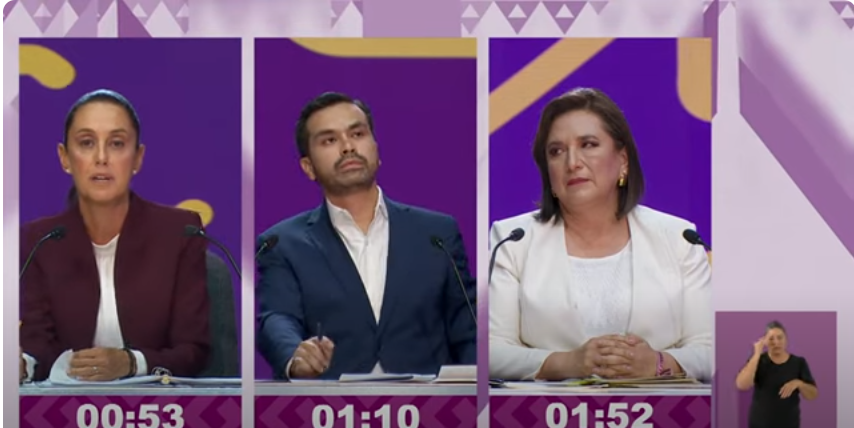
In the June 2nd elections, Mexico will choose between Claudia Sheinbaum, of the "Sigamos Haciendo Historia" coalition; Xóchitl Gálvez, of the "Fuerza y Corazón por México" alliance; and Jorge Álvarez Máynez, of the Citizens' Movement, for the presidency. During the campaign, there were three debates intended to explore their policy proposals. However, their messages consisted more of accusations and evasions, with few substantive proposals, particularly regarding how to guarantee the well-being and human rights of diverse and historically marginalized populations.
One of the biggest social criticisms of the three debates is that the candidates maintained a narrative of personal attacks and accusations against their political parties, with little clarity regarding government policies. When they had the opportunity to discuss vulnerable groups, some of these weren't even mentioned.
When discussing migration, inequality, poverty, climate change, and sustainable development, there was also no intersectional approach. This is despite the fact that there are projects and policies that currently impact some of these populations, such as the Maya Train , the security strategy , and the militarized migration policy , for example.
Proposals for LGBT people: punitivism and no guarantee of an expansion of rights
-Only in the first presidential debate was there a specific segment on vulnerable groups. And while LGBTI+ people were mentioned, the proposals took a punitive approach rather than one focused on preventing violence or discrimination. There was talk of “punishing hate crimes.”
-Nor was there any talk of guaranteeing other rights such as health, education, work, and housing to this population.
-When health was discussed, HIV was linked solely to the LGBT+ population.
Comprehensive sex education was not part of the agenda of any of the three candidates. Abortion was barely mentioned by Jorge Álvarez Máynez.
-Nor did they address the needs that are lacking to guarantee decriminalization and access to this right.
-There was no mention of Afro-Mexican people. Neither their recognition nor their discrimination was discussed. The intersection with other issues where this Mexican population is affected by militarized migration policies was not addressed.
– People living with disabilities were only mentioned in the first debate as part of a section on vulnerable groups. And this single mention was framed within a rehabilitation approach, where the proposals, lacking clarity on how to implement them, amounted to the creation of “rehabilitation programs.”
Inequality, poverty, climate change
In both the second and third debates, the topics to be addressed gave the candidates an opportunity to broaden their perspective on how to approach poverty, inequality, climate change and sustainable development, organized crime and security.
But when it came to climate change and sustainable development, poverty and inequality, the candidates didn't differ much in their proposals to continue with megaprojects. No one mentioned the Indigenous and rural communities affected by these developments. To combat poverty, all three candidates explained that they would continue with social programs.
When the topic of poverty was discussed, indigenous peoples were mentioned, but no candidate proposed how they would address the inequality gap they experience in Mexico.
Punitiveness and militarized security
On the security front, their proposals are not far apart. On the one hand, Claudia Sheinbaum intends to maintain and strengthen the National Guard and continue with the current security strategy. This is the same strategy that has been in place since 2006, with the army deployed in the streets.
For Xochitl Gálvez, creating models for municipal police forces and high-security prisons is one way the state can confront crime. Jorge Máynez proposes increased funding for police and drug regulation.
At one point during the third debate, they were questioned about security models beyond a punitive approach, involving the military and prisons, but none of the candidates responded to this.
We are present
We are committed to journalism that delves into the territories and conducts thorough investigations, combined with new technologies and narrative formats. We want the protagonists, their stories, and their struggles to be present.
SUPPORT US

FOLLOW US
Related notes

We are present
This and other stories are not usually on the media agenda. Together we can bring them to light.