

Rita Segato: “It is not power we seek, but the collapse of all power.”
Anthropologist and feminist activist Rita Segato spoke with Presentes about the anti-gender movement in Latin America and the continued power of feminist and diversity movements to erode patriarchy and capitalism.



Share

Renowned Latin American thinker, anthropologist, and feminist activist Rita Segato reflects in this interview with Presentes from Paris on the situation of women and diverse groups in the face of the regional advance of anti-gender rhetoric. “For about 10 years now, people have been appearing in the streets shouting against us. That's not a problem; that's proof of the movement's strength and what we threaten,” she said a few days ago, during a series of talks on feminist theories and practices at the Institute of Advanced Studies of Latin America in the French capital.
In her view, the demands of the feminist movement “give, protect, and grant sovereignty.” Both in life and in political reflection. “That degree of autonomy is seen as dangerous to the power structure,” she explains.
Born in Argentina, Segato pursued her career primarily in Brazil. There she began to specialize in gender violence, a topic she didn't choose, but which came to her through a commission from the authorities in Brasília in 1993. Since then, she has written more than a dozen works on the subject through a feminist and decolonial lens.
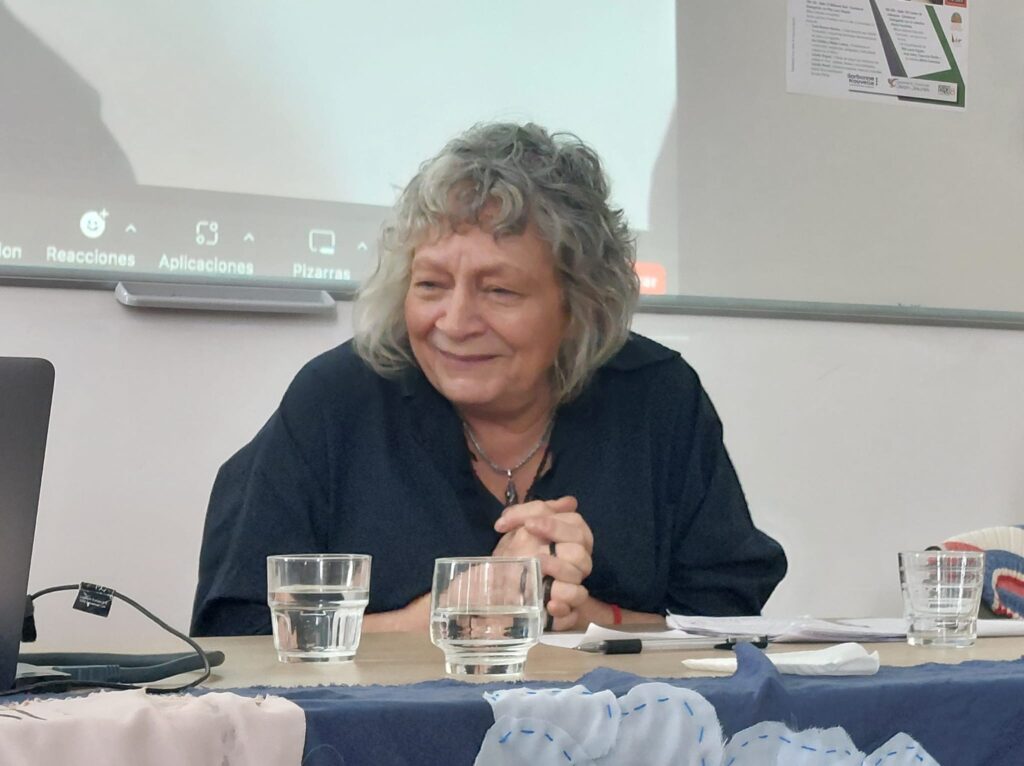
"There is a decline in power"
At 72, the academic carefully considers her words and strives to get to the heart of a line of thought that has taken her a lifetime to develop. “My effort, which I'm already quite tired of, is to give these explanations of things I've understood, I believe, in depth. This is partly because I'm an anthropologist, because many things were explained to me by people,” she confides.
Despite the “difficult” moment the women's movement is going through, the author is optimistic in stating that, faced with the “constant failure of male management”, the “margins” - in all aspects of life - are gaining momentum they did not have before.
“There is a decline in power. It is being emptied from within,” he states.
–How would you rate the situation of women and diverse groups in Latin America?
One of the things that has long been perplexing is that in Latin America we have extensive legislation and numerous public policies aimed at protecting women and combating femicide. But clearly, there isn't a proportional response from society. We should reflect on why. What is preventing the laws from addressing the ever-increasing phenomenon of violence against women? This situation is strange and relates to my comments about the crisis of faith in the state. Because something is amiss with state measures; they have immense difficulty reaching the population. I don't mean to say that there shouldn't be a state that cares for its people, but there should be a profound reflection on the obstacles the state faces in reaching the people and communities of the nation.
– And why do anti-gender movements and hate speech, which are not new, seem to have a greater impact today?
– That's another issue. In all right-wing governments, in all governments that support the five major precepts of capital (productivity, competitiveness, cost-benefit analysis, accumulation, concentration), there has been a convergence in the demonization of women. That is, in an attack on all the demands and proposals of the women's movement, whether we call it feminist or something else. The women's movement in society was suddenly co-opted by all the political sectors that oppose the critical field, those that belong to the conservative camp.
– This situation was exacerbated by leaders like Trump, Bolsonaro, Bukele, and now Milei.
Multiculturalism, a proposal that emerged from the liberal and capitalist North after the fall of the Berlin Wall, was a form of wealth distribution. It considered what were then called political identities, which I now call forms of minorityization. It had its good and bad points. It named the interests of minorities who had been harmed by history (Black people, Indigenous people, women, people of diverse sexualities) and attempted to protect them through affirmative action. It had this benign effect, but always as a form of redistribution.
In other words, it never involved any reflection on wealth. In reality, this multiculturalist distributionism was conceived from the Global North as yet another way to support capital, because it supports consumption by various "minorities." More recently, as clearly demonstrated by the rise of Trump and the increasingly strong resurgence of neo-fascism in Europe, multiculturalism is declining. It is no longer the current agenda.
«By breaking down patriarchy, capitalism is eroded»
“The extraordinary and brilliant think tanks realized that anti-patriarchal demands would actually cause fatal damage to the ship's hull. For me, power is not observable, it's secret, and those in power have secrets . But we can speculate on where they're headed based on epiphenomena, on what is visible. Clearly, there was a change of course at some point. In the multiculturalism project, it was thought that women and minority consumers were untrustworthy . It was perceived that behind the movement, which eroded the foundations of patriarchy, damage would be inflicted on the hull of capitalism. So, by dismantling patriarchy, the edifice on which it rests also crumbles, and we learn that it's possible to modify history, that it can be steered toward another horizon,” she says.
– What makes this demonization effective?
– These political parties place their messages in the most powerful media outlets: in mass media, on social networks, with trolls . They have access to countless media platforms, and in all of them they deliver their message with great force. “Let’s defend life,” for example. It’s very easy to respond to, but they’ve silenced us because of their vast access to the most powerful media outlets and their various platforms. In all these spaces, they’ve portrayed feminist demands as harmful; it’s counter-propaganda.
– Do media outlets critical of that discourse unwittingly fall into that trap?
– (Raises her voice) Because they don't understand what's happening to them! One of the worst problems is that the critical field is still clinging to—but badly—left-wing and right-wing ideas. As my daughter says: the left is stuck in the first half of the 20th century. They're incapable of reading about Nicaragua or Russia or realizing that the war in Ukraine isn't an ideological war, but purely a territorial one, a power struggle. That's why I call myself a critical thinker, not a leftist, because the way the left and right are constructed is by stupid people. When I criticized Evo Morales, for which I was insulted, it's clear today that I was right. He broke up the MAS party for power. Of course, there were great projects in Evo's early days, but they declined, and what gutted them was the underlying power grab, which is extremely dangerous and something we shouldn't even seek in feminism. We don't pursue the same goals as the patriarchy. It is not power we seek, but the collapse of all power. I am convinced of it.
Need for self-criticism
– When I hear her, I think of Argentina, which had made progress in equal rights and policies, and yet elected an outspoken anti-gender person as president.
– Of course, and that's what we urgently need to understand: where we went wrong. Because otherwise, we'll just keep going around in circles. Argentina, more than any other country, has a problem: its politics are like a pendulum. We don't know how to do one of the good things that communist activism in the 60s taught us, which is self-criticism. There is no self-criticism, not even they did it themselves. The meaning of this word has been completely distorted. We have to be self-critical because something was done very wrong.
– Given this situation, how are the feminist and LGBTIQ+ movements reacting?
– There are quite profound divergences within the movements. In the anti-racist movement, there's a category that seems fundamental to me, which is racial consciousness. It relates to what we sometimes call the Sepoys, a regiment of Hindus who fought for the British in India. Similarly, there should be a category in the feminist movement called gender consciousness. It's crucial to understand that the body isn't enough. And this is one of the biggest mistakes many are making now, that trans women can't be part of the movement . This contradicts the very foundations of feminist thought, which was precisely to de-biologize, to dismantle biological determinism, which was, in a way, the prejudice that placed women in an inferior position. And now they want to return to biologization! I don't understand. Factional infighting is starting, which is damaging to feminism. It's necessary to talk, to argue, and even to be able to disagree.
– Greater unity is needed…
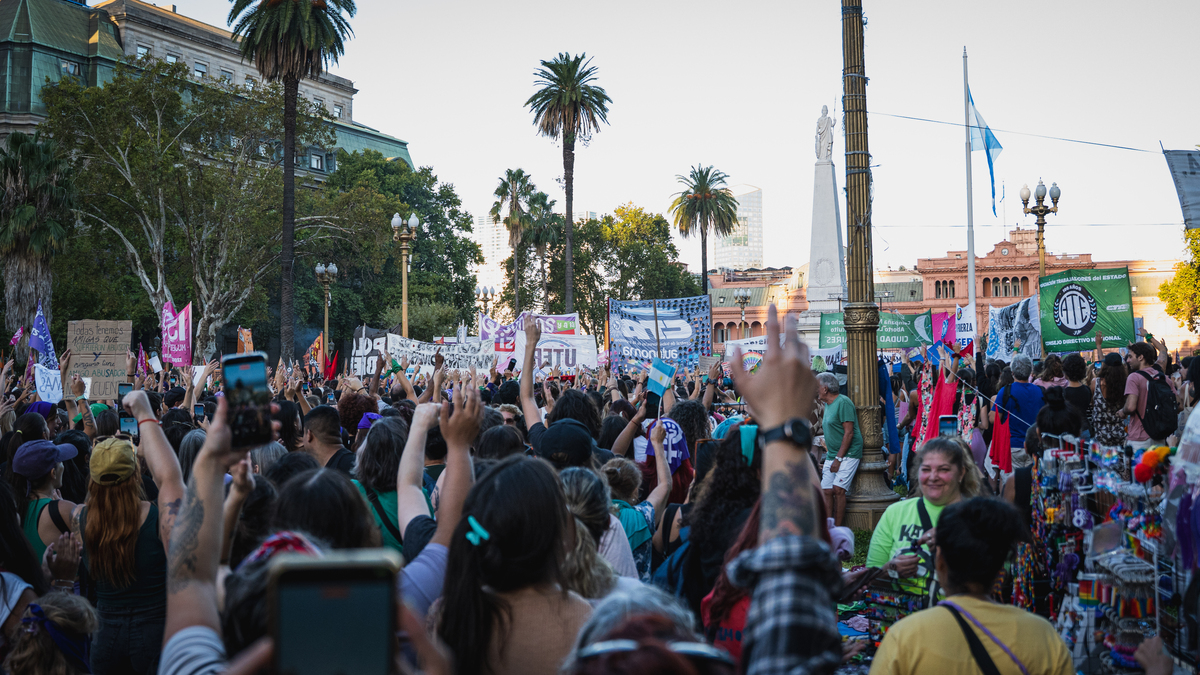
– But we don't need to agree on everything, please! The March 8th movement in Argentina showed that the factions abandoned their factionalism. It was one of the largest marches in recent times. So, we're not experiencing this rupture they're talking about, not at all.
Lesbian women and communal worlds: major threats
– In your view, one of the solutions to patriarchy would be to “domesticate politics,” and you often refer to indigenous societies. Are they an example of how this is possible?
– All Indigenous societies today are impacted by creolization, but some are truly undergoing a profound transformation. Many are experiencing a reemergence, while others are undergoing what Aníbal Quijano—my favorite author—calls the return of the past . It's not about going back to the past, but about that past finding us in the present. If we look around, we suddenly see a great number of very important leaders emerging from both Afro-descendant backgrounds—like Francia Márquez—and Indigenous backgrounds—like Berta Cáceres and many others in Brazil right now. But there are also many very young women who come from communal structures, where there is a kind of domesticity that I call feminine, structured differently and with different goals than male-dominated politics. Marielle Franco : the right wing is very clever and knows who it has to eliminate, including Berta… They are two central figures in this process where politics is done differently, through different paths, with different feelings and different slogans. They are extremely important figures in politics, that is, in what impacts collective life. Women who will impact collective life, but coming from a different kind of political experience, from communal worlds, where the domestic sphere is neither private nor intimate.
– And is that applicable in a Westernized world?
– It's not just applicable, it's happening. It's not my idea: Berta Cáceres existed, Marielle Franco existed, Sonia Guajajara exists, Elisa Loncón exists, and there are many others.
– How do you see the future?
– I'm a pretty optimistic person, all things considered. It's a difficult, very painful time. But don't forget that power doesn't just disintegrate and perish from external attacks; it's actually corrupted from within. As the English say, "Either it breaks you or it makes you." What doesn't destroy you, builds you up, and that's how it is.
Share
We are present
We are committed to journalism that delves into the territories and conducts thorough investigations, combined with new technologies and narrative formats. We want the protagonists, their stories, and their struggles to be present.
SUPPORT US

FOLLOW US
Related notes

We are present
This and other stories are not usually on the media agenda. Together we can bring them to light.