

Dida Aguirre, Quechua poetry as resistance and Andean philosophy
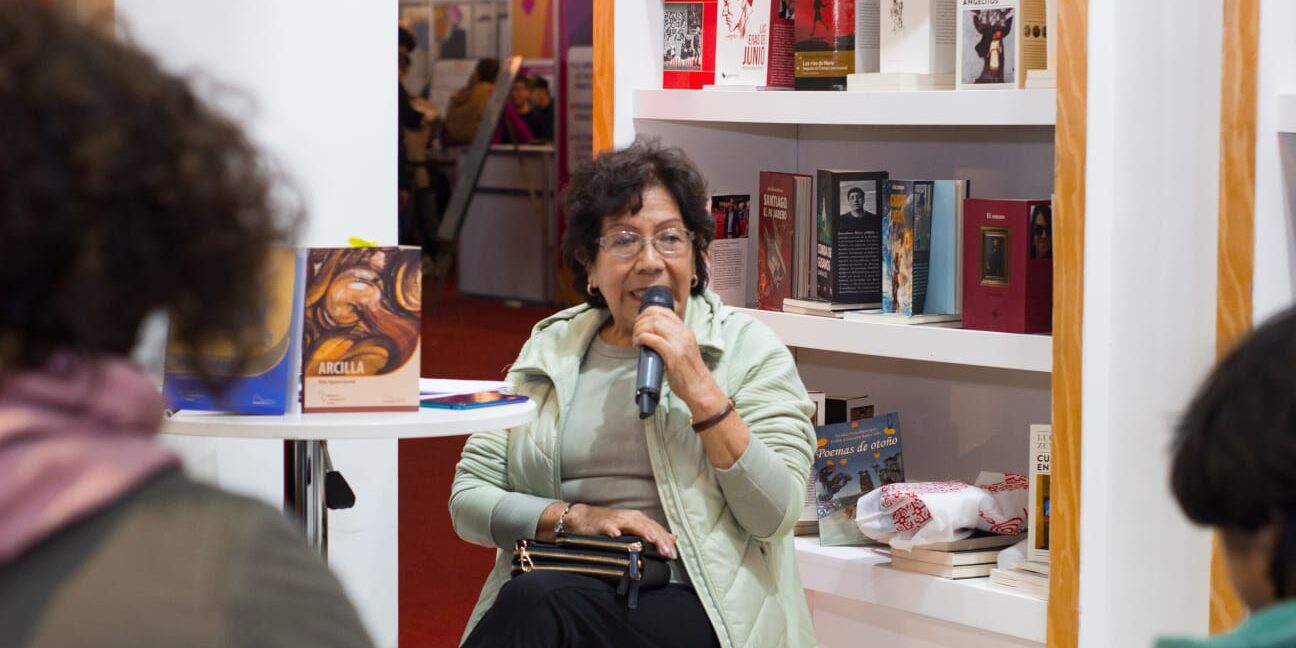
Dida Aguirre, a Peruvian poet, began writing in Quechua as an act of resistance and to tell the world: it is possible to write poetry in indigenous languages, which speak of solidarity and a philosophy kept by old women around the hearth.


Share

Dida Aguirre began writing in Quechua as an act of resistance, but also as a way to preserve and share a treasure. For her, Quechua was the voice of her mother. She wanted to record the ancestral knowledge that grandmothers guard around their hearths in the Andean region, like guardians, resisting since the Viceroyalty of Upper Peru, a center of power established in 1452 by the Spanish Crown to plunder the land's riches, destroying cultures along the way. Dida's poetry preserves the voice of a people who exist, resist, and seek a better future.
“Since colonial times, there has been a destruction of the Andean worldview and epistemology, which was replaced by a Westernized, rational conception of literature. In that sense, grandmothers, mothers, and elderly women have preserved this literature and this conception around the hearth,” the poet recounts, in a measured tone, in conversation with Presentes at the Buenos Aires International Book Fair, where she was one of the invited writers . Dida marvels at the size of the Book Fair.
Mario Vargas Llosa , a writer who won the Nobel Prize for Literature— whom Dida acknowledges as “excellent” in the Spanish language—"said that Quechua couldn't even be considered a language. That you couldn't write literature in it; much less poetry. So, in that environment, I thought I should leave a record. I had to write because my mother was a Quechua speaker, she spoke it beautifully, and I said, ' Well, there's poetry here ,'" Dida recalls.
Dida wrote three bilingual poetry collections. *Arcilla* (1988), the first, is being reissued. It was written “to bear witness and not let it go unnoticed that literature could be written in Quechua,” wrote Julio Noriega Bernui—linguist and specialist in Quechua and Latin American literature—in the prologue. He emphasizes the importance of bearing witness to the violence that killed peasants and students and “reduced entire communities to rubble.” In the poems, the slain ancestors are present: “From the / anonymous graves / resurrected / bodies covered / in fire / / -eyes of embers- // storm in / the joy of / living with the / dead.”
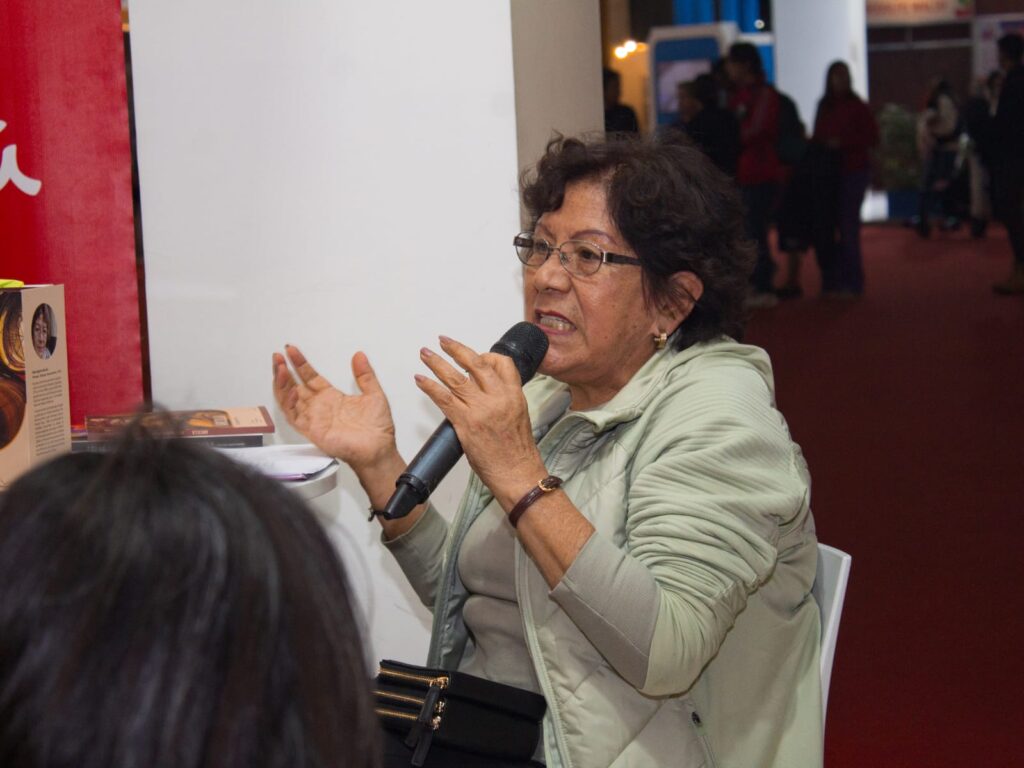
"Quechua philosophy resides in the elderly women"
Dida was born in 1953. For 37 years she worked as a university professor in the Social Work program. She currently lives with her 27-year-old son, who does not speak Quechua. Of Peru's 30 million inhabitants, only 3 million speak Quechua.
“In Peru, Andean knowledge is not valued,” Dida laments. In the jungle, social activists resist “fiercely.” Post-colonial society was structured around gold mining in the rivers; today, violence is perpetrated through illegal mining and logging, land trafficking, drug trafficking, and against the Indigenous peoples of the Amazon . In the jungle, the author points out, 40 recognized Indigenous languages are spoken, and 60 in total. This knowledge is not easily accessible.
“In research on decoloniality, in Western literature or philosophy, and in the construction of a new, authentically Latin American philosophy, silence is a barrier. Because the elderly women hold the knowledge, and it is often difficult for an outsider, even a family member, to enter the intimacy of their home after having left. Suddenly they are telling a joke, laughing, and if you approach, they fall silent and say something completely different. There is no fluid communication because, ancestrally, there is shame , on the one hand, and on the other hand, the preservation that only a joke or knowledge keeps alive. Quechua literature or philosophy itself resides in the elderly women.”
Silence, shame, and fear continue to act as informal mechanisms of social control. “ My father, for example, forbade me from speaking Spanish ,” Dida recounts. “My mother constantly spoke to me in Quechua, and I grew up in that environment. But my parents wanted me to speak Spanish correctly to avoid being ridiculed by my classmates; it was a form of protection. And the same thing happens today in communities where children are forbidden from speaking,” she points out.
Solidarity knowledge and languages
“Language carries with it a worldview that goes beyond the cosmovision itself. I believe that's one aspect; knowledge is shared . From the pre-Incan era, what the language itself brings is a society of reciprocity, solidarity, and fraternity, where sharing is very important,” says Dida. She recounts a traditional story from her people about the origin of the morning star, that bright and distant star. Two idle sons deceived their mother and were punished with the worst possible sentence: banishment, expulsion from the ayllu, the community based on kinship and territorial ties. The community is very important in Quechua life.
Dida's poetry highlights the cruelty of the enemy, but also delves into other realms, those of affection and tenderness. Like when a youthful love is expressed as "quellinwara," a word that has no translation.
Quellinwara is an eagle, god of the wind, loving heart, who appears smiling, “at the edge of my face / of blooming roses”, to whom he asks: “in / what turn has the / sorrow scratched you / in / what turn of the slope / your / bewitching eyes / with the morning star / flirted and loved each other?”.
Dida's poems "draw on a few isolated metaphors from Quechua speakers, Quechua stories and riddles, and, essentially, Andean nature and worldview. These sources were collected by my mother from oral tradition, and I embrace them without distorting even the naiveté they entail," explains Noriega's prologue.
“There’s a wonderful naiveté in Quechua,” says Dida. “And I try not to invade that, which is naive in the sense of a sensitivity to marvel at the things of the world. Like a Japanese haiku. It’s a loving, compassionate language that ‘pushes language to extremes,’ as José María Arguedas : to extremes of love, to extremes of hate, of insults. It’s a very powerful language, and within all of that there’s a worldview… without malice. That’s why you defend it, even though so-called high culture doesn’t value it, because it’s a very human spark .”
Poetry and languages in resistance
For the first time in its 48-year history, the 2024 Book Fair dedicated a special space to the voices of Indigenous peoples. Dida participated in several of these activities alongside other poets. Her books sold out before the reading "Your Voice Exists," which she gave with Kari Ardizzone .
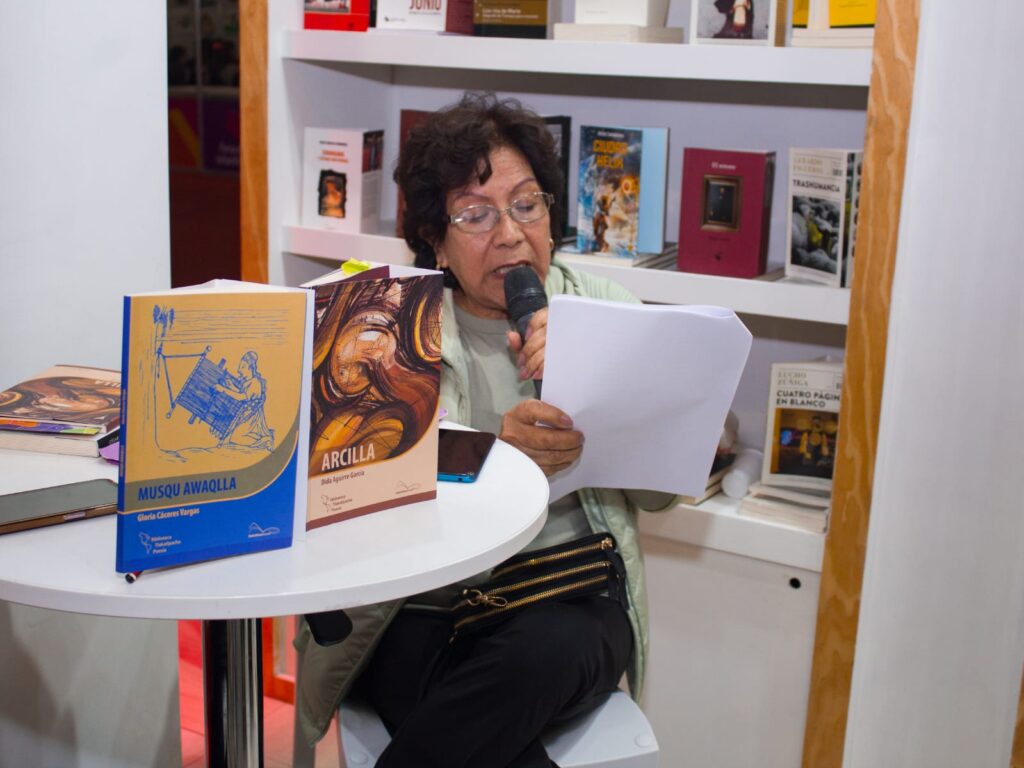
In addition to Arcilla, Dida published the bilingual poetry collections Qaparikuy (2012) and Jarawi (2000), the latter winning the Quechua poetry contest organized by the Federico Villarreal National University. Her writing flows in Quechua, and she says that translating into Spanish is very difficult for her. Therefore, her forthcoming book of haiku in Quechua will not be translated but rather commented upon.
To learn about Dida's Quechua poetry:
| Taya Lambras qasachapis maqtakuna haha! qaparikun pata pukuru kichkasapapas manas harkallanmankuchu Sonqollankus ruparikuchkan mamallay taytallay amaya manchachillaychu amachallaychu ninankuta sonqosapam kasqa rupariyninku. | Taya In the clearing of alders and tayas The young ones ¡jajaillas! shout neither slopes, thorny will stop them They say their hearts are burning my mother my father do not frighten them do not avoid their fires because their flame possesses an immense heart. |
Share
We are present
We are committed to journalism that delves into the territories and conducts thorough investigations, combined with new technologies and narrative formats. We want the protagonists, their stories, and their struggles to be present.
SUPPORT US

FOLLOW US
Related notes


We are present
This and other stories are not usually on the media agenda. Together we can bring them to light.