

Why is it called lesbicide?
Social, legal, and linguistic arguments for using the word "lesbicide"


Share

According to witnesses, when the women on fire tried to escape from the room, Barrientos hit and pushed them to prevent them from leaving.
“He had already threatened them once. It was last Christmas. He told them he was going to kill them both (Pamela and Mercedes), and look what happened now,” says Diego Hernán Britez. A street vendor, at 51 years old he lives on the second floor of the family hotel located at 1621 Olavarría Street, in the southern part of the City of Buenos Aires, where the crime occurred.
Diego says he overheard several of the verbal arguments that took place between the man and the women during the two years they lived there. He acknowledges that Barrientos disliked their being lesbians and made this explicit.
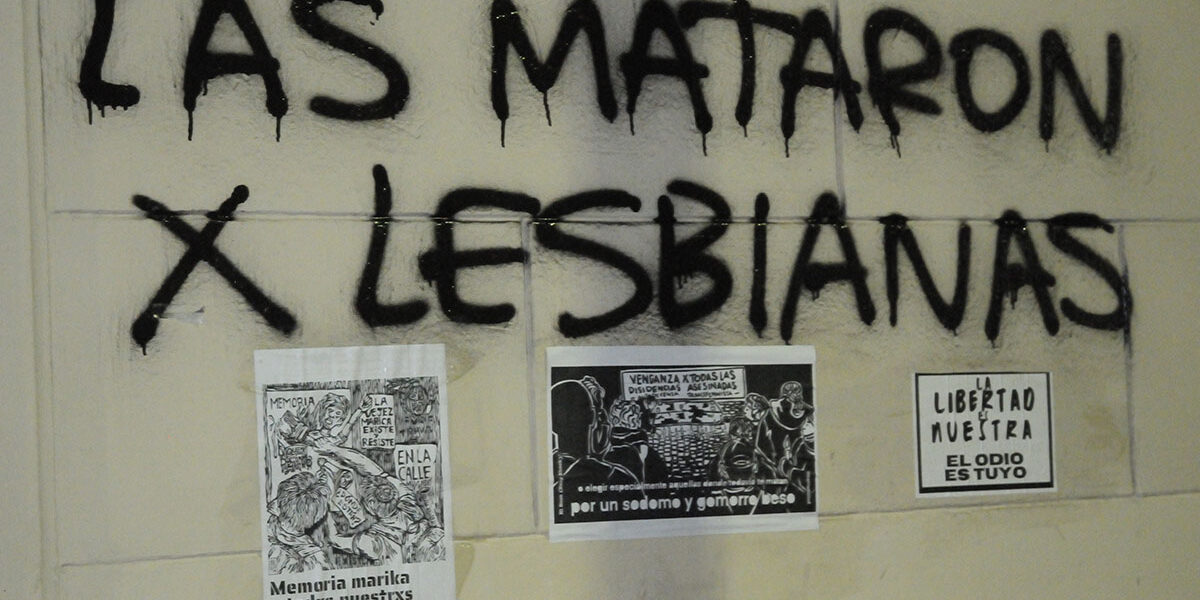
It was a hate crime, it was a lesbicide
Prior threats, insults based on sexual orientation, and cruelty constitute hate crimes or bias crimes, as defined by the Inter-American Commission on Human Rights (IACHR). The IACHR adopts the definition from United States legislation. These are: “crimes that demonstrate evidence of prejudice based on race, gender or gender identity, religion, disability, sexual orientation, or ethnicity.”
In 2012, Argentina passed Law 26.791 , which introduced the legal concept of femicide. While the term "femicide" is not used in the Penal Code, Article 80 (section 11) was amended to aggravate the crime of homicide when gender-based violence is involved and there is a relationship between the perpetrator and the victim. Life imprisonment was established as the penalty for femicide.
On the other hand, in section 4 of the same article of the Penal Code, the aggravating circumstance was added that punishes homicide committed "for pleasure, greed, racial, religious, gender hatred or hatred of sexual orientation, gender identity or its expression.".
In 2018, the courts used the term "transvesticide" for the first time to judge the hate crime against transgender human rights activist Diana Sacayán. The sentence applied both section 4 and section 11: for the presence of gender-based violence and for hatred based on gender identity. This was a global milestone and a victory for activists who insist on naming crimes against LGBTI+ people in their specific context.
Just as the word "femicide" is used to talk about crimes committed for reasons of gender, the word "travesticide" or "transfemicide" is used to talk about crimes committed against transvestite and trans people.
That is why the term "lesbicide" is used to speak out against a hate crime committed against lesbian women.
And the RAE?
As was made clear by the statements of presidential spokesperson Manuel Adorni—and all his social media trolls—the Argentine government denies the existence of hate crimes. It denies crimes against specific population groups based on race, ethnicity, gender, sexual orientation, or religion. It denies international human rights agreements and also the Argentine Penal Code.
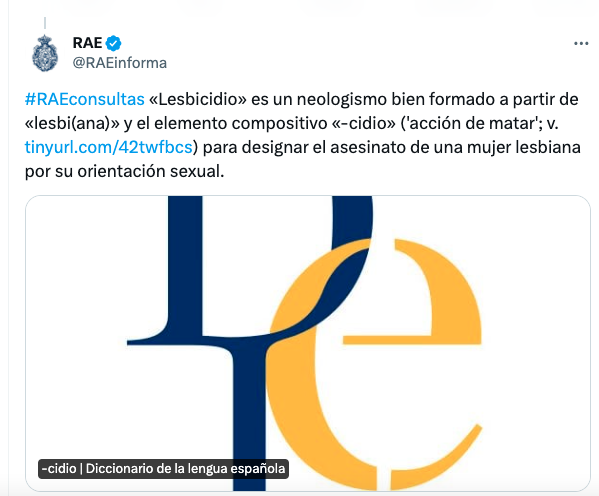
Furthermore, he denies the existence of the word "lesbicide", because it is not listed in the dictionary of the Royal Spanish Academy (RAE).
It's always a good time to explain that the Royal Spanish Academy (RAE) isn't a manual of the Spanish language; rather, it incorporates words based on their usage. It's not the RAE's place to dictate which words can or cannot be used, or whether they exist or not. Words exist independently of the opinions of the Royal Spanish Academy.
However, in this case, unlike what Adorni said, the RAE does accept the use of the term lesbicide.
We are present
We are committed to journalism that delves into the territories and conducts thorough investigations, combined with new technologies and narrative formats. We want the protagonists, their stories, and their struggles to be present.
SUPPORT US

FOLLOW US
Related notes


We are present
This and other stories are not usually on the media agenda. Together we can bring them to light.