

Mexico: Sex workers form coalition to defend their labor rights
People who engage in sex work have launched a coalition to defend labor rights and provide tools against discrimination and violence.



Share

MEXICO CITY, Mexico. On May 7th at the Tlatelolco University Cultural Center in Mexico City, sex workers, along with the organization ProDesc , launched the Prostitute Labor Coalition ( CLap! ). It is made up of organized sex workers who seek to defend their labor rights, social security, access to justice, the elimination of violence, and their effective participation in decision-making processes that impact their work in Mexico.
Under the Federal Labor Law, are recognized as having the freedom to form coalitions as a way to defend their common interests. Thus, under this framework, sex workers who have been doing community and collective work in Mexico City, Mérida, and the State of Mexico came together to create this form of organization to defend their labor rights and share resources.
“CLaP was born from the union of sex workers to protect ourselves from the widespread stigma that exists. CLaP is about creating this identity of people who work, who are heads of households, who support others around us, and that this has nothing to do with being victims or criminals,” commented María Midori during the presentation. She is part of CLaP and co-founded the Mexican Alliance of Sex Workers ( AMETS ).
In Mexico, sex work lacks explicit labor protections and is not illegal. However, regulations exist that allow for the criminalization of sex workers, and social stigma persists.

Demands for “sex work as a life project”
In the presentation, Midori explained that, during a year of work prior to the launch of the CLaP, they identified four main objectives to address the immediate needs of people engaged in sex work. These are the recognition of sex work as work; guaranteeing social security, the right to housing, the right to health, and retirement.
Also highlighted was the need for access to justice and the ability to carry out their work free from discrimination and violence. Regarding this, Muñeca Martínez, founder of the Trans Intersectional Command in Mérida , Yucatán, commented during the presentation that the criminalization of sex work and police harassment through police ordinances continues to occur, especially in decentralized states and the outskirts of large cities.
Furthermore, the need to listen to and involve sex workers in decision-making spaces, in laws that directly impact their work, was emphasized.
A recent example where those who engage in sex work were not heard occurred in 2022 when trans congresswoman María Clemente García presented an initiative to regulate sex work, which was described by sex workers as "a step backward" that also "criminalizes and feeds the punitive system."
Since then, there has been no further attempt to regulate sex work at the federal level or to eliminate crimes arbitrarily used to criminalize sex workers on the street, especially in non-centralized cities across the country.

How to become a member?
There are two ways to join: one is during the outreach visits that members of the Coalition make to different work locations. The other is through a digital form that can be requested on CLaP's social media accounts: Facebook , X (formerly Twitter), and Instagram . Those eligible to join are people who currently engage in sex work in any of its forms.
In both methods, CLaP says it has strategies for protecting personal data, and that this information will be used exclusively by the Coalition.
Currently, there are 80 affiliated workers located in Mexico City, Mérida, and the State of Mexico. Their future goal is to achieve national reach through existing networks within the country.
“Each affiliation represents a story, a wound, a story of resilience, of having to come out of the closet, of having to publicly acknowledge oneself as a sex worker. Each of these 80 affiliations also involves taking away the power of shame from sex work and recognizing it as a life project ,” said Natalia Lane, a human rights defender and sex worker.
For now, CLAP does not have disaggregated data. But during the presentation, they called on institutions to recognize the vulnerabilities of sex workers and their intersectional experiences as LGBT individuals, migrants, racialized people, or people with disabilities, etc.
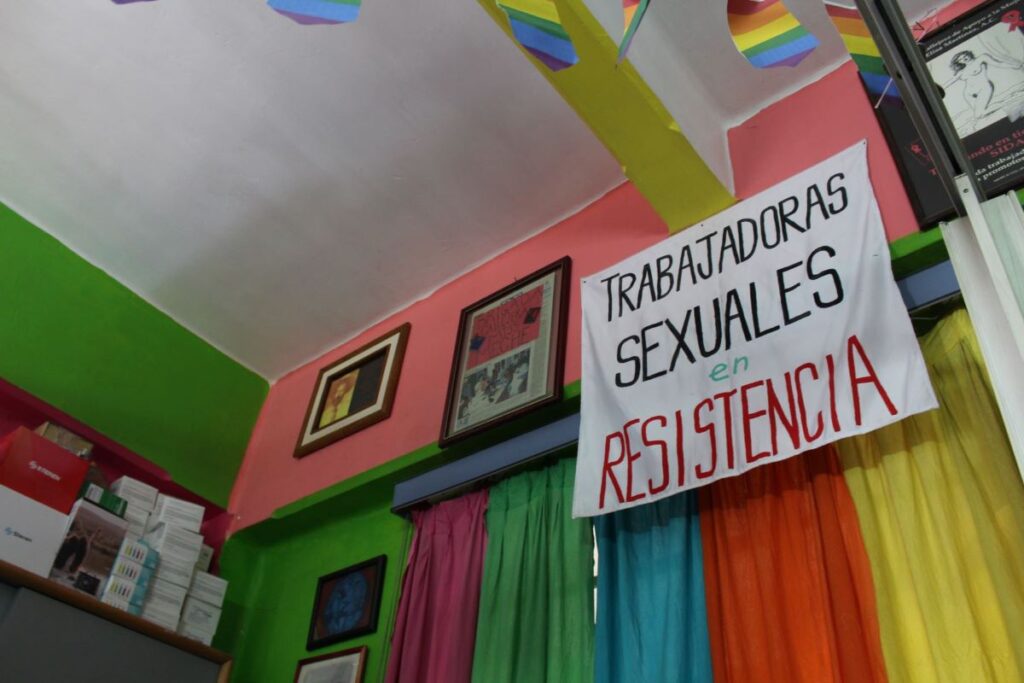
Clap is also for trans and cis men who do sex work
This Coalition is made up of cis and trans women, as well as cis and trans men. This openness to diverse gender identities is one of the organization's objectives.
Yaz says that sex work helped him recognize himself as a trans man. But he warns that openly stating at work that he is not a woman means facing another stigma. Yaz has to work from a gender expression where he is perceived as a woman because otherwise, “there are no clients, no work, no food,” he says.
For Santy Mito, a cisgender bisexual man, coming out as a sex worker is “ambivalent” because it involves wanting to protect his identity while also making visible that “it is a reality that there are guys who do sex work and stating it means thinking about the historical debt that male sex workers have with the female sex workers who put their bodies on the line first.”
We are present
We are committed to journalism that delves into the territories and conducts thorough investigations, combined with new technologies and narrative formats. We want the protagonists, their stories, and their struggles to be present.
SUPPORT US

FOLLOW US
Related notes


We are present
This and other stories are not usually on the media agenda. Together we can bring them to light.