

Mexico Elections 2024: Usurpation of candidacies from diverse populations in Oaxaca
Activists denounce that different political parties are usurping the candidacies of diverse populations.


Share

In the last week, LGBT+ activists and people living with disabilities have denounced the usurpation of candidacies under the affirmative action policies that allow the participation of people who are part of vulnerable groups in the 2024 elections in the state of Oaxaca.
In the current electoral process, the National Electoral Institute (INE) approved affirmative actions so that indigenous, LGBT, Afro-Mexican, Mexican migrant people and people living with a disability can participate and run for a place in local and federal congresses, as well as in the Senate.
Thus, political parties are obliged to apply the INE/CG635/2023 of the Electoral Tribunal of the INE to assign at least 50 of the 500 federal deputies and 9 of the 128 senators to people belonging to these five populations, respecting gender parity.
In this article we explain how these quotas work and what the challenges are for their implementation.
What is the principle of self-identification?
For candidates from historically marginalized groups to be eligible, political parties are obligated to nominate them through the principle of self-identification. This means the voluntary act of individuals declaring their membership in a specific group.
The INE's guidelines on simple self-identification apply to LGBT+ and Afro-Mexican individuals and stipulate that the person only needs to state that they belong to that group. Meanwhile, for Indigenous people, migrants, and people living with disabilities, the principle of qualified self-identification applies. These guidelines establish certain requirements.
For Indigenous people, the principle of qualified self-identification requires the presentation of documents that prove their connection to the Indigenous community they claim to represent. This also includes documentation of their community work and the endorsement of the Indigenous authority to which they belong.
In the case of people living with a disability, the INE requires as a prerequisite the presentation of medical reports that certify their disability and functionality.
The deception of the parties
Since these affirmative actions were implemented in 2018, there have been reports of identity theft, fraud, and manipulation by political parties to deceptively comply with the affirmative action measures that they are obligated to fulfill by the Electoral Tribunal.
According to INE data processed by Cadera de Eva, as of April 3, only two national political parties managed to meet the quota for representation of vulnerable groups.
In total, of the 63 candidacies that each political party had to present, only the Citizen Movement (MC) and the Green Ecologist Party of Mexico , complied with the number of candidacies with 176 and 72, respectively.
However, the INE (National Electoral Institute) withdrew 23 indigenous candidacies because the candidates either belonged to indigenous communities or their affiliation was not recognized by those communities. Meanwhile, the General Council of this autonomous body specified that 50% of the canceled candidacies belonged to the Citizens' Movement party.
Rainbow fee usurpation in Oaxaca
LGBT activists in Oaxaca denounced that Daniela Taurino, -appointed earlier this year as 'State Coordinator LGBTQ+' of the Morena political party in Oaxaca-, was designated as a candidate for local deputy of district 12, headquartered in Santa Lucía del Camino, under the affirmative action of sexual diversity.
In response, activists are filing appeals with the IEEPCO and the INE to have the candidacies registered as LGBT+ reviewed, particularly highlighting their community work in support of the human rights of this population.
Activist Azul Montealegre told Verificado y Presentes that activists in Oaxaca are monitoring candidacies to identify those who use affirmative action in a deceptive way to obtain political office.
This observatory is not public. But Montealegre said they detected at least three instances of usurpation of the rainbow quota by those aspiring to a majority in Miahuatlán and Oaxaca City.
“Affirmative action measures are intended for groups that have suffered discrimination and a lack of opportunities for decades, with the aim of being represented in the political sphere. Unfortunately, although the INE and IEEPCO intend to guarantee this right, they do not strengthen the guidelines to prevent usurpation and the instrumentalization of diverse identities,” explains activist Montealegre.
According to a public document from the IEEPCO (Oaxaca State Electoral Institute), 14 people in Oaxaca registered as candidates for a majority under the affirmative action program for sexual diversity. And, lacking a registry of proportional representation , it is unknown how many of these self-identify as LGBT+.
Usurpation of spaces for people with disabilities
In addition to the utilitarian trend of affirmative action for sexual diversity, groups and civil organizations in Oaxaca have denounced the usurpation of popularly elected positions intended for people with disabilities.
In March 2024 , people with disabilities asked the IEEPCO not to allow the registration of the candidacy for local deputy of Elvia Gabriela Pérez López given that the candidate has never shown to have any disability.
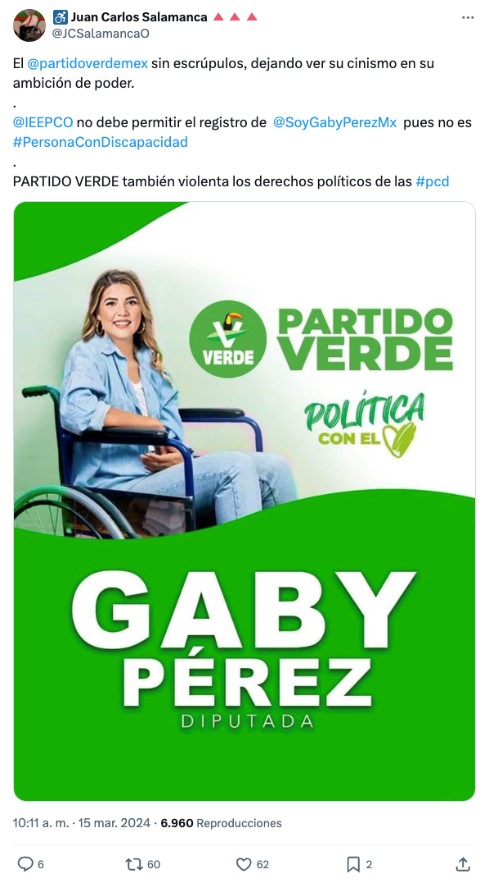
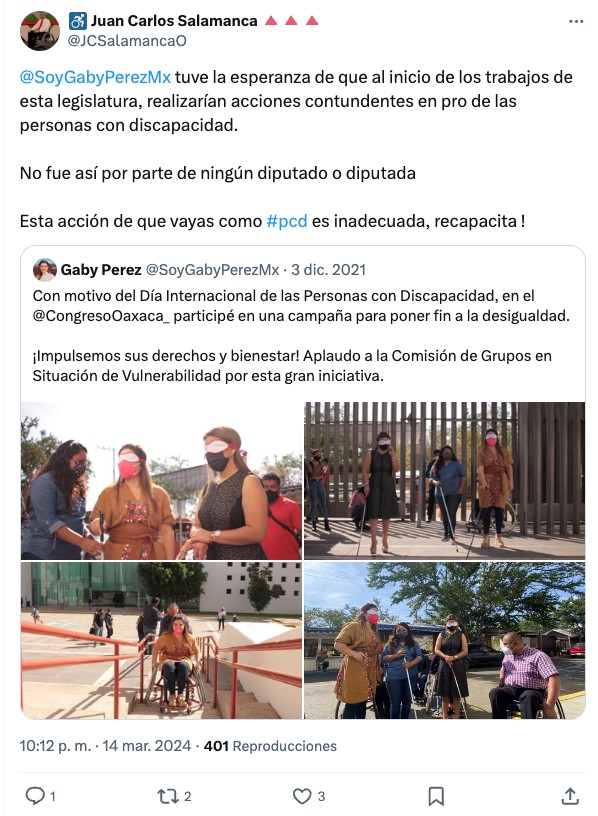
Juan Carlos Salamanca , president of the Reyes Heroles Institute and a person with a disability, stated that Gabriela Pérez was usurping an electoral affirmative action to reach a seat in the State Congress.
After the preliminary list of candidates, which included Pérez López, leaked responded that she would not seek re-election to the State Congress due to the affirmative action for disability.
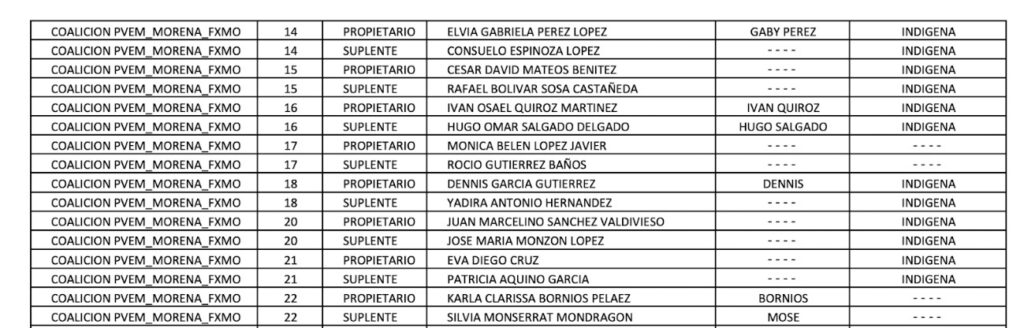
However, Gaby Pérez is currently campaigning to be re-elected for the Etla district, but now using the affirmative action policy for indigenous people.
With slogans like “inclusion, not pretense,” people with disabilities set up a clothesline protest in front of the Santo Domingo de Guzmán church in Oaxaca's historic center at the end of April. There, they displayed photographs of local politicians accused of usurping electoral positions through affirmative action programs.
“We encountered many people occupying the LGBT+ and disability quotas who do not belong to these vulnerable groups. Several of them are well-known local politicians who had never openly identified as LGBT+, using a brace, or facing the social barriers of having a disability,” said Pedro Miranda Gijón, a blind visual artist who denounced this usurpation of political spaces on the clothesline protest.
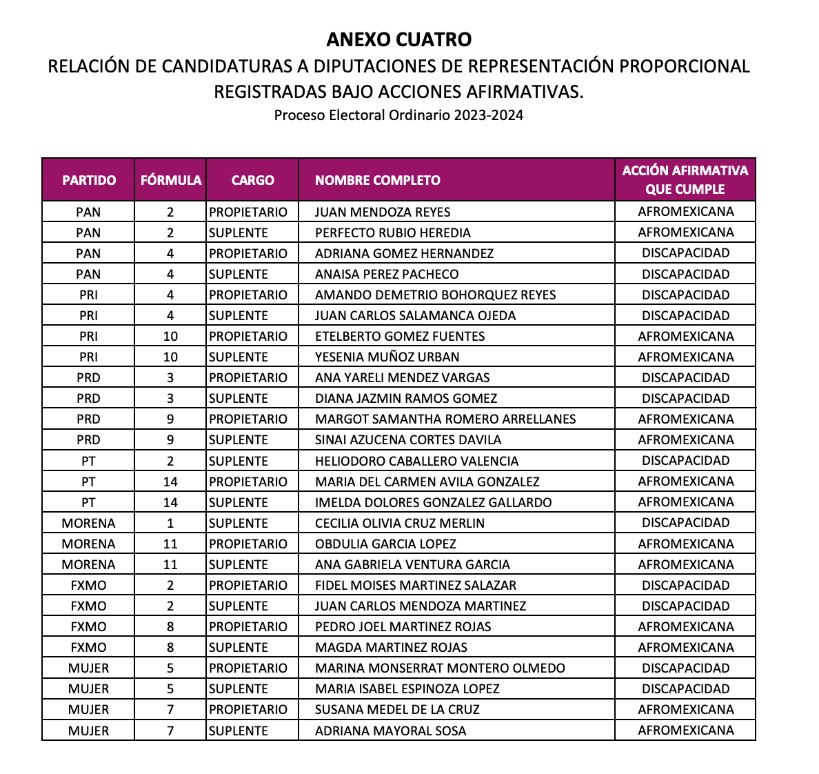
As an example of this simulation, Pedro mentioned the case of Gaby Perez and the congressional seat held by Amando Bohorquez Reyes, a former legislator and former director of Civil Protection who has no disability.
“He’s very well-known in Oaxaca because he’s held several public offices. His alternate is Juan Carlos Salamanca, a longtime PRI member who uses a wheelchair and truly lives with a disability. So what the state PRI is doing is giving the primary candidacy to a man without a disability, and as his alternate, someone who does have a disability, but only, as they say here in town, ‘to pull the wool over our eyes,’ to hide the fact that it’s usurpation.”
The display of “impersonators and usurpers” also included photographs of María del Carmen Ricárdez Vela , who ran for Senate as an indigenous candidate for the PRI party. Also displayed were photographs of Juan Mendoza Reyes and Perfecto Rubio Heredia , former PAN deputies registered as Afro-Mexican.
In response to this situation, groups are demanding that electoral institutions recognize the usurpation of affirmative action policies, replace them, and implement measures to prevent the abuse of legal loopholes that parties use to usurp spaces of representation belonging to historically discriminated groups.
“They are deceiving not only the State Electoral Institute, the INE (National Electoral Institute), and the Electoral Tribunal of the State of Oaxaca, but all of society. How can they ask for votes? How can they say, ‘Vote for me’? They are lying. They are occupying a space that doesn’t belong to them,” questions Pedro Miranda Gijón, a blind activist and visual artist.
We are present
We are committed to journalism that delves into the territories and conducts thorough investigations, combined with new technologies and narrative formats. We want the protagonists, their stories, and their struggles to be present.
SUPPORT US

FOLLOW US
Related notes


We are present
This and other stories are not usually on the media agenda. Together we can bring them to light.