

LGBT hate crimes increased in Argentina during 2023
According to the report by the Argentine LGBT Federation, there were 133 hate crimes, of which 118 were attacks against trans women.


Share

BUENOS AIRES, Argentina. “They killed Zoe,” the women at the Hotel Gondolín were told on Saturday, November 11, 2023. The news was delivered by two employees of the Casa Rosada, Zoe's coworkers, whom the police had contacted to inform them that the 46-year-old trans woman had been murdered by her partner.
In 2023, Argentina recorded 133 hate crimes in which the sexual orientation, gender identity, and/or gender expression of all the victims were used as a discriminatory pretext for human rights violations and violence. This is according to the annual report of the National Observatory of LGBT+ Hate Crimes, managed by the LGBT Ombudsman's Office of the City of Buenos Aires and the National Ombudsman's Office, in conjunction with the Argentine LGBT Federation.
The figure represents an increase compared to 2022, when there were 129 hate crimes . The previous year there were 120. As in previous years, the most affected are trans women (transvestites, transsexuals, and transgender people), accounting for 88% of cases (118). They are followed by cisgender gay men (7 cases), trans men (3), non-binary people (3), and lesbians (2).
The report explains that these are not exact figures. They include only cases reported by the media or filed as complaints with the LGBT Ombudsman's Office, with FALGBT+ organizations, or documented by the Center for Documentation and Trans Situation in Latin America and the Caribbean. These figures “only offer a glimpse into a reality that is undoubtedly much more serious than the numbers suggest.”
Murders in the LGBT community
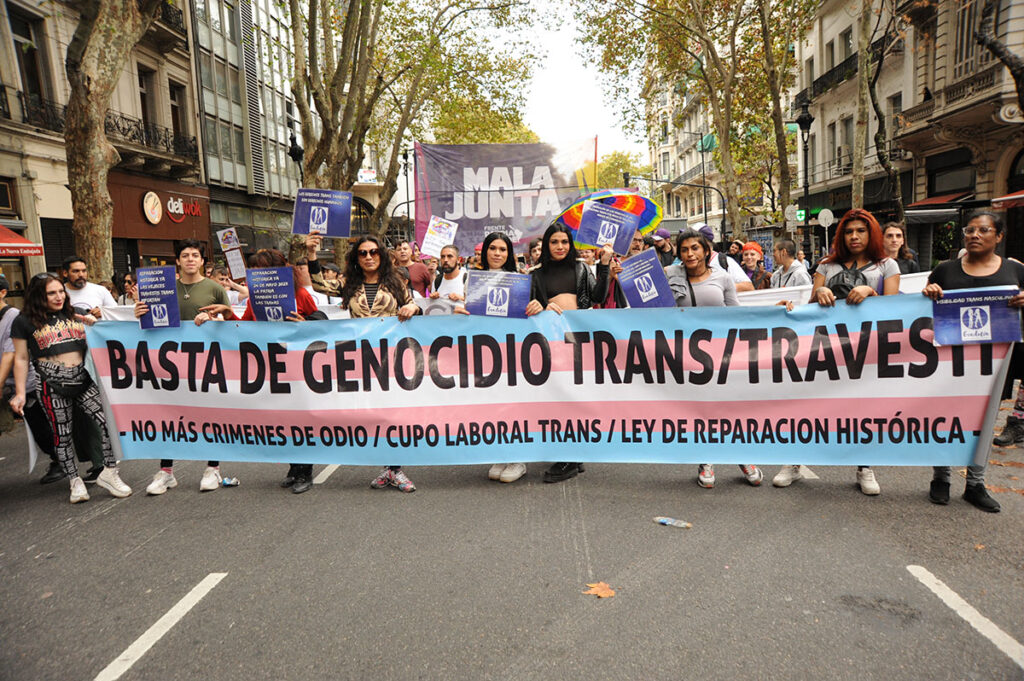
Of all the hate crimes recorded, 68% of the cases (91) correspond to injuries to the right to life, that is, murders, suicides and deaths due to historical and structural state absence and/or abandonment.
Zoe was one of them. She was murdered on Saturday, November 11, in a hotel located in the Balvanera neighborhood of Buenos Aires. Her partner, Fabián Villegas, stabbed her, inflicting a fatal wound. He himself reported the crime.
Of those 91 violations of the right to life, nine were murders: eight of trans women and one of a cisgender gay man. In addition, 80 deaths were due to structural violence –all of them trans women–, and two were suicides –one of a trans woman and one of a trans man– .
Lautaro Castillo Retamales was murdered in September by two men who contacted him through Grindr. Noelia Martínez, a lawyer and friend of Lautaro, asked the prosecutor's office to request reports from Facebook, Instagram, and Grindr. "We understand that they made contact through Grindr," she stated.
This type of crime, which combines robbery and assaults or hate crimes through meetings coordinated by dating apps, is being denounced by the LGBTIQ+ community.
Regarding the 80 deaths attributed to structural violence, the report notes that this number is actually inaccurate and is undoubtedly significantly lower than the true figure . “This is because these deaths are not reported in the media. Access to this data is only possible through direct reports from victims' families, and primarily, thanks to information provided by other members of the LGBT+ community.”
Attacks and institutional violence: who were the perpetrators and where did the hate crimes occur?
The report also reveals who the perpetrators of hate crimes are. 26% were committed by private individuals, and 71% by the state. Within this latter percentage, 11% were specifically perpetrated by members of the security forces “in the exercise of their state function.” In other words, cases of institutional violence.
The case of Sofía Fernández illustrates this. She was a 39-year-old trans woman, a language teacher, who was found dead in a cell at Police Station 5 in Derqui, Buenos Aires Province. She had been arrested under circumstances that remain unclear. According to the autopsy, her death was caused by airway obstruction. She had bruises and signs of torture on her body.
Regarding the relationship between victims of hate crimes and their perpetrators, 48.57% of the perpetrators are unknown to the victims; and in 25.71% of cases, the perpetrators are neighbors or acquaintances. Most of these perpetrators are clients of the victims' sex work, or are boyfriends or partners.
Regarding the location where hate crimes occurred, the highest percentage was in public places, the victims' homes, and police stations or prisons, with 24% of cases in each category.
Lautaro Jaime, a 25-year-old gay man, reported a hate attack he suffered outside the Amérika nightclub on Sunday morning, March 5th, at the hands of three men. One of them punched him in the face from behind, leaving a cut while yelling “fucking faggot.”
What are the recommendations to improve the situation of LGBT+ people?
At the end of the report, the National Observatory of LGBT+ Hate Crimes presents a series of recommendations.
First, it demands that the National Executive Branch guarantee respect for all public policies and every advance made in the area of LGBT+ rights . Furthermore, it demands the continuation of all programs, social assistance, and food aid for the LGBT+ community.
It also recommends the enactment of a new National Law on Discriminatory Acts , a comprehensive law for trans people , and "the implementation of tax incentives in the private sector to actively promote the labor inclusion of trans people and combat discrimination in the labor market."
However, the situation has worsened. By April of this year, the national government had dismissed at least 100 transgender and transvestite people who worked in the public administration.
We are present
We are committed to journalism that delves into the territories and conducts thorough investigations, combined with new technologies and narrative formats. We want the protagonists, their stories, and their struggles to be present.
SUPPORT US

FOLLOW US
Related notes
We are present
This and other stories are not usually on the media agenda. Together we can bring them to light.