

The government of Jujuy ordered the closure of the country's only bilingual indigenous kindergarten
The Wawa Huasi Kindergarten has been operating for 14 years and now the government of Jujuy says that bilingual education (Quechua and Spanish) is "indoctrination".


Share

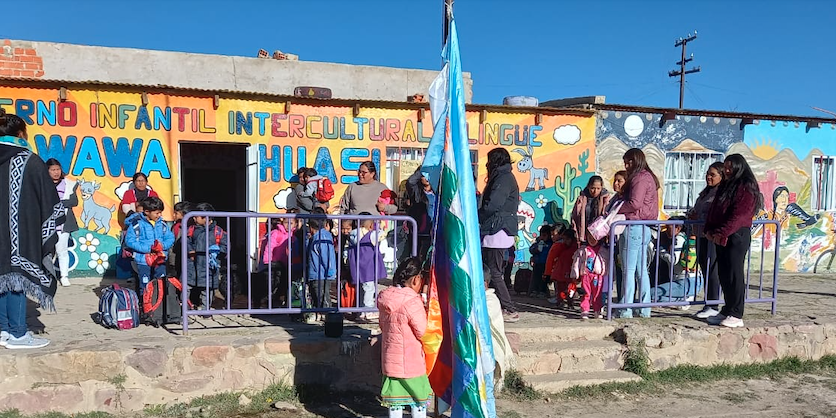
The Wawa Huasi Intercultural Bilingual Nursery School , the only community-run and bilingual (Quechua and Spanish) nursery school in the country, is on the verge of closing its doors. The Ministry of Education of Jujuy denied its incorporation into the official education system. The nursery school is located in La Quiaca, on the border with Bolivia, and is run by the Natividad Quispe Community.
The decision, made through Resolution No. 763 of the Jujuy Ministry of Education, was officially communicated on April 25. The Natividad Quispe Community interprets it as an act of revenge for their participation in the struggle waged last year against the constitutional reform promoted by former Governor Gerardo Morales.
The Ministry's argument is that the kindergarten operates on the grounds of the old General Belgrano railway station. It maintains that those responsible for Wawa Huasi "continue to fail to meet the optimal requirements for its authorization." Both claims are refuted by the kindergarten's director and by the Llankaj Maki Council of Indigenous Peoples, the organization to which the Natividad Quispe Community belongs.
Resolution 763 also stipulates that the Directorate of Early Childhood Education "shall proceed with the seizure and safekeeping of the documentation relating to the students and books belonging to the Nursery School." It further orders that the Directorate "relocate the students to nearby institutions." Regarding the staff of this Nursery School—14 teachers and eight support personnel—the resolution only states that it authorizes "the necessary adjustments to the employment status of the affected staff."

"Those children have a right and it must be recognized."
“It was a real shock to us,” said the director. At the beginning of her conversation with Presentes, she was also descriptive: “We are very upset, very hurt, very sad, about the situation the kindergarten is going through,” Vilma Llampa, the kindergarten director, told Presentes.
The news triggered an emergency meeting with the parents of the 150 children between the ages of two and five who currently attend Wawa Huasi. They agreed that the preschool should not close and demanded the presence of the Minister of Education, Miriam Serrano.
“We and the parents said that we are not going to close the doors on Monday. These children have a right, and that right must be recognized,” said the principal, for whom it is unheard of that a Minister of Education would close a school with 150 children enrolled.
The resolution is effective immediately, so the Garden should close its doors that day. However, the Garden's management and the Llankaj Maki Council plan to continue pressing for a meeting with the government.
“Each new administration comes in familiar with Wawa Huasi. They know how it works,” the director emphasized. She recalled that former Governor Morales had committed to building a new building for the kindergarten, and the community had already donated the land for that purpose.

"We submitted everything on time and in the correct format."
“What the resolution says is not true,” he clarified regarding the claim that they did not comply with the official requirements. “We have proof within the Kindergarten that we have repeatedly submitted, every year, everything required, the specific documentation for the Kindergarten. Everything they require, on time and in the correct format,” he insisted.
Wawa Huasi is an institution with 14 years of experience. It began operating on June 7, 2010, through the initiative of newly graduated Indigenous teachers who recognized the need for women in La Quiaca to have a place where their children could be cared for while they worked at the CCC cooperatives. The preschool has won awards at science fairs representing the Puna and La Quebrada regions.
“We have been suffering many reprisals”
Jorge Angulo, the provincial coordinator of the Llankaj Maki Council of Indigenous Peoples, interpreted the closure order of Wawa Huasi as an act of persecution by the Jujuy government against the indigenous communities that made a substantial contribution to last year's protests.
“We have been suffering many reprisals and pressure tactics since last year,” Angulo told Presentes.
A month ago, the contracts of 23 Indigenous teachers, including six from Wawa Huasi, were not renewed. The reason given, verbally, was “in line with the national government’s position.” They say that education is indoctrination, in this case, bilingual intercultural education.
They were also told that this education "promotes people like those who were at the road blockades last year," he said.
In the same vein, he pointed out that one of the administrative officials who is currently in the Secretariat of Socio-educational Policies of the province "is a former member of the constituent assembly for the reform of the Constitution of the provincial government."
This is Julio Alarcón, a member of the Radical Civic Union's constituent assembly and "one of those who pushed for the removal of the road blockades." "We understand that at its core, this is retaliation," a "vindictive" decision.
"There is a directive against everything related to indigenous people."
The coordinator explained that the Council has requested meetings with Governor Carlos Sadir and the Minister of Education, but has received no response so far. Next Tuesday, the Council will hold a press conference at the Legislature, together with the unions. “We will also demand our participation in the Legislature's Education Committee meeting on Tuesday,” he added.
He asserted that in a meeting with the Indigenous Peoples Commission it became clear that "there is a directive against everything that comes from indigenous communities," for having been part of the fight against the reform.
Since October of last year, the Council has been requesting a meeting with the Minister of Education. This stems from the previous administration's formation of a working group to explore ways to implement intercultural education. "We were working quite well together and had even agreed on an educational proposal we had submitted, with their feedback and input." The idea was to continue this work, but that hasn't happened until now, "and with everything that's going on, we've taken a huge step backward," he added.
We are present
We are committed to journalism that delves into the territories and conducts thorough investigations, combined with new technologies and narrative formats. We want the protagonists, their stories, and their struggles to be present.
SUPPORT US

FOLLOW US
Related notes


We are present
This and other stories are not usually on the media agenda. Together we can bring them to light.