

Peru: Extremist "anti-communist and anti-gender" groups increase attacks and remain unpunished
La Resistencia is one of the far-right groups that attacks human rights organizations, feminists, and journalists. Why do they continue to act with impunity?


Share

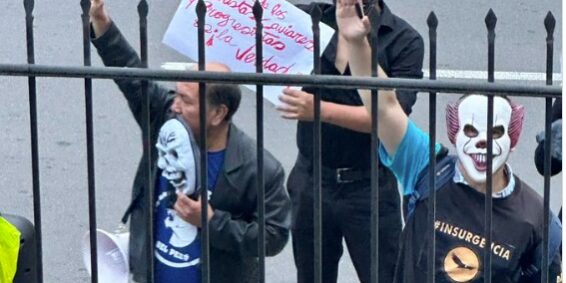
Memorials; human rights events and headquarters; feminist demonstrations; libraries; and even schools: the targets for Peruvian extremist groups are limitless. Since 2017, attacks and violent interventions by far-right groups that have moved from social media to the streets have multiplied in Peru. One of these groups, "La Resistencia" (The Resistance), held its latest demonstration on April 16 of this year, this time at the entrance of a school: the Atusparia School in Lima. A group of people appeared there with banners and megaphones, claiming that the school was a front for the Shining Path terrorist group. The police were notified but chose not to intervene.
"The Resistance, God, Fatherland, and Family" is a collective founded as a civil association in 2018 by Juan José Muñico González. It gained prominence during various political crises, especially after 2021. The organization defends Fujimorist ideology, declares itself anti-communist, and opposes what they call "gender ideology." It thus aligns itself with another movement born in the country in 2016: "Don't Mess With My Children," which campaigned nationwide against the rights of transgender children and gender-inclusive education in school curricula, thanks to the support of various sectors of Congress.
Freedom of expression?
Alongside “Los Combatientes” and “La Insurgencia,” the Resistance formed the self-styled “Popular Democratic Front,” a fascist-leaning group (some of its members have even adopted the fascist salute) to oppose the government of Pedro Castillo (2021-2022). These groups attempted to reach the Government Palace on June 6, 2021, before Castillo's inauguration. Aligned with Fujimorism, despite the fact that the leader of Fuerza Popular, Keiko Fujimori, denied any connection to them, they continue to carry out actions with impunity.
“This group hides behind an alleged misuse of freedom of expression,” human rights lawyer María Ysabel Cedano explained to Presentes. “The police, the Public Prosecutor’s Office, and the on-duty criminal courts should take action because they are committing crimes of harassment, defamation, and disturbing the peace. These are crimes against integrity, liberty, life, body, and health. But for the State, the law, and its institutions, they are simply an organization exercising its right to freedom of expression.”
Background
According to an investigation by the news site Ojo Público , the earliest known incident involved former military officer Pedro Rejas Tataje, a close associate of former president Alberto Fujimori. In 2007, Rejas Tataje forcibly entered the Palace of Justice with a group of Carapintadas (rebellious military officers).
In 2012, Rocío Silva Santisteban, former secretary of the National Human Rights Coordinator, was the victim of a televised attack in which she was spat on. She is one of many politicians, leaders, journalists, and activists who have been harassed by La Resistencia and its offshoots. Officials such as Jorge Salas Arena, president of the National Elections Board, have been targeted, with repeated sit-ins outside his home. They have also vandalized events organized by human rights organizations, such as the disruption of an Amnesty International event last May. The event was to present a report on the violence that occurred during the protests against Dina Boluarte's inauguration. Boluarte replaced Castillo after attempts to impeach him in Congress and a failed self-coup.
They have also not hesitated to attack children's spaces, such as the fundraising fair held by the Miguelina Acosta Library, the first recorded attack on minors, in May 2022. They also attacked journalists such as Gustavo Gorriti and Rosa María Palacios, going to their homes and workplaces.
Against memory
The sculpture "The Weeping Eye," located in the Alameda de la Memoria (Memory Promenade), has been one of their favorite targets. Currently, with the support of Lima's mayor, Rafael López Aliaga, they are seeking to demolish the effigy that symbolizes all the victims of the internal armed conflict and is a National Cultural Heritage site.
Gisela Ortiz, spokesperson for the families of victims of the La Cantuta Massacre (1992), witnessed several of these attacks on the Ojo que Llora (Eye That Cries). She points out that groups like La Resistencia (The Resistance) have powerful people and organizations behind them who protect them. That is why they are not afraid of reporting the attacks.
“There is an 'inability' to identify who is operating behind the scenes, those who do the dirty work. We don't know who finances them, who they obey. Behind them are political parties, but also police chiefs who are protecting them. That's why they don't arrest anyone when they're caught in the act,” he told Presntes.
Another target of attacks was the exhibition “What Color Are Your Dead,” a photographic display about the massacre of 49 protesters by the Armed Forces during protests against the government of Dina Boluarte between December 2022 and March 2023. The exhibition was attacked by La Resistencia on both occasions it was held.
“There were about eight people from La Resistencia inside the house we had rented for the event. We started herding them out. But these people began to invade the parking lot, banging on the glass doors, they set up a speaker, and they were like that for an hour and a half,” Mario Colán, photographer of the exhibition, tells Presentes.
Their banners are anti-democratic, as they do not allow dissent or dialogue. They attack anyone who thinks differently from them. They defend the crimes committed during Alberto Fujimori's time. And they are anti-gender, since they oppose the gender perspective in the curriculum, supporting disinformation campaigns like "Don't mess with my children."
The legal complaints
María Ysabel Cedano represents the victims of forced sterilizations (thousands of Andean women during the Fujimori regime) and witnessed several attacks. On September 28, 2021, the Association of Victims of Forced Sterilizations held a peaceful protest in front of the courthouse, and members of the Resistance attacked them.
“They were exercising their political freedoms of expression. They filed a complaint, Congresswoman Ruth Luque accompanied them, as did the Ministry of Women; they even identified the aggressor, but they were unable to get the investigation to move forward,” she told Presentes.
The assailant of these women was Ricardo Alvarado Arias, a member of one of the branches of La Resistencia known as Los Insurgentes, who has multiple assault charges against him. Despite this, he remains free.
the National Human Rights Coordinator and the Association for Human Rights (APRODEH) filed a complaint against La Resistencia and its affiliates with the Attorney General's Office and the Organized Crime Prosecutor's Office. They defined La Resistencia as " a criminal organization made up of multiple people, with a stable, permanent, and long-standing structure, where its members have assigned tasks and whose activities are aimed at committing various illegal acts, such as harassment, with the purpose of harming, injuring, or obstructing the freedom of action of certain authorities, individuals, or civil groups ." The Public Prosecutor's Office investigated the group, but those 11 harassment complaints were dismissed.
"No matter how many times you report them to the police station, there is no investigation that moves forward, that identifies those responsible whose names are public, whose faces are already known, because they are people identified not only by the media, but also by various public complaints that come out," said Gisela Ortiz.
In February 2024, Juan José Muñico Gonzales, alias Jota Maelo, leader of La Resistencia, was sentenced to one year and six months in prison for defamation against the Legal Defense Institute. Later, the judge ordered that the sentence be converted into 70 days of community service.
State complicity
Lawyer Cedano points out that there are several factors that allow La Resistencia to act with impunity: its link with Fujimorism; with the political party Popular Renewal; with high-ranking officials of the PNP and the Government:
“They act this way because the law and institutions don't apply to them. Even though they are a criminal organization that announces the commission of its crimes. The Crime Prevention Prosecutor's Office, the Criminal Prosecutor's Offices, and the National Police don't act. These aren't cases of apathy or negligence; they are a protected organization. They are a version of the Colina Group or the Rodrigo Franco Command (paramilitary groups from the Fujimori government in the 90s and the García government in the 80s) in this context. Basically, they threaten people's integrity, emotional and mental health, and instill fear and terror,” Cedano tells Presentes.
Despite being aware of their actions, state institutions such as the Ombudsman's Office and the Ministry of Culture have met with these groups, stating that "everyone must be heard in a democracy."
"They serve the objectives of political parties and the State, attacking institutions and people who are inconvenient for them and who put at risk the corruption and human rights violations that operate in this country," Cedano added.
We are present
We are committed to journalism that delves into the territories and conducts thorough investigations, combined with new technologies and narrative formats. We want the protagonists, their stories, and their struggles to be present.
SUPPORT US

FOLLOW US
Related notes
We are present
This and other stories are not usually on the media agenda. Together we can bring them to light.