

Historic university march: public education is defended in the streets of Argentina
More than a million people took to the streets of Argentina in a historic and diverse federal university march. This is how we saw it from Presentes.


Share

BUENOS AIRES, Argentina. More than a million people mobilized in Buenos Aires and hundreds of thousands more took to the streets across Argentina in a nationwide university march to put a stop to President Javier Milei's austerity measures.
It was a day of pride and struggle, with a diverse march filled with handmade signs and chants against the government. In Buenos Aires, public transportation collapsed, and the streets near the demonstration area, from Congress to Plaza de Mayo, were jammed, making it difficult to get around. Many of the groups that had gathered at 3:30 p.m. were unable to move for a couple of hours.
Few people managed to reach the square where at 6 o'clock sharp, Taty Almeida, from Mothers of Plaza de Mayo Founding Line, and Adolfo Pérez, representing human rights organizations, among others, spoke, a document was read and the cry " Public education is defended, now and forever " was shouted loudly.

Courtesy of Tiempo Argentino.
“All the problems we have can be solved with more education and public universities, with more investment in science and technology. We want our institutions to be the mechanism that allows Argentina to overcome structural inequalities and embark on the path of development and sovereignty. Education saves us and makes us free. We call on Argentine society to defend it,” read the document, which was read by Piera Fernández De Piccoli, president of the Argentine University Federation (FUA) .
Why do we march?
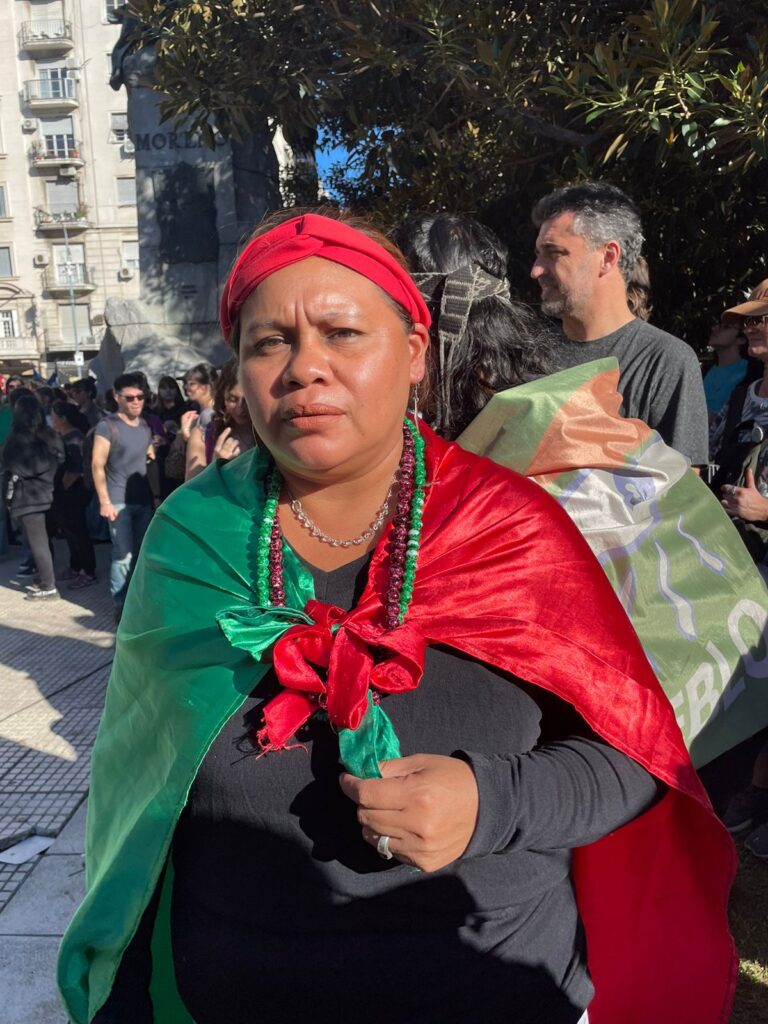
“I’m marching in defense of the public university, because it gave a large space to Indigenous peoples, and there are already young people who have graduated. They are here for our rights. I want to tell the president that as long as there is an Indigenous person present who speaks their language, no one is going to take what is ours,” said Gabriela Situe, president of the Guarani Indigenous community, who came from Jujuy, with tears in her eyes.
A large contingent from the Mocha Celis Trans and Non-Binary Popular High School also marched. "The LGBTIQ+ and non-binary community defends free, public university education. We say no to this austerity measure by the national government and demand that it fund public education nationwide," said Manu Mirelles.
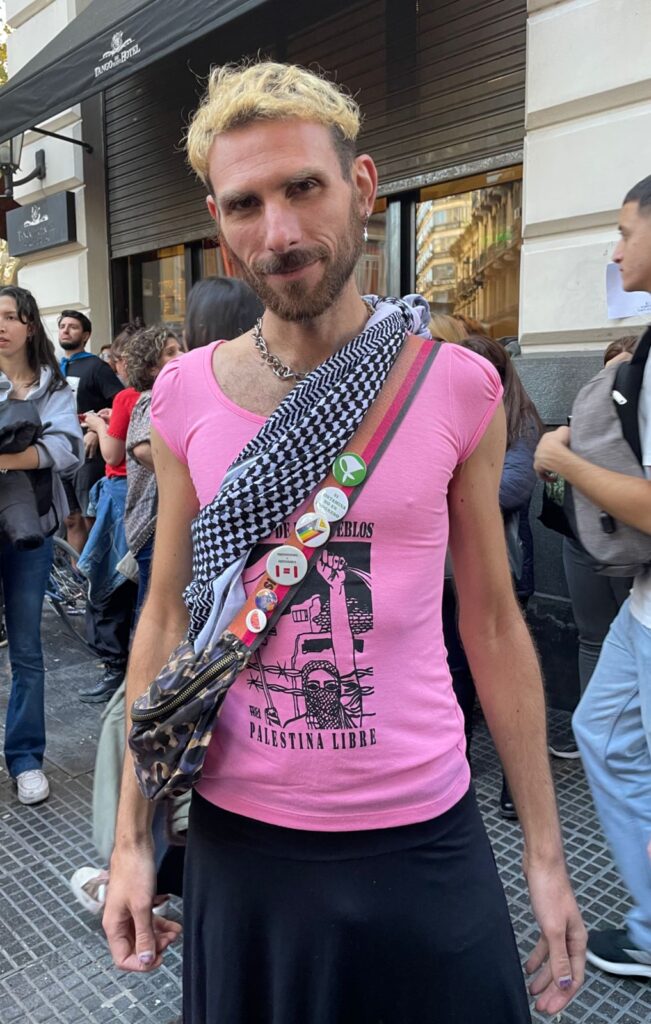
“I march to defend public education and resist this system of necropolitics, which wants to dominate us and leave us unconscious, without any kind of education. I march so that we can wake up and have the words; they are our weapons,” shared Nikki, a non-binary trans student at UNA (National University of the Arts) and part of Jews for Palestine.
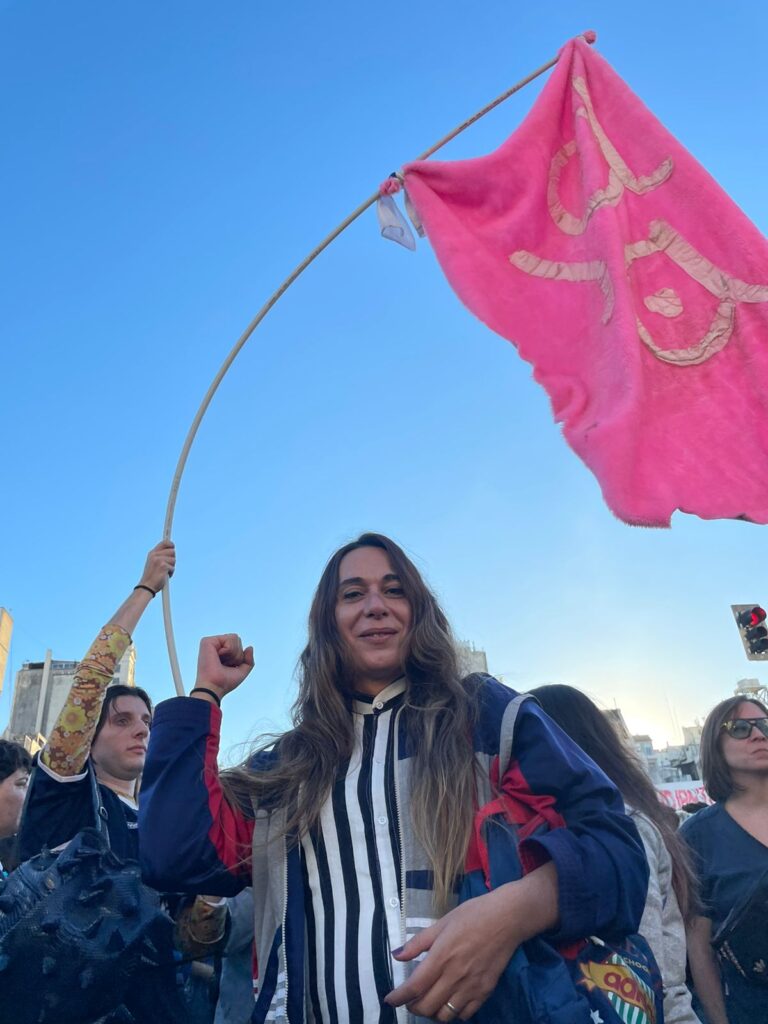
“I’m marching so that we, the dissidents, can continue occupying the universities and bringing our knowledge, which challenges the standardized knowledge of the academic elite,” Violeta Alegre, a trans activist, DJ, and artist, told us. She marched with the Mostri column. “Life is at risk, enough is enough!” read the pink banner that organized the dance and the protest.
The march for public education brought back the joy of being in the streets. The feeling of community, of not being alone in the face of an adverse scenario of economic austerity, denialism, and hate speech. Since Javier Milei's government began, this was undoubtedly the largest march, but it was also a demonstration with a triumphant spirit: that of taking to the streets en masse to defend a right.
Poster Show
The demands were expressed in thousands of signs; it was impossible to list them all.
"We, as diverse groups, defend public education because it is one of the few ways to change our life narratives."
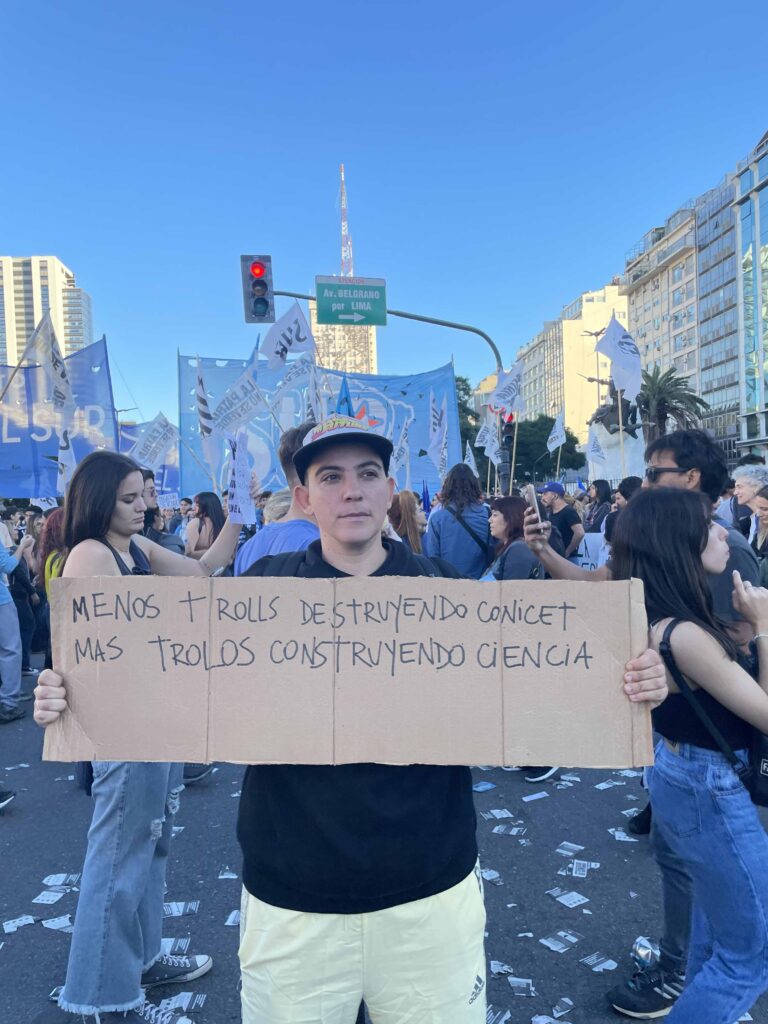
"Fewer trolls destroying Conicet, more trolls building science"
"Queers in defense of free public education"
"We, the children of workers, want to study."
"Why so much fear of educating the people?"
"To educate is to fight"
"I want to save public education because public education saved me."
"The brain is blind if it has nothing to eat."
"Public education to transform ourselves"
"Without science there is no Conan"
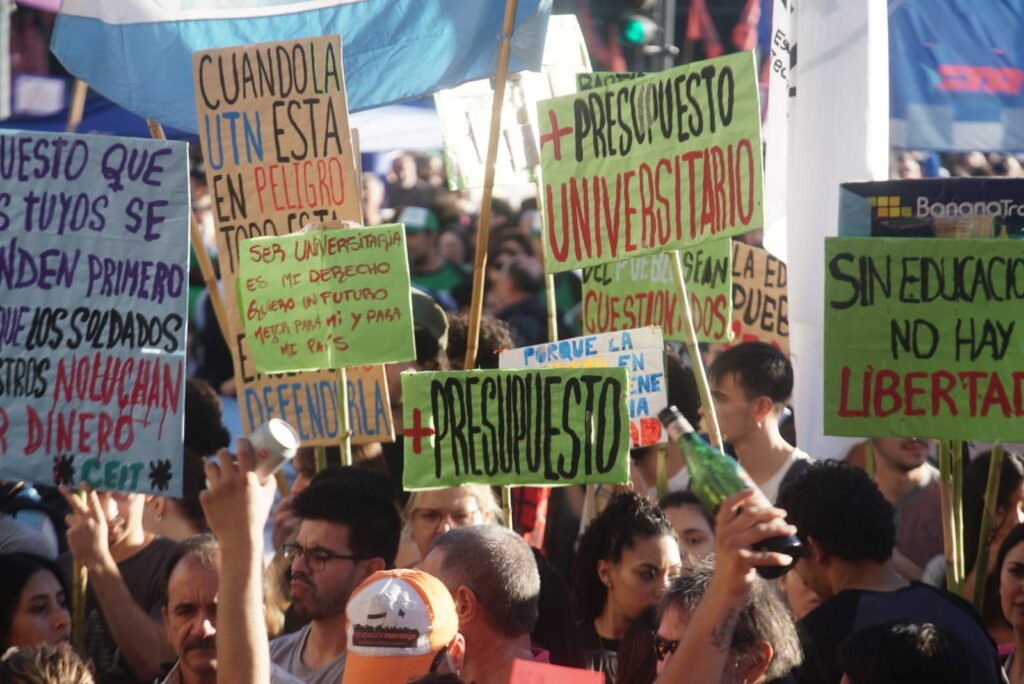
That's how we saw and experienced it from Presentes
Lucas Fauno Gutiérrez : “It was one of the largest demonstrations I've ever attended. Each sign represented not only a personal story but also a collective achievement: that's what happens when the State is present in a positive way, ALL of society grows. In the #UniversityMarch, we also marched—those of us who didn't graduate from a public university but who understand that this is a basic human right and no government can deny it to us.”
María Eugenia Ludueña : “We always want a march to be historic, meaning it can have an impact on the present and the future. And yesterday it was: hopefully it will have weight in decisions, alliances, and political structures. It doesn't seem like a coincidence that yesterday's march was one of the largest in recent years and the biggest since Milei's government began.”
The first mass mobilization against this government was driven by the workers' movements on January 24th. This was followed by the March 8th feminist demonstrations at the Congress, and then the March 24th march for Memory, Truth, and Justice. Putting our bodies on the line to celebrate—as in the incredible mobilization for the World Cup—and to put a stop to a power that attacks historical achievements is part of our real strength in a world permeated by virtual power. During Macri's presidency, another remarkable march succeeded in overturning the 2x1 law (commutation of sentences for genocidal criminals). The struggles for human rights are part of our identity and pride, as are public education and free university tuition.
Agustina Ramos : “I had never participated in such a massive march before (I'm 27 years old). Meeting up with a friend, getting around, buying something, or going to the bathroom are always odysseys at marches, but at this one in particular, they were almost impossible. Besides the number of people, the pace of the march was slow because at least ten things were happening at once on every block; everything was vying for attention: giant effigies of Patricia Bullrich, original signs like “Without science there is no Conan,” and the countless book covers held aloft that you flipped through to see who was behind them.”
I was impressed by the number of people who attended the march for the first time. They were happy, convinced. The demand was so clear and powerful that people from all walks of life joined in: it didn't matter if you went to university or not. It was something more important: the defense of our public education. That's how groups of students from private universities like UADE (Universidad Argentina de la Empresa), with whom there's a sort of humorous "rivalry" with the Faculty of Social Sciences at UBA—where I belong—came, and this time we were all able to embrace the same cause. Unions and grassroots economic organizations also arrived, while we all chanted, "University for the workers, and if you don't like it, tough luck."
Maby Sosa : “A sign hangs from a balcony that reads: ‘The greatest achievement was that the university was filled with the children of workers.’ Juan Domingo Perón said this 54 years ago in reference to free university education in Argentina. But this Tuesday, April 23, it encapsulated the core of the demands of thousands upon thousands of Argentinians who mobilized.”
In recent months, the feeling of a society asleep in the face of the "chainsaw" and an Executive Branch characterized by cruelty was overwhelming. Yesterday, that feeling erupted into protest. Creative signs returned, chants were heard, and the drive to fight for rights was renewed.
The "worker-student" alliance took to the streets again and made it clear that free and public education ceased to be a subject of debate years ago because it is a hard-won right.
If you'd like to tell us about your experience at the march, you can do so in the comments below or on our social media, where we continue to share and reflect collectively.
We are present
We are committed to journalism that delves into the territories and conducts thorough investigations, combined with new technologies and narrative formats. We want the protagonists, their stories, and their struggles to be present.
SUPPORT US

FOLLOW US
Related notes



We are present
This and other stories are not usually on the media agenda. Together we can bring them to light.