

Racism and discrimination limit indigenous and Afro-Mexican participation in the 2024 elections
In this explainer, we tell you why, despite advances in political rights for Indigenous and Afro-Mexican populations, racism and discrimination persist. What about affirmative action?



Share

Despite advances in political rights for indigenous and Afro-Mexican populations, racism and discrimination against these groups still persist in the electoral process, hindering the full participation of this sector of the population.
Since 2017, the National Electoral Institute (INE) created affirmative actions, a series of guidelines that promote the inclusion of certain population groups in the rosters of national political parties for the positions of deputies and senators.
The INE (National Electoral Institute) requires each party to submit 39 nominations for indigenous people and five for Afro-Mexican people, despite this being a minimal percentage compared to the total number of positions being designated this year ; civil organizations and online users have denounced that national political parties nominate people in these quotas who do not belong to the groups benefiting from affirmative action .
What are Affirmative Actions?
Historically, certain vulnerable groups have been excluded from different decision-making spaces.
Affirmative actions are public policies whose objective is to compensate for the conditions that discriminate against certain social groups in the exercise of their political-electoral rights, to represent the decisions of their population in the creation and voting of laws or the budget allocation.
Affirmative actions related to people's ethnicity, such as the indigenous and Afro-Mexican population, are applied to electoral districts where the population concentration is at least 60 percent.
In Mexico, 13 states have candidates for indigenous and Afro-Mexican people , even though about 19% of the Mexican population identifies as part of an indigenous community , according to the National Institute of Statistics and Geography ( Inegi ).
Indigenous People
Affirmative action policies for Indigenous people have been modified since their implementation. Of the 39 nominations, 34 are for seats in the Chamber of Deputies, while 5 are for the Senate.
Of the total number of candidates seeking a seat in Congress through this affirmative action, 21 will be elected by relative majority (highest number of votes on election day), of which 11 must be women.
The remaining seats in the provincial council will be assigned by proportional representation formula (those candidates have at least 3% of the valid vote cast).
For the Senate , of the five candidates, four must be elected by relative majority and the remaining one by proportional representation.
The states in which affirmative action for people who self-describe as indigenous are: Campeche, Chiapas, Guerrero, Hidalgo, State of Mexico, Oaxaca, Puebla, San Luis Potosí, Veracruz, Quintana Roo and Yucatán.
Afro-Mexican people
Starting in November 2023, Afro-Mexican people were added to the affirmative action program. Of the five nominations required, four are for a seat in the Chamber of Deputies and one for the Senate, respecting the principle of gender parity.
Of the affirmative actions for Congress, three nominations must be allocated by relative majority (those who obtain the most votes on election day) and the remaining one by proportional representation formula (those who have at least 3% of the valid vote cast).
In the case of the Senate, the Afro-Mexican person who runs will be in the high or low block depending on where they assign the person they propose for sexual diversity.
The usurpation of affirmative action generates racism
Although the percentage of candidates for affirmative action is proportionally low to the total number of positions to be filled in this election process, national political parties have placed people who do not belong to the groups that affirmative action represents.
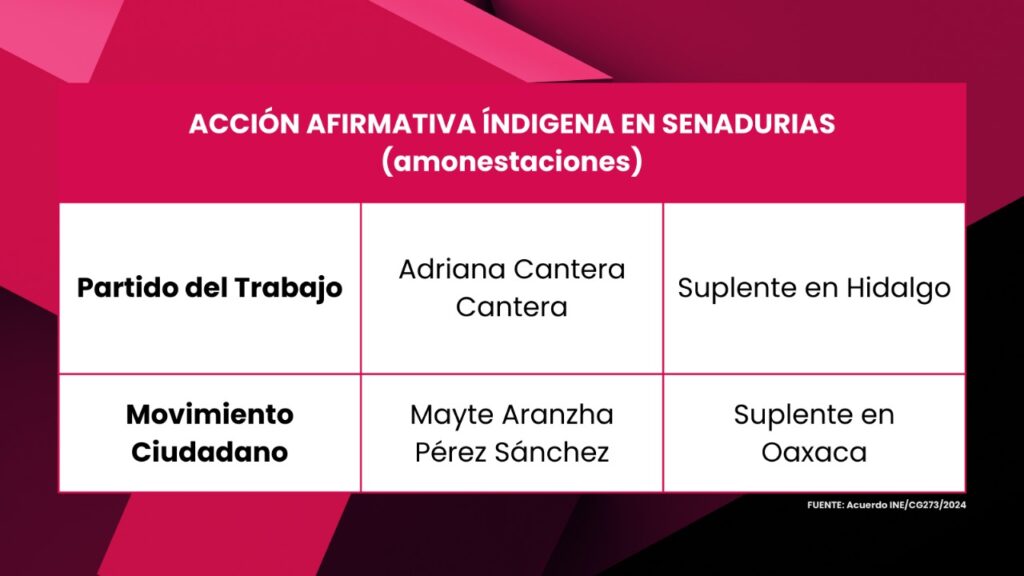
On March 13, 2024 , the General Council of the INE publicly admonished the Labor Party (PT), Citizen Movement (MC) and National Regeneration Movement (MORENA) for not meeting the requirements regarding gender parity and affirmative action when attempting to register “fake” indigenous and Afro-Mexican people.
Among the registrations that were cancelled for Senate candidates are those related to indigenous affirmative action:
Regarding the federal deputies , the INE registered the following non-compliances, which mostly belong to the Citizen Movement party.
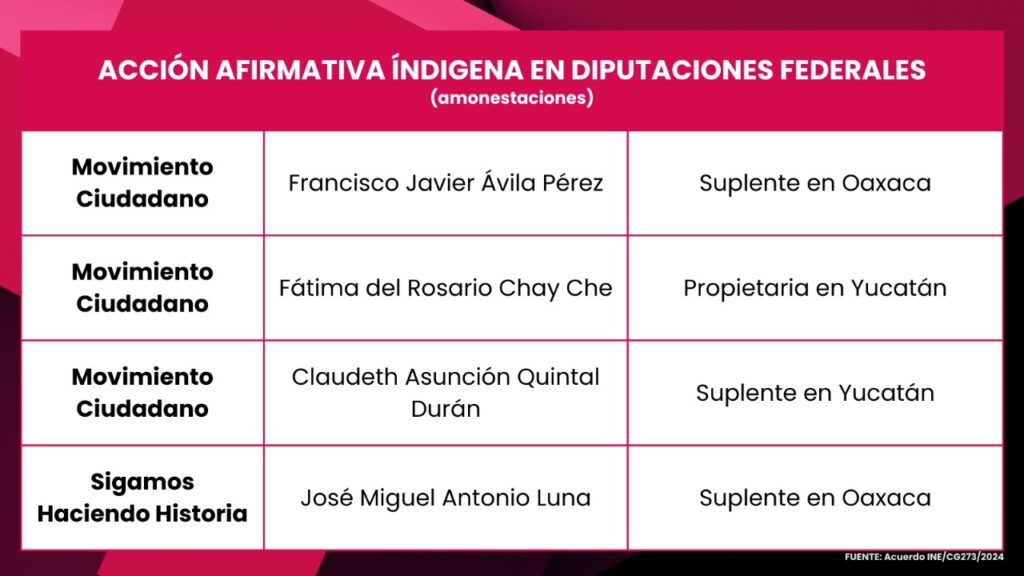
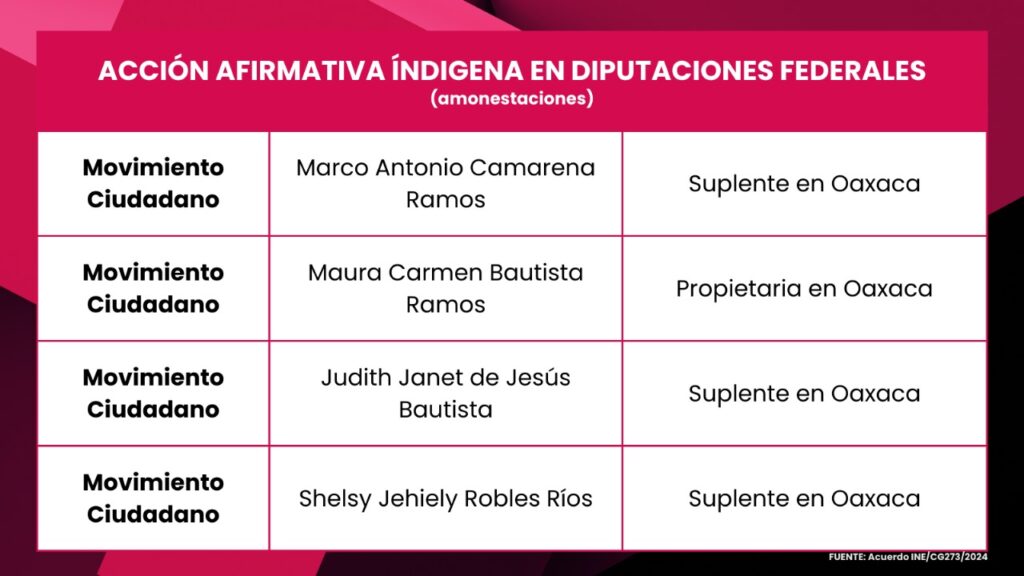
Furthermore, since the start of the electoral process, a dozen complaints have been filed against candidates running for indigenous AA, some of which are related to the state of Hidalgo , where media outlets reported that organizations are seeking to challenge the candidacies of six people.
In Campeche, the Electoral Institute of the State of Campeche , on April 8, 2023, requested the Democratic Space Party to comply with affirmative actions, due to "lack of agreement with the Guidelines for Registration of Candidates and the Guidelines for Indigenous Self-Affiliation."
Meanwhile, in Morelos, users mentioned the case of candidate Tania Valentina Rodríguez Ruiz (PT), who for the fourth time self-identifies as an Afro-Mexican person, as well as Jonathan Marquez (PRI), who received a challenge from Morena Impepac for accessing an affirmative action as an indigenous person.
In Quintana Roo, Senate candidate Anahí Gonzalez of the Morena party was challenged for identifying herself as an indigenous .
In Yucatán, members of the Morena and Green Party alliance challenged the candidacies of Julián Zacarías Curi and Esteban Abraham Macarí for not speaking indigenous languages; in one month, the Electoral Tribunal of the State of Yucatán has resolved several cases of affirmative action.
Animal Político reported that, according to information from the INE, other candidates were challenged, such as Nestor Camarillo, Juan José Canul Pérez, Jazmín Yaneli Villanueva Moo, and Jorge Luis Sánchez Reyes.
Usurpation and indifference is violence
Among the requirements for accessing a public office through affirmative action are: belonging to an indigenous community, speaking the language, being a descendant, having represented said group, being a member of an indigenous civil association , as well as having a certificate of self-identification issued by an authority.
However, these broad requirements are used to promote candidacies that do not correspond to members of indigenous communities, according to Gisela Carlos Fregoso , PhD, educational researcher and collaborator of the Collective to Eliminate Racism in Mexico (COPERA).
“Requesting endless paperwork, I understand, and researchers, activists, even Indigenous people understand, that it's done so that mestizo and white people don't take advantage of something that doesn't belong to them, don't occupy positions that aren't theirs because they haven't experienced the historical inequality that Indigenous and Afro-descendant people have suffered. It's understandable. The problem arises when the government puts these obstacles in the way of Indigenous people, and then the ones who don't apply the full force of the law and the rigorous evaluation process are mestizo and white people,” he mentioned in an interview about affirmative action.
Representativeness is important, because in the Legislative Branch, it is where the necessary initiatives can be promoted to benefit vulnerable groups, as well as voting against or in favor of reforms that may affect the guarantees or quality of life of people.
Affirmative action policies in their offices don't matter if we're ignored in all public policies, proposals, and plans, even before they take office. #DebateINE #PresidentialDebate2024 #DebateX
— Majo Trejo (@IamMajoTrejo) April 8, 2024
In an interview with Verificado, José Antonio Aguilar , director of the organization RacismoMX , explains that although the guidelines for affirmative action may have some flaws, they are necessary and should not be revoked.
“It’s being proposed in a legislative forum. So, obviously, that would be a crucial or extremely important part for these quotas to work in the medium or long term. Again, our position is: it’s better that they exist now at this point in history than not at all, but we have to improve them so that they are filled by people from these populations,” Aguilar mentioned.
Since the implementation of affirmative action, comments have been recorded questioning the "forced inclusion" of minority groups, questioning their education and preparation for a representative position, in addition to racist, classist and even sexist comments.
🔴 Electoral reform is needed to prevent affirmative action from creating problems with candidacies: @MemoValenciaR . #Revolutionaries @XochitlRuizG pic.twitter.com/OokvCrEy0Q
— PRI Michoacán (@CDEPRIMICH) April 2, 2024
| Glossary : Aporophobia: rejection of people without resources or who are homeless. Classism: A form of discrimination based on a person's social class. It refers to attitudes and behaviors that treat people differently depending on the social class to which they belong. |
This is an example of both aporophobia and classism, as it continues to devalue and fuel prejudices against the indigenous and Afro-Mexican population by suggesting they are not prepared for public office.
According to Gisela Carlos Fregoso , the denial of the ability to hold a political office can be considered as epistemic racism .
“When they argue that Indigenous and Afro-descendant people are not prepared to hold certain positions, that is pure and simple epistemic racism. Epistemic racism is believing that other people don't think, that they don't think and therefore—as if they were stupid—they don't have the capacity to decide, (that) they are not prepared to decide on diplomatic matters, on drug trafficking matters, that they are not prepared, that their knowledge is worthless,” the doctor mentioned.
Affirmative action is an important step to guarantee the political participation of historically discriminated groups and must evolve with each electoral process.
However, there is still a long way to go to eliminate racism and discrimination in the political sphere, as political parties continue to nominate candidates who do not belong to these groups.
This article is part of the Hate Speech and Disinformation Observatory of Verificado . A project carried out with the support of the International Women's Media Foundation (IWMF) as part of the Howard G. Buffett Fund for Women Journalists.
We are present
We are committed to journalism that delves into the territories and conducts thorough investigations, combined with new technologies and narrative formats. We want the protagonists, their stories, and their struggles to be present.
SUPPORT US

FOLLOW US
Related notes



We are present
This and other stories are not usually on the media agenda. Together we can bring them to light.