

El Salvador: They were accused of being gang members, but arrested for being lesbians
In May 2023, a lesbian couple was arrested without evidence. Only one of them was released. At least 62 violations against the LGBT population have been reported during the Bukele regime.


Share

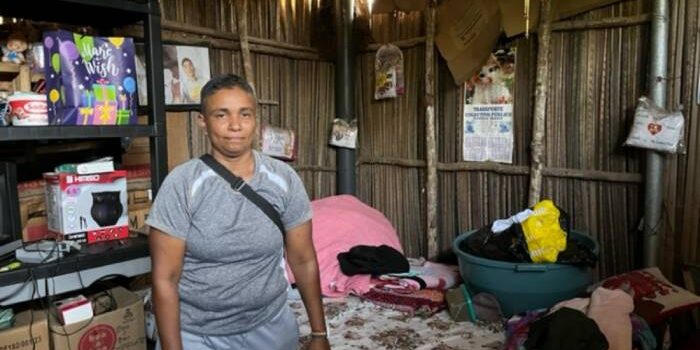
ESPÍRITU SANTO ISLAND, El Salvador . Following an anonymous tip, Sandra Hernández and her partner, Eidi Claros, were arrested for allegedly belonging to a gang. Hernández claims that her coworkers reported them to the authorities. She says they found it offensive to see a lesbian couple prospering in a coastal community of the Central American country.
The couple was arrested one night in April 2023 following an anonymous tip. They were then sent to prison under the State of Emergency in El Salvador, in effect since March 27, 2022. Neither of them belongs to any Salvadoran gangs.
Hernández was released a month later with alternative measures to detention because she was scheduled for a hysterectomy. Her partner, however, remains in custody. Sandra has no information about his condition.
Arrested for being lesbians
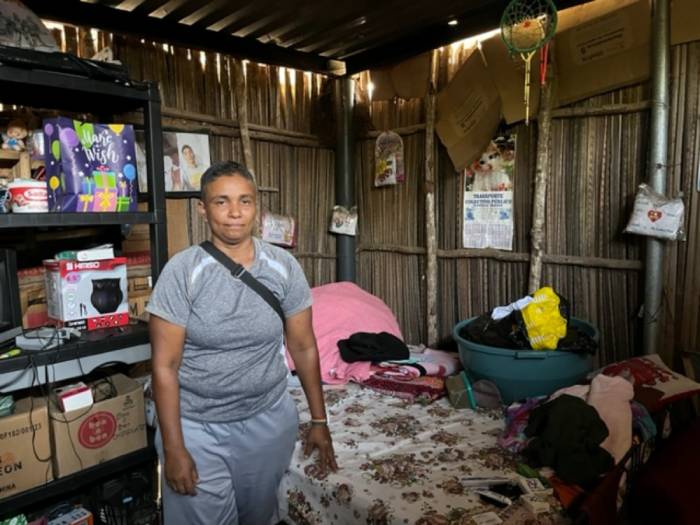
Hernández and Claros met in prison in 2017. One was serving a sentence for illicit association and the other for smuggling drugs into prisons. Upon completing their sentences and being released, the women settled in 2018 on Espíritu Santo Island, 107 kilometers southeast of the capital, San Salvador, Hernández's birthplace.
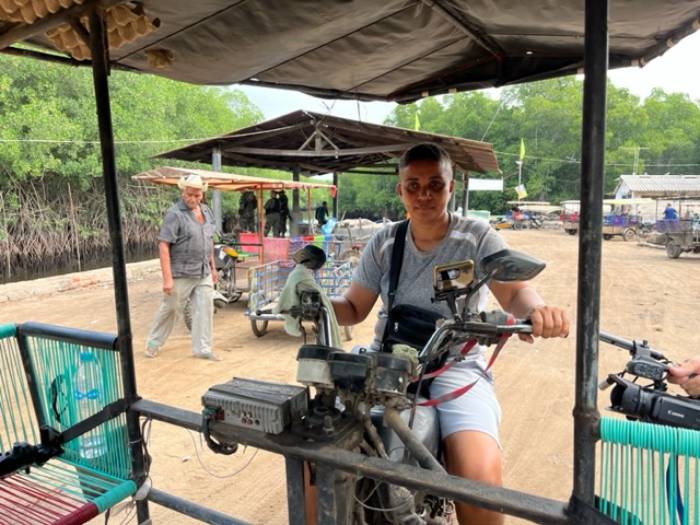
They started their project from scratch to build their house, made mostly of coconut branches. Sandra also bought a motorcycle and modified it into a cart to transport cargo and people. In addition, she asked the directors of the cooperative that manages the island for permission for Eidi to have her coffee and sweet bread stand at the island's dock.
“There is a lot of discrimination from men; machismo prevails here. A man can have two or three women and feel more like a man. But seeing a woman with another woman, getting along well and climbing the ladder in their careers, that doesn't sit well with them,” Sandra told Presentes .
She reported that her colleagues, who also work in the cart transport sector, harassed Eidi at her job and made sexual advances towards her.
She claimed they were “envious” of her relationship and the success she had built with her transportation business. Some of her colleagues asked the board to revoke Eidi’s permit simply because she wasn’t from the community. “There can’t be one woman with another woman here,” lamented 43-year-old Hernández.
How the arrest happened
On the night of April 28, 2023, a group of soldiers arrived at the couple's home to take Sandra into custody because of her prior prison sentence, even though she had already served her time. As Eidi questioned them, the soldiers arrested her as well, while insulting her for being a lesbian, according to the Network of Women Human Rights Defenders .
El Salvador has been under a state of emergency for two years , suspending constitutional guarantees , to combat violent gangs. Implemented on March 27, 2022, state security forces have arrested more than 78,000 suspected gang members.
However, these criminal structures do not allow members of the LGBTI population among their members.
Human rights organizations reported that hundreds of people were arrested after being denounced through anonymous calls or accusations promoted for personal reasons.
Two years into the state of emergency, Amnesty International stated that “the suspension of rights that, according to international standards, must be guaranteed under any circumstances, such as the right to a fair trial, the principle of legality in criminal matters, and the prohibition of torture and discrimination, are actions that cannot be justified under any circumstances or context.”.
Fear of the authorities
Since her release from prison, Sandra Hernández has redoubled her efforts to earn money. She must cover her own expenses and pay child support for her partner, Eidi Claros, who is in prison.
Hernández must come up with $150 a month to pay for a food package delivered to his partner in prison. He also needs to set aside an additional $50 for transportation to the prison, located on the other side of the country. He must also raise another sum to travel from his home to another department to sign in at a courthouse every 15 days.
The island's inhabitants report no past gang activity. However, 25 people have been arbitrarily detained under similar circumstances. Only eight have been released.
Humanitarian Legal Aid and the Center for Exchange and Solidarity (CIS) , an organization that has been working to develop Salvadoran communities since 1993, are preparing a lawsuit against the state of El Salvador in the Inter-American Court of Human Rights (IACHR) for cases on the island.
Residents allege that all those arrested were captured because police and soldiers had to meet daily arrest quotas and because of anonymous tips that the authorities did not investigate beforehand.
A place without gangs
The impoverished island is home to about 350 families, more than 1,300 people, most of whom are engaged in coconut production, fishing, and the extraction of clams (mollusks) in the mangroves.
“It’s a very beautiful place, everything is peaceful, there’s no danger of anything. Everything is tranquil in this place. Tourists like it when they come because it’s a very quiet area,” Salvador Panameño, a 59-year-old resident, told Presentes .
For this reason, the community is surprised by the raids and arrests. They report being afraid of the presence of soldiers and police patrolling the area, as they could be detained for any reason.
On March 11, Verónica Delgado, a Salvadoran activist searching for her missing daughter, was arrested. She was detained by police, allegedly for illicit association, after a police officer deemed her "suspicious."
Despite having a letter of release, the member of the Search Bloc for Disappeared Persons in El Salvador was released on April 3, when the Easter holidays ended.
Humanitarian Legal Aid, which provides legal assistance to victims of the state of emergency, estimates that some 26,000 people have been prosecuted without evidence for two years. Furthermore, they are being held in overcrowded prisons, at a rate of up to 148%.
Furthermore, they report that 240 people have died in state custody, 238 adults and 2 minors. The human rights of more than 5,775 people have been violated.
Arrests and discrimination
The organization Amate reports 62 violations against LGBTI+ populations within the framework of the state of emergency, including 39 arbitrary detentions, mainly affecting trans women and gay men.
When questioned about all the arbitrary arrests, Nayib Bukele said that there was no "perfect police force" anywhere.
“Has our police made mistakes? Of course. That is why our judicial system has released innocent people and will continue to release all those wrongfully arrested,” Bukele said at a press conference on the day he won his reelection on February 4.
“Unfortunately, the Salvadoran State’s tendency to minimize, conceal, delegitimize, and deny the allegations from various actors, both national and international, regarding the serious violations that have been documented in El Salvador, suggests that during President Bukele’s second term there could be a deepening of the crisis that has been observed in recent years,” Amnesty International in a statement.
The war on gangs has led to a 68.8% reduction in homicides during 2023, according to official statistics. Authorities report that 154 murders were committed last year, compared to 495 the previous year.
Although Eidi remains detained, Sandra sets up the coffee stand she used to run at the pier every day, hoping that her companion will return to the island.
“I get home, I look at her pictures, I look at her things. In that loneliness, I have no one to talk to, and I wish I could think this is a dream and that it will pass, but we'll see when it ends, because we only ask God for strength to get through this, because it's not easy,” she said.
We are present
We are committed to journalism that delves into the territories and conducts thorough investigations, combined with new technologies and narrative formats. We want the protagonists, their stories, and their struggles to be present.
SUPPORT US

FOLLOW US
Related notes


We are present
This and other stories are not usually on the media agenda. Together we can bring them to light.