

Argentina: In two weeks, at least 85 transvestite and trans state workers were fired
More than 85 layoffs of transvestite and trans people in two weeks in the State and an attack on the job quota.


Share

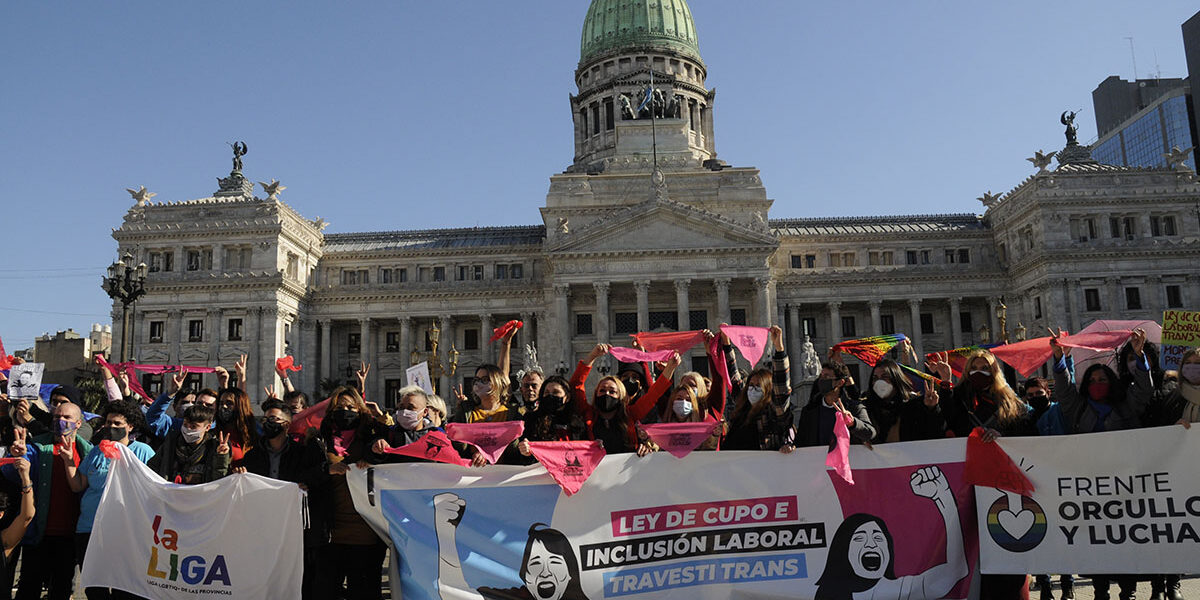
The national government has dismissed at least 85 transgender and transvestite public employees in the last two weeks. Activists and union members asserted that this constitutes “an explicit attack on the trans population” and “a huge setback” in hard-won rights. Furthermore, these organizations have documented the dismissal of 10 transgender workers in various municipalities across the country.
“It is an attack on the dismantling of these policies that changed the lives of many people and the country,” Pato Laterra, a member of the TTNB (Transvestites, Trans and Non-Binary) Workers' Front of the State and of the TranSindical Zaguán collective .
In December, Decree 84/2023 exempted those who had been hired through quotas (for people with disabilities and for transgender and transvestite employment) from the "non-renewal of contracts." However, these workers received news of their dismissal via email in recent days.
Multiple attacks
The State Workers' Front and the State Workers' Association (ATE) have identified 85 transgender and transvestite individuals who have been laid off so far. The majority of these employees worked at the National Secretariat of Labor, Employment and Social Security (28 people), ANSES (20), and the Secretariat of Social Development (13). Some of them had been employed for over 10 years.
“We’re talking about an attack targeting the trans job quota. But they also want to dismantle the offices and the federalization of public policies. Most of the layoffs were in the ANSES (National Social Security Administration) and Labor Secretariat offices, which are the gateways to public policies. These offices are the window to the State,” Laterra explained.
By December of last year, 955 people had entered the national public sector through the trans and travesti employment quota. “With the 85 dismissals that have occurred so far, we are talking about almost 10% of the payroll . This is an attack that is much greater than what we might imagine is directed at cisgender people in the national public administration, which corresponds to roughly 3%,” stated Laterra, who is also a professor of Economics and Gender at the National University of La Plata and the University of Buenos Aires.
Meanwhile, labor unions are also documenting the dismissals of transgender and transvestite individuals from various municipalities across the country. So far, they have identified 10 cases from municipalities in Río Negro, Córdoba, Mendoza, and the National University of San Martín, though the actual number could be higher.
A record job placement
Since the “Diana Sacayán – Lohana Berkins” Law for the Promotion of Access to Formal Employment for Transvestite, Transsexual and Transgender (TTT) People , sanctioned in 2021, the labor insertion of this group in the public sphere increased by more than 900%.
“The trans quota is the result of a process that began in 2012 with invaluable human rights activists like Diana Sacayán. It involved a long development process. It was approved in 2015 in the Province of Buenos Aires. In 2017, the Trans Quota Front was formed with the organizations that promoted projects in the national legislature. In 2019, when I took over as Undersecretary of Diversity Policies at the Ministry of Women, I revived that entire social agenda. President Alberto Fernández issued the decree establishing the trans quota and made it a public policy in 2020. And in June of the following year, it became a national law ,” explained trans activist Alba Rueda and former LGBTI+ ambassador at the Ministry of Foreign Affairs.
Much more than a job
“I was fired on Wednesday night, March 27, 2024, right at the start of Holy Week, via email. They didn't take into account the trans and travesti employment quota law,” Bárbara Ubran told Pesentes. She is a 27-year-old trans woman. She started working in February 2022 at a branch of the National Labor Secretariat in the town of Santa Rosa, La Pampa province, through the trans quota.
Access to formal employment was difficult throughout her life due to the discrimination that exists towards the transvestite and trans community: first within their families, which forces many to leave their homes; then at school, which prevents them from finishing their studies; and finally in the workplace.
“From the age of 15, prostitution was always present because it was the only option. Later, I did odd jobs here and there, hustling to make ends meet. I worked as a dishwasher in restaurants or kiosks. But they always paid you half of what everyone else did. Because of your identity, they say, 'Oh, she desperately needs money,'” she explained. In recent years, her employment situation “had improved a bit,” she said, since she co-hosted a program on public television in La Pampa and worked in a community library.
“For me, work is super important because, personally, it gave me the power to fight every day, to want to learn more, to live. It gave me a great sense of security and self-worth. Work itself dignified me a lot,” she emphasized.

Setback in rights
Franco, a 37-year-old trans man who identifies as "kwir," also found it difficult to find employment before. "Until I had my identity, it was very difficult for me to live my life, from the most intimate aspects to the social ones. Only when I had my identity did I feel more prepared to go out and look for work," he shared with this agency.
After an interview process that lasted between four and five months, Franco began working last August at the territorial agency of the Ministry of Labor located in the town of Viedma, Río Negro province. There, he was in charge of managing and supporting entrepreneurs in Viedma and surrounding areas.
“From the moment Milei took office, there was a great deal of uncertainty about whether these policies would continue or not, and a defunding and increasingly large dismantling began. Agency heads, mid-level authorities, and project approvals started to disappear, and program budgets weren't being updated. Then came the issue of layoffs. We had been exempted in December, and now we're down on our luck. We're here, holding on,” he said.
For Clarisa Gambera, Secretary of Gender and Diversity of ATE Nacional , the layoffs imply "a huge setback in terms of the democratization of the workplace and the progress in fighting against discrimination against people who had been absolutely excluded from the possibility of having a job."
“The fact that the State can incorporate transvestite, trans, and non-binary people also set a beacon for the private sector . It was a complex process involving training and workshops in the workplace and in human resources. When you reverse a public policy that was an investment by the State, it is always a profound setback and leads to disinvestment,” she emphasized in an interview with Presentes.
Those affected by the layoffs are “worried, sad, and dismayed because this takes away their ability to live day to day, to have a decent income to support themselves,” Laterra described.
Collective actions
“The dismissal of transgender people speaks to a brutal dehumanization by the State. This has many implications for people who are once again being expelled from their jobs in a context of greater poverty and inequality, and it seeks to send a message to society,” Rueda added.
These dismissals occur within the framework of a set of measures that attack the gender agenda, such as the prohibition of inclusive language , the intention to reduce the Micaela Law , the closure of Inadi , or the non-renewal of the contract of Diana Zurco , the first trans presenter of the National Public Television .
In response to this situation, the Argentine LGBT Federation (FALGBT) will file collective and individual injunctions "to demand the reinstatement of all those dismissed, especially those who were fulfilling the quotas for people with disabilities and trans people," said María Rachid, a member of the FALGBT's board of directors.
They will also submit a request for information to the National Congress through Deputy Esteban Paulón regarding the dismissals in the State of people who have entered through different quotas.
Meanwhile, today at 5:30 p.m. a TTNB Workers' Assembly will take place at Belgrano 2527, which can also be followed virtually through the networks @travajadorxsttnb .
We are present
We are committed to journalism that delves into the territories and conducts thorough investigations, combined with new technologies and narrative formats. We want the protagonists, their stories, and their struggles to be present.
SUPPORT US

FOLLOW US
Related notes



We are present
This and other stories are not usually on the media agenda. Together we can bring them to light.
1 Comment