

Elections in Mexico: How does the trans-electoral protocol work?
Since 2017, a protocol has existed in Mexico to allow transgender people to exercise their right to vote in elections.


Share

MEXICO CITY, Mexico. Mexico was the first country in Latin America to have a protocol guaranteeing the right to vote for transgender people. It includes training strategies for electoral authorities and specific guidelines to be applied on election day to ensure the exercise of the right to vote and promote the civic participation of transgender people.
In December 2017, the General Council of the National Electoral Institute (INE) Protocol to adopt measures aimed at guaranteeing transgender people the right to vote under equal conditions and without discrimination in all types of elections and mechanisms of citizen participation. It was applied for the first time in the 2018-2019 electoral process.
The creation of the protocol involved working groups with trans activists from across the country, civil society organizations, and institutions responsible for promoting human rights in Mexico. During the 2018-2019 election cycle, campaigns to promote the trans protocol reached approximately 1.5 million people.
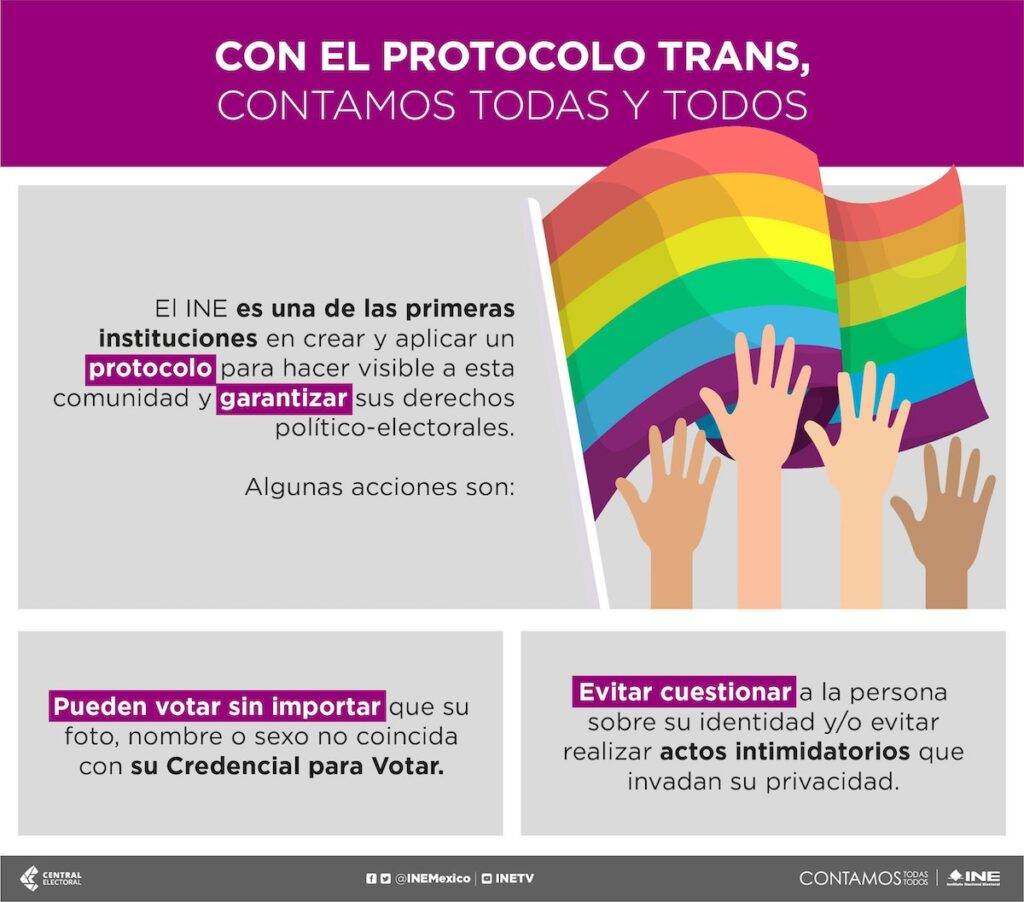
For the current election period, the INE (National Electoral Institute) has not launched any campaign to promote or disseminate this protocol. Nor has it provided information on how transgender and non-binary people can exercise their right to vote free from discrimination on June 2nd.
In this explainer we answer: How does the protocol work? Can any trans and non-binary person vote? How do I update my voter registration information? And how do I report an act of discrimination during the elections?
I am a trans person, how can I vote?
On June 2nd you must go to your polling place to vote; you can locate your polling place link
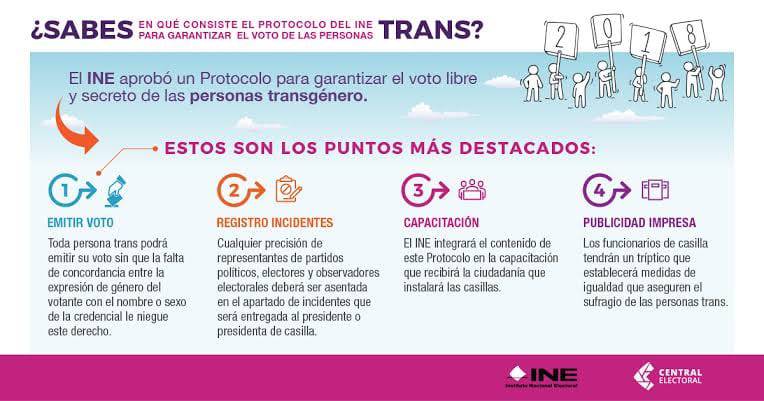
The first guideline of the protocol is clear. It states: “Under no circumstances may a lack of consistency between the voter's gender expression and the photograph on the Voter ID card, or with the name or sex (male or female) recorded therein, be grounds for preventing them from voting.”
In other words, any transgender or non-binary person, with or without changes to their voter registration information, can cast their vote. No one at the polling place should question your identity or ask for additional documents to verify it.
According to the protocol:
- Polling station officials must address all people, regardless of their gender identity, by their last names as they appear on their voter ID card.
- No one should apply procedures to confirm your gender identity.
- Nor do they ask for proof of your identity or legal status. You don't need to present your birth certificate or any other identification document.
- They must not question your identity or invade your privacy.
- They must avoid staring, uncomfortable, impertinent questions about your body, appearance, and gestures, or any other behavior that restricts your free development of personality.
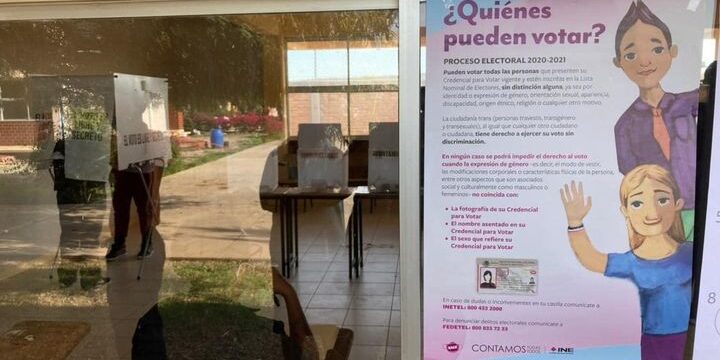
The protocol states that, in each voting booth, a poster about the trans protocol containing information on how the protocol works must be visibly displayed.
Furthermore, polling station presidents and polling station officials must be familiar with, apply, and have readily available the trans protocol brochure . And in case of incidents, they must report them.
Can any trans and non-binary person vote?
Like any other Mexican citizen, all trans and non-binary people can vote. You must have a valid voter ID, be registered to vote, and be over 18 years old.
Although this protocol was presented in 2017 and has not been updated, non-binary people have been recognized by the INE (National Electoral Institute) since February 2023. If you are a non-binary person and you chose to have 'X' appear in the sex field, this should not be an impediment to voting.
How do I update my voter registration card information?
This procedure is carried out at INE service centers. Here you can find the one closest to you.
For trans people:
- If you updated your birth certificate due to gender identity recognition, you can request that your voter ID card reflects your name and sex: [from M to F] and [from M to F].
- If you have not completed your gender identity recognition process, it is not possible to change your name and sex; you can only request an update to your photo that reflects your gender expression.
For non-binary people:
- If you don't have a birth certificate or CURP (Mexican national ID number): your non-binary identity will only be reflected with an 'X' in the sex field. However, the other gender markers on the INE (Mexican National Electoral Institute) form will show M or H, depending on the gender identity you were assigned at birth; the same applies to your name.
- Procedure with rectified birth certificate and CURP: the INE must necessarily standardize this data on your voter ID: your name, the 'X' must appear in the four gender markers: in the sex box; the voter ID, CURP and OCR code (the numbers on the back of your ID).
All people, regardless of their gender identity, can choose whether or not to include the 'sex' box on their voter registration card, as well as other information such as their home address.
Furthermore, in no case is it necessary to prove hormonal, psychological, psychiatric treatment, surgical intervention or court sentence to carry out these procedures which are administrative and free of charge.
How to report an act of discrimination during elections?
In every election or citizen participation mechanism organized by the INE, the trans protocol must be applied. This measure also entails training members of the public who serve as electoral authorities on election day and are called 'polling station officials'.
According to the same protocol, each local and district council must submit a report to the INE's training and civic education department on any incidents that occurred related to the participation of trans people during the election day.
Anyone who goes to vote, regardless of their gender identity, can report any act of discrimination, including the failure to apply the transgender electoral protocol. Reports can be made directly to INETEL by phone or through social media: on Twitter (formerly Twitter), on Facebook , or by phone at 800 433 2000. The INE also has this system for reporting administrative offenses and acts of corruption.
Additionally, you can file a discrimination complaint National Council to Prevent and Eliminate Discrimination (Conapred) .
According to information from the INE, the people who attend must be properly trained, know the trans protocol well, as well as other materials related to the issuance of the vote and citizen participation in electoral processes without discrimination.
In case of incidents and non-compliance with the trans protocol, each district board must prepare and submit to the Executive Directorate of Electoral Training and Civic Education (DECEyEC) a written report on the incidents that occurred and that are related to the participation of trans people in the electoral boxes, in order to systematize the information and monitor the application of the trans protocol.
We are present
We are committed to journalism that delves into the territories and conducts thorough investigations, combined with new technologies and narrative formats. We want the protagonists, their stories, and their struggles to be present.
SUPPORT US

FOLLOW US
Related notes


We are present
This and other stories are not usually on the media agenda. Together we can bring them to light.